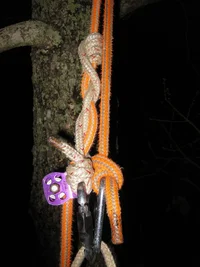
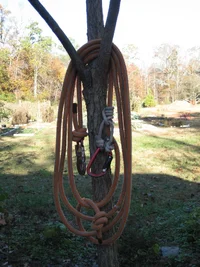
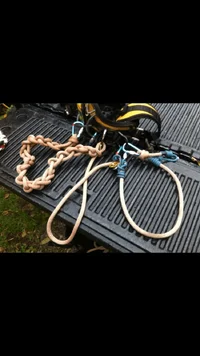
More from early daze;
.
Favored easy splice-ability of 3strand/hard lay, and also unique friction-hitch properties
when mated with the smaller (2leg pull) cord.
.
Key would be aligning modified pull on D by hitch,
to mimic original engineered strength/position of pull on D, when loaded.
So there whee modification to base system over time to that end.
previous to this version lanyard revved thru D, and had keychain grab, both as hard friction-hitch tenders.
(as opposed to lanyard outside and part of friction-hitch tender strategy is soft device/line)
.
also 2 fisted version/ double ended:
mytreelessons.com/images/19 foot lanyard
.
3strand backspace here is dead/end positive stop.
floating and backspace have simple, not weight bearing hardware swivels for rope manage-ment .
.
.
i favored flat, Tenex for climbing line friction-hitch, for how it grabs and wears etc.
In this mostly 1hand adjustment /self tending friction-hitch type builds on lanyard,
the taller sitting round profile is of course better,
>>than the flat Tenex that wouldn't get 'combed' by the tender strategy the same.
>>FLAT is stronger on the turn, because is flat ,
>>has virtually NO DIMENSION on the outer/leveraged arc of hitch cord around forced around tight bight of host line.
>>TENEX also doesn't resist the bend like harder round cords, so harder to mechanically leverage Tenex against itself on these tight bights