hollow basswood....

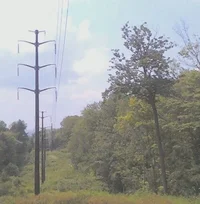
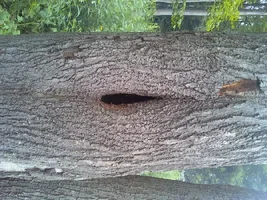
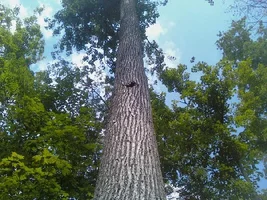
Hello Buzzers--I'm looking for your thoughts. I'm on Hazard Tree mitigation assignment for the week for our local windfarms 115kv transmission line. I came across this Basswood today that was on my list, and this tree is roughly 70-80ft tall and approx. 24 inch DBH. The tree has an extensive cavity and decay column from the base up to roughly 20ft up to a woodpecker hole that I can fit my fist into, the column maybe higher not sure how high up yet. The tree has maybe 15-20% lean towards the lines. Shell thickness of sound wood from what I could determine at the base is maybe 3-4 inches from looking into the cavity. The tree's crown is mixed with live foliage and lots of dead in the tips. The tree has to come down, however, knowing how weak basswoods can be I'm reluctant to climb it. I'm torn between climbing (piecing out small) or dumping the whole tree. When do you guys consider a tree unsafe to climb, How comfortable would you guys be pulling this hollow tree over against the lean, uphill, away from 115kv. I want to top the dang thing out--but I talked myself out of it to seek TreeBuzz support. Thanks
 
Sounds like your best to dump it.

Our best advice is to set atleast 2 lines. One to hold static and perpendicular to hydrolines. The 2nd as your pull line to direct into the landing zone.
Should be able to pivot the whole tree to land parallel to the electric lines.
The hard part is the cut and determining the holding wood or how much decay is present. 3 snug 2" ratchet straps should be enough to keep it from blowing open. Cut made between them. Lots of in and out and hinge wood shaving before you reach the point where it is over centre and gravity is a major factor.

Tilia species with rot is like climbin a wet paper roll.
I woood do it slowly with as may saw poles as can be handled and cut/remove weight as you climb up with inspection.

My worst/best experience was with a rotted White Pine that you could see the light of day thru a crack about 4' long, it had a terrific lean over a condominium.

I actually used 3 lines with the 3rd as additional support run thru a porti. And the main static line was air grade steel cable 1/2"
I do not know what you call this rig MB Triangulation Rig.
Truly a stressful drop but with great success and save the client huge dollars because the other option would have required two cranes.

Hope this helps and makes sense to you all.

Actually created scale models of the tree and rigging and performed many calculations to ensure all things added up to success.
Thinking about it now gives me a thunderous headache. I enjoy math but trig is crazy.
So many ways to rig a slam dunk, pretty interested to hear others.
smile.gif
 
Yes polesaw takes a bit of patience but makes removal very safe as it creates no shock loads.

whether removal is needed...it depends on client criteria. 3-4" shell can hold up a lot, and tree could rejuvenate after reduction.
 
Are there adjacent trees to climb/rig from? It should be removed. Is it possible to get a second set of eyes on it?

I, personally, would not climb that tree with 3-4" of solid? wood and a 15-20* lean, on a 24" DBH linden. That would be considered "critical risk". Other options need to be considered. Guying it; bucket; crane

If it needs to be felled, felling it directly against the lean is always the best option, . Very precise notch and backcut. At least a 90* open face notch, to compensate for the lean. Once cut into, for the notch, will it crumble, endangering the cutter? Linden does have good hingewood, if it's solid.
 
Thanks Norm for the help...
This basswood needs to come down--the main target like I mentioned is a 115kv line. No other trees close by to climb, to access the said tree. However, there is alot of room to pull the tree back against the lean. I have a rope come-along, and I could put together some M.A. if needed. I will post pictures, but it won't be until Monday-I have been holding off on this tree. My concern is the huge decay column right where I need to place the hinge. Stay tuned for pics. Furthermore, this is an off road right-of-way, no access for equipment. climbing or felling seem to be the only options.
 
Compared to the storm loads the tree has stood up to so far, how much load does a <200# human secured to the lower stem add? Next to nothing. Why refuse to climb such a tree, without signs of active failure? It knows how to stand better than we do.

There seems to be a lot more risk in the felling scenario than the usage of a 7m polesaw. Generally, there's far more danger in relying on machines and our calculations of physics (based on our abysmally low level of biomechanical knowledge) than placing one's body on a tree that understands mechanical advantage far better than we mere humans ever will.

If the tree was a pipe then formulas could be effective. But the tree is not a pipe. Of course until we see the tree all this chat is not so useful. good on you to bring on the images.

O and target is but one factor--other utilities reduce and retain hollow trees for habitat; doesn't NatlGrid recognize that value?
 
Hey Guy, I totally agree with your reasoning--I've thought about the fact that my body weight is negligable in this scenerio. However, we all have comfort levels, and I guess I question, not my ability, but my decision. My gut tells me to climb the tree and piece out the tops and fell the spar. This, in my opinion is the best choice--perhaps I will leave the spar standing for wildlife habitat, BTW this job is for Noble Environmental--they have large windfarms around here and I'm sure they will have no problem leaving a wildlife snag on the tranny ROW. I will be back on the property on monday, and I will do a deliberate inspection, and post pics--thanks for the thoughts...
 
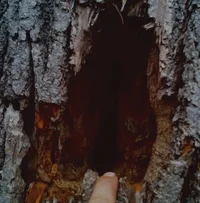
close up of cavity of decay column--shows sign of good growth here, however, I inspected another cavity 20' up and growth is much less the outer shell thickness seems much less. Also shows evidence of a horizontal crack in the deadwood which you can't see in the close up pic..
 

Attachments

  • 289999-basswood3.webp
    289999-basswood3.webp
    81.1 KB · Views: 180
another 20foot up, lots of decay, and looks like carpenter ant activity, only a few inches of sound wood outer shell, and the decay column runs all the way down to the bottom. I was able to drop pieces of bark down the column.
 

Attachments

  • 290000-basswood2.webp
    290000-basswood2.webp
    81.4 KB · Views: 169
I also noticed during the crown inspection there was a ton of sapsucker activity. Is that associated with insect activity, or are they attracted to basswoods for any reason? Just wondering--never have seen such extensive sapsucker holes throughout a crown like this tree exhibits.
 
[ QUOTE ]
I also noticed during the crown inspection there was a ton of sapsucker activity. Is that associated with insect activity, or are they attracted to basswoods for any reason? Just wondering--never have seen such extensive sapsucker holes throughout a crown like this tree exhibits.

[/ QUOTE ]

Anecdotal observations are that stressed trees seem to get pecked more. Re management, gotta stick with the lightfooted ascension and polesaw topping vs. one-piece felling; less risk to all concerned imo.

As for leaving the trunk for habitat, depends on mtc cycles and risk tolerance of mgt. leaving it 20' might be nice for the beasties, but I'm not sure I'd want to be the one making that cut, so maybe best to fell spar after topping

Nice pics thanks!
smile.gif
 
Hey guy, that makes sense--today was the last day on the job, and the tree still stands. I was hoping to get my GF out to the site for a second set of experienced eyes--he was a no show. I'm sure I'll be back next year, if she's still standing.
 
Sometimes I miss ROW work. Personally, if I couldn't scoot a bucket up that that baby, I might very well climb it as opposed to trust in hinge wood that may or may not be there once I started cutting at the base. How crappy would it be to rig up all the MA and start cutting only to find out that the one place in the trunk that you absolutely need a little meat is the one place that is lacking. I mean, what would be your options at that point? Too bad the job is over until next year. Tree may be worse off then and climbing may be out of the question.
 
I agree with Guy,
except about the pole saws.. tree has held in wind and rain. it will hold a climber. As long as you can bomb everything, IMO climbing is safe, though your mind may have to convince your body that its a good thing to do..

On the other hand the tree looks like it has only a slight lean and that should be able to be overcome fairly easily..

How are you planning on setting the pull lines??

Go with a minimum of two lines, set extremely high.. If you only have one rope come along, set up a friction hitch to keep the progress above the MA system, so you can tie one off, and switch the come along to the other line. If you set a high enough pull line, you should be able to start getting that tree stood up, even before you begin cutting. That should make you feel better about the fall..

The additional leverage in setting a high pull line is crucial!

Good luck with it!
 
Uh.... you're not suggesting that he pull the tree upright before cutting his notch and making his back cut are you. Putting that kind of force on this tree prior to severing any fiber would be senseless and dangerous in my mind. That would create a high potential for a catastrophic failure of an already compromised pedestal. It could barber chair with too much tension. Why not place the face notch and bore cut leaving a back strap. Then place a wedge on either side in the back. Tension the line slightly and sever the back strap in the stump material. Walk away and pull the tree over. I see no reason to risk climbing the tree weather you "guess" it will hold a climber or not. Yes it has seen wind loads and storms in the past, but so have all the trees that fail. And some fail in very slight wind events. Just sayin'. If you feel it will hold a climber, then you must feel it has sufficient wood fiber. If that is the case it should have a hinge there somewhere. A door generally has three hinges to swing on. If you remove the center hinge the door will still swing as long as the two remaining hinges are well anchored. In alot of cases, the outer wood in a hollow tree is very strong fiber. Do some investigating with a drill and see what you find for wood fiber. Or do a vertical bore with your chainsaw. If there is concern that the tree might go backwards onto the lines, you could side guy it and fell it parallel to them.
 
Not exactly upright.. but if he has a high line set and starts to get some pull on it, that tree in particular will begin to "stand up", showing him whether he has enough pull to overcome the backlean, which should give him the needed confidence to make the fall ..

So the type of force I would suggest using in pretensioning the line would be enough to begin to compensate for the back lean, not much more. That is, he should clearly see the tree begin to move. Seeing how much the tree moves under what kind of load gives the faller a lot of needed info..
 

New threads New posts

Back
Top Bottom