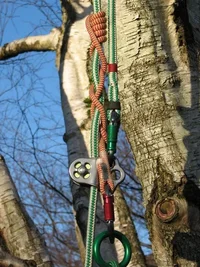
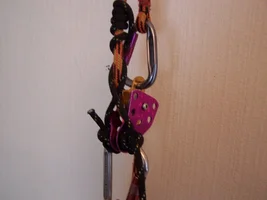
Hitchclimber

I'm afraid part of your confusion Rupe is down to my delay on getting the treemagineers web-site up and running. My excuse? Hmm.... let's see... technical hitches and mental energy low?

Hopefully by the end of next week that'll be sorted though (the web site that is). From the site you'll be able to download as a PDF the "Hitch Climbers' Guide to the Canopy" that delves deeper into the how and why behind the Hitch Climber concept and describes alternative applications.

Hopefully this should clarify some of the issues that have cropped up here. As to the hitch getting stuck... just try some variations on sling lengths and krab conifigurations. I've really not found it to be a major issue.

Again, here's a high quality product with a lot of thought behind it, based on a number issues we felt needed adressing. If you like it and feel you can incoporate it into your climbing system, that's great, if not that's also fine by me.

Dismissing it out of hand seems a bit of a pity, though.
 

Attachments

  • 84253-IMG_0909.webp
    84253-IMG_0909.webp
    84.4 KB · Views: 276
mark, got to use the hc for 2 hrs in a tree and I love the product.

rupe, the issue is the for those of us who use a more compact hitch such as a distel, the hitch snags a bit on the biner. the whole point that I started this thread was to see if a way to resolve this issue could be found.
 
[ QUOTE ]
That would be a good idea for me, however in the states we need to have a self-locking biner for any life support application.

[/ QUOTE ]

says who?
Maybe for competitions, but I havent seen any biner police walking around the job site. I think that is a stupid rule even for the competitions. The autolocking biners are considered in the rock climbing world to be more dangerous than screw locks because there is a tendency to get complacent and people start to trust them to lock on their own, which in my experience, none of them ever do unless graphited with frequency. There is no such thing as idiot proof. Even the word "selflocking" is a misleading term as it gives the impression that you do not have to be involved in the locking process.

The mighty mouse wierd autolock has so far never clogged on me but it does have a habit of sometimes locking itself open. Fundamentaly, you still have to take the time to make sure everytime before leaning back, that your locking biner, regardless of style,
is locked.

Therefore, there is no added safety benefit to an autolocking biner IMO. I do think they save a little time possibly. Easier to handle with gloves maybe. But safety wise, both biners require you to double check. If you are not making sure your biner is either screwed locked, or manually checking the autolock function, then you are setting yourself up for a mishap.

My feeling is that Screw locks are perfectly acceptable tools for climbing. That is what they are made for. They also make screw locks that are much smaller and slicker than autolocking biners. To me the downside to screwlocks is when they get locked too tight. The whole process of screwing and unscrewing is labor intensive. The autolocking saves me a few seconds.

there is no reason whatsoever you should not use screwlocks if they provide you with a feature that helps you climb more effeciently and safely. Just dont take it to a competition.
 
off topic i know, but 7 or 8 years ago we were probably all climbing on screw gates. are there any statistics to show that accidents involving krabs have been reduced since the 3-ways came on the scene?
 
[ QUOTE ]


Dismissing it out of hand seems a bit of a pity, though.

[/ QUOTE ]

Mark, I didn't mean to dismiss it totally, I'm just saying I don't really get it. I bought one as soon as it was available and used it for a few days. Its a really nicley made bit of kit, I agree with Jelte about that.

One problem which I did mention earlier is that mine didn't coem with instruction (it was a display one from Martyn H. he'd sold all the others and couldn't find its instructions) so it is possible that I am missing something, and I'm sure the PDF guide will be useful, maybe you could e mail me a copy??

In the meantime my set up appears to be the same as in your picture and I'll try and explain the problems I'm having.

Rupe
 

Attachments

  • 84334-a.webp
    84334-a.webp
    62.1 KB · Views: 187
[ QUOTE ]


rupe, the issue is the for those of us who use a more compact hitch such as a distel, the hitch snags a bit on the biner. the whole point that I started this thread was to see if a way to resolve this issue could be found.

[/ QUOTE ]

True I have been using a distel hitch with it, which is a short hitch, however this isnt really the problem, its more to do with where the splice end of your rope goes.
 
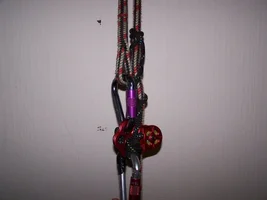
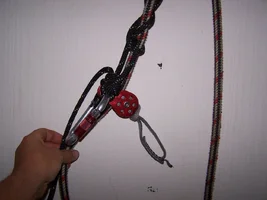
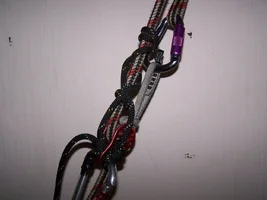
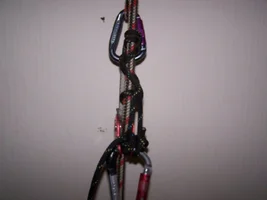
Now the Hitch climber(HC) enables us to have both parts of the rope in allinment one in front of the other instead of side by side(left or right)

This is a neat idea and may even help the pulley to tender the slack.

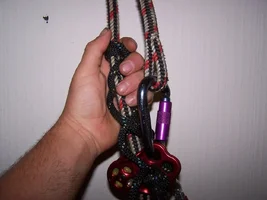
The problem I'm having is that the spliced end of the rope is attached in front of the hitch, ie. between the climber and the hitch, so to operate it you have to reach round the back, and to pull yourself up your have to grab the back rope.

In Mark's picture here

http://www.treebuzz.com/forum/images/upload/84263-IMG_0912.jpg

the climber is going to be to the right so the rope end is in front of the hitch.

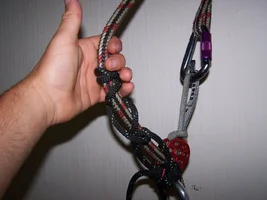
In my picture attached, I'm showing how you reach from behind to get to the hitch and the spliced end is in the way.
 

Attachments

  • 84340-x.webp
    84340-x.webp
    92.7 KB · Views: 238
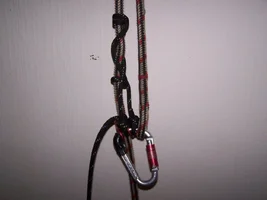
So what I'm gettign at is that I would like the spliced end to go behind the hitch, and I don't know if that can be done with the hitch climber but I wanted to find a way of doing it.

Thats why I was asking about using the back of a petzl fixe pulley for attachment, not for friction hitches but for the rope itself.

I used a small dyneema sling (22Kn) girth hitched to the back of the pulley.
 

Attachments

  • 84341-e.webp
    84341-e.webp
    79 KB · Views: 227
Now the two parts of rope are in line front to back not left and right, but this time the splice is behind the pulley.
 

Attachments

  • 84344-g.webp
    84344-g.webp
    37.5 KB · Views: 190
I've been climbing on this set up for the past week and I like it. To me it does what the HC does but differently.

The is no "flop" in the pulley and it tends the slack perfectly.

It turns out that ISC make a pulley with a double becket that may work nicely for this set up, I'll try and get hold of one and see.

I tried a few other ways of setting this up. I found an old petzl double pulley with extra beckett that works nice but is a bit cumbersome.
 
Heres a pic with the double pulley. I've not climbed on this but it would work ok, its just to show how the extra beckett is used.
 

Attachments

  • 84349-i.webp
    84349-i.webp
    65.8 KB · Views: 233
looks from the pic that the spliced end will have a very positive effect on self tending the pulley like u have it set! i think nod sells a pulley that has a small steel rod as a becket....he certainly had one last year at wales.
 
I also have been using the HC for the last month now. I used it from day one without noticing any real drawbacks. I guess for my setup and the way I climb it works nicely. The only difference I felt was that the two parts of line are very close to one another. The beneifit for me is a clean and simple alignment, one attachment to the harness, and a much nicer fairleading motion. I like it. And, it is very, very well made- even balanced!
tongue.gif
 

New threads New posts

Kask Stihl NORTHEASTERN Arborists Wesspur TreeStuff.com Teufelberger Westminster X-Rigging Teufelberger
Back
Top Bottom