Hitch Climber Expertise Needed...

Brady Chapman

Participating member
Location
Bethel, ME
I recently ordered a hitch climber setup (have been climbing on a taughtline hitch forever) and I am curious about termination knot possibilities. My climbing line does not have a spliced eye, nor do I really feel like spending the money to get one at this juncture, but I am aware of the potential problems with the termination knot affecting the friction hitch. Is there an alternative termination knot that can be used that will not affect the friction hitch?
 
The chance of it slipping for any real distance is slim. The real problem is it doesn't set quick especially when your weight isn't all the way in it. If you see an issue I would say just get the splice. Otherwise, maybe use a smaller profile extension for your rope. It just needs to be long enough keep the splice below it. A single leg of smaller cordage or webbing could work.
 
The chance of it slipping for any real distance is slim. The real problem is it doesn't set quick especially when your weight isn't all the way in it. If you see an issue I would say just get the splice. Otherwise, maybe use a smaller profile extension for your rope. It just needs to be long enough keep the splice below it. A single leg of smaller cordage or webbing could work.
Thank You Mark, just out of curiosity do you have a preference on your friction hitch? I feel like the general consensus for the hitch climber and/or rope wrench (which I ordered as well) seems to be the VT. I will definitely play around with a few but I always appreciate expert opinions. I'm trying climb my way out of the dark ages :)
 
I tried to find something on the web about the "O" system, with little success. There's one short video I found on YouTube, but for me it produced no sound, so I could not hear the climber's explanation of how it all worked.

I thought Sherrill used to have an illustration of it, but I can't find that either.

I think the basic idea is to have a way of adjusting how far away your climbing system is from you, to make it easier to pull straight down from below the hitch.

Tim
 
I tried to find something on the web about the "O" system, with little success. There's one short video I found on YouTube, but for me it produced no sound, so I could not hear the climber's explanation of how it all worked.

I thought Sherrill used to have an illustration of it, but I can't find that either.

I think the basic idea is to have a way of adjusting how far away your climbing system is from you, to make it easier to pull straight down from below the hitch.

Tim

This looks similar to the setup the guy dubbed a "slace termination" in the hitch climber's guide to canopy
 
Short length of webbing or an eye and eye does the same thing, moves the HC away from you to allow you to pull easier. Just make sure the hitch is not out of reach when sitting back.
 
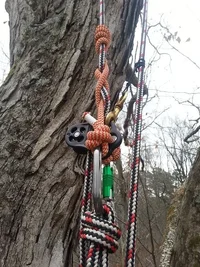
Here's a picture of the Hitch Climber in an O-rig setup. the climbing rope loops through the bridge attachment (ring or biner) which is just below and out of the frame of the picture.
 

Attachments

  • 2014-01-21 15.45.45.webp
    2014-01-21 15.45.45.webp
    109.4 KB · Views: 274
Thanks for posting that photo, dogwood. Much appreciated. I missed a chance today to see a climber using something that looked similar, only using what looked to be a Blake's hitch on one leg with the other side of the hitch cord going to the other leg of the rope.

Every time I saw him he was fairly high up in the tree; I never did get to actually speak with him. Too bad.

Tim
 
Thank You Mark, just out of curiosity do you have a preference on your friction hitch? I feel like the general consensus for the hitch climber and/or rope wrench (which I ordered as well) seems to be the VT. I will definitely play around with a few but I always appreciate expert opinions. I'm trying climb my way out of the dark ages :)
A version of a VT is my choice!
 
Brady, how old is your line? If you ever make it down to Brunswick I can splice it for you if its not too beat up. I also have a virtually new hank of Imori with splices that I could let go of on the cheap
 
Here is a video showing the set up of 'climbing in a loop' AKA the O-rig. The problem you will run into using this system with a termination knot is cumbersome changes of TIP. To re-crotch your line, you'll have to untie your termination knot unless your bridge ring is hugenormous. Although it doesn't address the OP's problem, I find an adjustable bridge a more elegant solution.

I'd have to agree with some of the other posters here that I haven't found a termination knot to interfere too badly with my hitch on the standard hitch climber set up, and when it does, you just have to spread the legs of your line apart slightly until the knot catches. Before I switched to mostly mechanicals, this became an unconscious habit for me even though I climbed with a splice more than 2/3s of the time.

The fisherman's, buntline, and anchor hitch all have an orientation that interferes more, and one that interferes less; just unclip and rotate the biner if it seems like a hassle. If you really have problems, this guy and an extra biner will move your knot up out of the way of your friction hitch.

As far as knots go, if you're moving from a Blake's or a Tautline, my advice is to start with a Distel and a Michoacán; they're tied in almost identical fashion to the knots you're coming from, they have less sit-back, and they're less finicky than the VT. Plus, they're good to know anyhow; I still use a Distel on most of my lanyards.

Once you've gotten used to the new system, start playing with the VT, XT, and Cooper's. The thing with the latter three is that they are much harder to dial in because they behave differently depending on the weight of the climber, the diameter of the host line, the diameter of the split tail, and how the moons of Saturn align that day. There's also a million and one variations to learn and try.

You will eventually end up climbing on one of them, but you'll be more productive in the near term if you start with the Distel/Michoacán and ease your way into the VT. Once you've got all that under your belt, crack open the TK and the Knut and see how you like them.

 
Last edited:

New threads New posts

Back
Top Bottom