Harnesses can break

I've read about Todd for years. What a tragic loss to his family.

If I remember right he was on a climb with Greg Lowe when an avalanche swept Greg to his death.

I'll bet that a lot of climbers are looking closely at their gear now.
 
That is a shame. But at least he died doing what he loved, demonstarting what he was about.

It is a timely reminder that fluffy webbing is far worse than cuts - lots of abrasion on webbing is bad news. Failure wasn't caused by fall forces either (although obviously previous falls will have weakend the webbing), so it could easily happen like this with work positioning.

Not wishing to use this sad event as an advertising platform at all, but I would like to point out that the webbing sought for TreeFlex is the most durable we could find, and one reason 45mm webbing should be used for work harnesses, rather than 22mm typical for sport. In fact 45mm is written into the fall arrest harness standard. I'm not sure about the work positioning standard, but I find no hardship in using harnesses with 45mm webbing. More expensive, but good for piece of mind; we can't back up a harness.

Having said that, when tying into a rock harness, always pass the rope through the leg loops and waist rather than belay loop - get a 2nd chance that way. And on the rappel, if using the belay loop, I always attach a Machard Tresse below the belay/rappel device, attached to the leg loop. Not the best way to be left hanging should the belay loop fail, but preferable to free fall.

Choose and use your gear wisely.
frown.gif
 
I'm not trying to attack anyone personally but the idea that someone dies "doing what they love" somehow makes that death a little more acceptable is just wacky.
Phil
 
If you can die while doing something that makes you happy, if you are going to go is the best way to go, wether that be sex, vactioning or in his case climbing, it was obviously his passion
 
what a loss, just goes to show how important regular inspecton and renewal of our gear is.
i dont feel guilty replacing my climbing rope and snaps every 6months
 
Not wishing to get involved in a spirit vs matter debate, it all depends on whether you believe the point to life is life itself....
cool.gif


Accept death
Learn to live
Live to learn
Learn to love

Death and higher risk of death is a fact, whether we choose to accept it or not.
 
Paulo,
In regards to correct tying in method on a rock belt I completely agree with you.The so called belay loop is not to be used as an attachment point while climbing it is quite clearly stated on the label on all rock belts I have ever seen.What I would say is that rock belts should be replaced after any significant fall.Why such an experienced climber would use only this loop for protection is anyones guess.
Ok well on to the real reason I replied to this post.
In regards to statement that all webbing must be 45mm,Yes this is a requirement but I think that you are taking it out of context.In my interpretation of the regulations this would relate only to the width of the webbing in contact with the load :ie the person sitting in it.
This is to stop cutting in damage in the event of a fall by spreading the energy over a greater area and reduce restriction of blood flow when hanging.This is not really an issue with most work positioning and fall arrest harnesses of today as the load bearing webbing is enclosed in large pads that spread the weight of the climber with great effect both in a fall or while hanging.
Intended or not your post would lead us to beleive that this requirement would have something to do with wear and strength.If this was the case then the regulation would also state thickness and material.
45mm wide 1mm thick rated webbing will wear no slower than 25mm wide 2mm thick rated webbing if made from the same material.The width of something has absolutely no bearing on the strength or abrasion resistance without a great number of other things not least type of material and thickness.

Didj

I'm not a pheasant plucker I'm a pheasant pluckers son and I'm only plucking pheasants till the pheasant plucker comes.....
grin.gif
 
When you ride "manky" stuff long enough you become complacent. Todd was a true bad a*#. A belay loop failure, unbelievable. Failed under bodyweight, rappelling? It must have been a really old harness. The accident could have been there other way since most folks belay from this loop, in which case his partner may have died. Retiring a harness after a fall would be a little overboard, maybe base retirement on wear and tear. The stiching must have been trashed. I'll be scopeing my rock harness tonight.
 
[ QUOTE ]
The so called belay loop is not to be used as an attachment point while climbing

[/ QUOTE ]
I totally agree that it's not to be used while climbing but the answer is in the description. It is a "belay loop" which is exactly what it was being used for in this situation. Rappeling on a fixed double line is a form of self belay where there is little possiblity of a major shock load. If that loop can handle a factor 2 fall of another climber I'm sure it can handle a climbers weight. Besides to rap you need to tie in with a carabiner. Ever try cliping through both the tie in loops, they aren't designed for it. Doesn't sound like climber error to me. Just an unfortunate case of complacency. Seems the better you get the greater the tendancy to forget the little things you take for granted. Sad when it results in a tradgedy.
 
The "belay" loop on rock climbing harnesses is usually the STRONGEST PART OF THE HARNESS. It absolutely IS an acceptable place to tie in to.

Why do you think it's there?

love
nick
 
Hi Murph,
I would not like to comment on how or why he fell as the only information is this eyewitness account,and in the scenarios you discribe I would agree with you that the use of the belay loop is acceptable.
Nick my remark on use of the belay loop was regarding climbing lead where there is the potential of taking big fall factors and popping gear.Use of the loop in this situation is NOT ACCEPTABLE.

Didj
 
[ QUOTE ]

Nick my remark on use of the belay loop was regarding climbing lead where there is the potential of taking big fall factors and popping gear.Use of the loop in this situation is NOT ACCEPTABLE.

Didj

[/ QUOTE ]

...according to?

That loop, on most harnesses made in the last 8 years or so, is the strongest part of the harness. Usually made of triple layer of webbing sewn with one to five bar tacks AND (this is the crucial part) 2 rows of invisible-unless-you're-looking-for-it stitching that runs along each edge of the loop.

Why NOT tie in to that?

love
nick
 
Hi Nick,
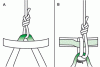
This is taken from Petzls infomation on harness config.If the harness is the same as in fig A then it was designed with the single attachment.The majority of rock belts are of the fig 2 Type and as you can see the rope does not tie into the belay loop.Black Diamond,and Edelweiss also say the same thing..

Love Didj
 

Attachments

  • 60671-tiein2_bis.gif
    60671-tiein2_bis.gif
    8.6 KB · Views: 92
[ QUOTE ]
Paulo,
Ok well on to the real reason I replied to this post.
In regards to statement that all webbing must be 45mm,Yes this is a requirement but I think that you are taking it out of context.In my interpretation of the regulations this would relate only to the width of the webbing in contact with the load :ie the person sitting in it.
This is to stop cutting in damage in the event of a fall by spreading the energy over a greater area and reduce restriction of blood flow when hanging.This is not really an issue with most work positioning and fall arrest harnesses of today as the load bearing webbing is enclosed in large pads that spread the weight of the climber with great effect both in a fall or while hanging.
Intended or not your post would lead us to beleive that this requirement would have something to do with wear and strength.If this was the case then the regulation would also state thickness and material.
45mm wide 1mm thick rated webbing will wear no slower than 25mm wide 2mm thick rated webbing if made from the same material.The width of something has absolutely no bearing on the strength or abrasion resistance without a great number of other things not least type of material and thickness.
Didj

[/ QUOTE ]

Interesting points Didj; I'm not sure why the webbing width should be 45mm. I'll find out from manufacturers.

The reason we use it is to distribute load the way we want it around the pelvic rim, and for abdominal support when using the harness from hip Dees (working poles leaning on a lanyard). Originally we tried a small abdominal pad. This worked well, but pressured the bladder when sitting rather than standing - such are the challenges of harness design the way we use them! We found broad webbing coupled with the fixed waist attachment offered an efective compromise; support when working from hip dees, flexibility when sitting. It also supports the leg loops well the way we designed them.

The durability point I was putting across was resistance to abrasion, and nothing to do with the width. The webbing we use is exceptionally resistant to UV and abrasion.

Where webbing runs through metal work in a sliding action, the durability of webbing is an important issue.
cool.gif


It is easy to overlook the strenght loss from 'fluffed' webbing, which this accident points out. Faded colours are also an indication of UV degradation. I know older climbers that prefer their older harnesses. 5 years of regular use is enough for any harness, let alone one that suffers falls on occassion. It works out as a few pence per working day. I think my lifes worth more than that.

The belay loop is the strongest part Nick. But I think this is a security issue rather than strength; if the waist loop fails you'll still be held by the legs in a fall and vice versa. I think that is why leaders are encouraged to tie into both, rather than the belay loop. That wouldn't have saved this accident, but backing up with a prusik on the leg might have.

cool.gif
 
Hi Mahk

Because the belay loop is designed for rappelling and belaying, so the only errors (it seems), were using a harness well beyond its disposal date, and not backing up the rappel from a leg loop (although it is considered good UK practice to attach rappel device and back up prusik to the belay loop). Clipping a karabiner through the waist belt and leg loop risers for rappelling runs the risk of cross loading and tri-loading. Some harnesses like BDs alpine BOD had no belay loop to aid easy donning whilst standing in crampons (both feet can stay on the ground - useful if you've strayed to far up icy slopes before donning harness). The safest way to use this, is to pass a short runner through waist and leg loops and then clip a krab. Some condone using the tie in loop of a fig 8 as the belay loop, but this doesn't load the fig 8 knot properly. In Craig Connelly's mountaineering book (USA), he advocates a Yosemite bowline as the better option.

As No Bivvy pointed out, if Todd's partner (the witness) had fallen whilst leading, Todd's belay loop almost certainly would have failed, possibly resulting in the partners death, depending upon how many runners it pulled out on the way up. Not a good situation for the remaining person's conscience if it had turned out that way!

Because most belay devices (excepting grigri types) are designed to slip at 2kN, the force on the belayer's belay loop is similar to that that could be generated whilst rappelling (depending on the weight of climber and equipment). The belay loops are built so strong to take into account the lack of technical knowledge factor - the average weekend warrior doesn't always grasp the realities of the engineering situations they put themselves in.

The belay loop should only fail on the leader if worn and used to catch a hard fall without an appropriate dynamic belay, or on the belayer if the leader fell before placing protection above the belay. For this reason, its best to run the rope through two or three protection pieces as a single equalised anchor at the belay ( http://www.chockstone.org/TechTips/Equalise.htm ), and the belayer tie in to them seperately, rather than the belayer tie in to two equalised pieces and just run the rope direct from belay device to leader, hoping the first SINGLE runner the leader places protects the fall; that could be a long time coming!
crazy.gif


In arb terms, would you sooner catch a falling log that weighed the same as you on a rope tied off your waist direct, or have that rope run through a sling and krab above you first?

At the end of the day, the weak harness put both men at risk. I expect the hard nature of todd's climbing had exposed the harness to quite a lot of UV and abrasion and falls. Its always the dose that makes the poison.

Whether working on trees or playing on rock, choose your equipment and partners carefully.
cool.gif
 

New threads New posts

Back
Top Bottom