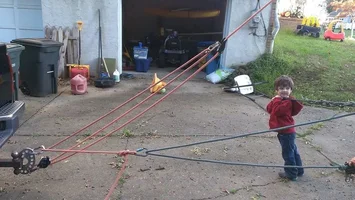
Guess the MA

NEED MORE INFORMATION. NOT ALL THE PIECES OF THE PUZZLE CAN BE SEEN IN THE PHOTO. MISSING INFO IS OVER THE LADS LEFT SHOULDER. COULD YOU PLEASE SET IT UP AGAIN AND TAKE ANOTHER PHOTO FROM THREE STEPS BACK?
 
Good point about missing some info. The little guy is holding extra rope that was off to the side not included. The blue line has one end going to an anchor and the other is being pulled.

A system is only compound when you add another ma to another without a change of direction between them.
 
attached to an anchor as its own system. Hoping someone settles this debate for me. I have seen the 5:1 complex system done a few different ways. Seems like these conversations will always get you different answers....
 
[ QUOTE ]
Good point about missing some info. The little guy is holding extra rope that was off to the side not included. The blue line has one end going to an anchor and the other is being pulled.

A system is only compound when you add another ma to another without a change of direction between them.

[/ QUOTE ]

I assumed the blue line went to a biner/pulley from the boys hand where the rope is shortened. Otherwise, if it just went to another anchor then the whole system would be no MA as nothing would move.

With all due respect I will have to disagree with you on what makes a compound system compound.
A compound system is the compounding of one MA system to another, a multiplication problem, in this case a 2:1 multiplying a 3:1 for a 6:1 MA. It does not matter if there is a redirect between them or how long the line is between them, it is still a multiplication problem.
A simple system is one in which the components of the system are added together to increase the MA. In math it is a summation problem. In other words, you can keep adding sheaves and line to increase the MA.

In this case the boy is pulling on the blue line, he will pull on that line, (assuming your nice to him and don't make him cry) until both sides or line of that system are gone, two lengths of rope were used to get the biner to come back half the distance of those two lengths of rope. 2:1

As he pulls on the line those other 3 segments of rope will all be used to pull the Petzl shunt to the back of your trailer hitch. All three lengths of rope will be used to move that shunt a third of the distance of those three segments of climb line. 3:1.

So, you have a 2:1 pulling on a 3:1 making it a 6:1.

Again, discounting the angle/spread of the blue line.
 
[ QUOTE ]


I assumed the blue line went to a biner/pulley from the boys hand where the rope is shortened. Otherwise, if it just went to another anchor then the whole system would be no MA as nothing would move.

With all due respect I will have to disagree with you on what makes a compound system compound.
A compound system is the compounding of one MA system to another, a multiplication problem, in this case a 2:1 multiplying a 3:1 for a 6:1 MA. It does not matter if there is a redirect between them or how long the line is between them, it is still a multiplication problem.
A simple system is one in which the components of the system are added together to increase the MA. In math it is a summation problem. In other words, you can keep adding sheaves and line to increase the MA.

In this case the boy is pulling on the blue line, he will pull on that line, (assuming your nice to him and don't make him cry) until both sides or line of that system are gone, two lengths of rope were used to get the biner to come back half the distance of those two lengths of rope. 2:1

As he pulls on the line those other 3 segments of rope will all be used to pull the Petzl shunt to the back of your trailer hitch. All three lengths of rope will be used to move that shunt a third of the distance of those three segments of climb line. 3:1.

So, you have a 2:1 pulling on a 3:1 making it a 6:1.

Again, discounting the angle/spread of the blue line.

[/ QUOTE ]

icon14.gif

What Richard said.
 
Okay, here is my 2 cents...

First, Richard is asking half the question. The problem is, from this picture we do not know what objects are stationery and what will be in motion. It appears there are two opposing trucks connected by their trailer hitches. So, the first question is, will either truck be in motion ? The possible answers are:
A) Both trucks fixed <- there is no MA
B) Left fixed, Right moves <- either 2:1 or 3:1 (see below for explanation)
C) Left moves, Right fixed <- this is a 3:1
D) Left moves, Right moves <- left MA x right MA, which is either 6=(3:1x2:1) or 9=(3:1x3:1). However, the weight required to pull would be some ratio of two truck weights.


Now, the second question is, For scenario B) "Right moves, left fixed":
B1) If upper portion of rope the boy is holding is attached to a fixed object i.e. a tree, the MA on the right would be 2:1 (as Richard said, w/o motion, this adds no MA).
B2) If upper portion of rope the boy is holding is also attached to the moving truck, the MA on the right would be 3:1

Of course, all of this is negating any influences of friction.
 
Ive got it!
The neighbor kid got his hot wheel mired in the mud.
They tried to jack it up with a railroad jack, but the jack bent.
They need a way to lift and pull at the same time so they spiked a telephone pole and put a block as a redirect (out of the frame of the photo)
The angle of deflection of that block was 110 deg so we need to figure that in.
Both kids fired up the trucks and took off. The hot wheel popped out of the mud with a sickening sucking sound.
Only damage was some slight glazing to the blue rope.
A successful salvage operation, no one was hurt.
 
Agreed 6:1

I truly hope tat your chice of gear is only to illustrate the system.

Using ascenders as rope grabs or progress capturing devices in MA systems will quickly lead to damage or breakage.

Friction hitches and steel biners or links are a better choice...even to illustrate a teaching point
 
lol, na just playing around and what was right there. If that was a real setup for work it would need to be a cleaner setup. Also would not be pulling toward a load (when ever poss). Nope this was more of answering a debate between two friends. Have it on my Facebook as well. Friend is losing big on this one. Should have put money on it!!
 
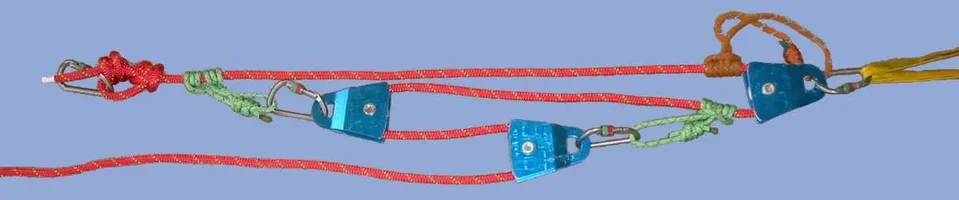
correct me if I am wrong. This was my side of the argument by thinking this was a complex 5:1. I could be wrong for sure though, I don't normally get to caught up in making complex setups when you can just as easy compound a system and get better results.
 

Attachments

  • 371914-complex5to1.webp
    371914-complex5to1.webp
    31 KB · Views: 51
[ QUOTE ]
correct me if I am wrong. This was my side of the argument by thinking this was a complex 5:1. I could be wrong for sure though, I don't normally get to caught up in making complex setups when you can just as easy compound a system and get better results.

[/ QUOTE ]
If used for a hauling system it is 5:1 with a progress capture pursik, if used as a climbing system (you are the load) it is 6:1.
The lower prusik can be eliminated without effecting the outcome.
This configuration is actually quite useful. If you are climbing DdRT and then set a hand ascender above with a revolver you get a 3:1 acting on a 2:1 making it 6:1. Add a Rig in place of that lower pulley (attached to your harness anchor) and you have the progress capture.
Could be a very useful system if you were doing a pick off and wanted to descend with the injured on the DdRT system. I'm away from home or I would set it up and take a picture so hope you can see what I'm describing.
 
If the blue line is a simple 2:1 that the boy is pulling the tail of and the orange line setup is a 3:1 (Rads plus 1) the boy would only be able to pull five times his input with this setup (or less considering one redirect is not a pulley). 3:1 is complex with PC, 2:1 is simple.
 

New threads New posts

Back
Top Bottom