GRCS Rigging

chris_girard

Branched out member
Location
Gilmanton, N.H.
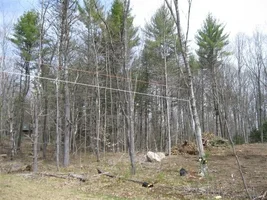
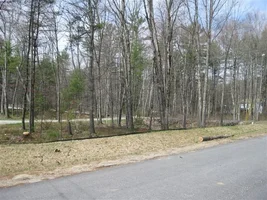
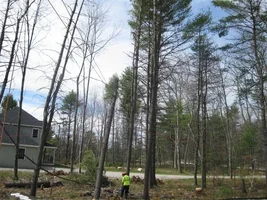
Here’s a job that we did yesterday. More storm cleanup from the last big windstorm. This was a 12”dbh White pine that had uprooted and was crotched into the adjacent pines on the right. There are power lines located in front of it and a property owner’s driveway and house just to the left. Can’t really see it. I could not just cut it and have it slide out without having it do damage to the lines.

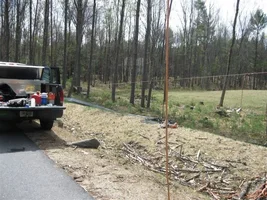
This tree was definitely a hazard as most of the anchor roots had been compromised. The plan was to guy the tree to stabilize it and safely climb it. I used my 24’ ladder leaned up against the tree to set a Hobbs block with a DWT. I ran two ½” double braids through the block and back to another tree across the street, where the GRCS was anchored.

After taking up some slack, we then set two side stabilizer lines using a couple more double braids with prussic loops connected to Maasdam rope come alongs.

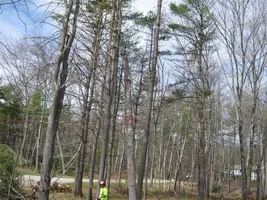
After tensioning everything up, I set an AFC in the pine to the right and then proceeded to climb the uprooted line. I removed the branches as I ascended and the plan was to top the pine out and chunk it down in 6’ lengths, until I could just fell it. The wind was blowing pretty well yesterday and I did not feel comfortable in the tree. I setup breakaway lanyard using a non-rated biner connected to my saddle. I was still connected to my AFC.

Everything went as planned with no hang-ups or problems. Here are a few pics.
 

Attachments

  • 225817-rigging1.webp
    225817-rigging1.webp
    54.2 KB · Views: 370
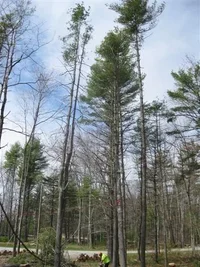
Here's a view of the standing stem, sfter the tree was topped and the weight was reduced down to the Hobbs block.
 

Attachments

  • 225821-rigging5.webp
    225821-rigging5.webp
    107.3 KB · Views: 247
Thanks guys.

Not really that difficult of a job, but the plan was good and sound.

I had such a good fairlead with the Hobbs block and DWT, that if there had been room I could have lifted that tree right up and felled it 180 degrees to its lean.

I didn't want to drop it across the new road behind it though, so I just rigged and guyed it safely to climb and wreck out.
 
Thanks Norm, I'm no cowboy and there was no way that I was going to climb that tree without having it guyed properly.

Even with the lines in it, the wind was nerve racking knowing that the roots had been compromised but I knew it was OK.
 
Good work.


How much strain does it take to break that non-rated 'biner. Your body will absorb the strain until it breaks.

I would like to incorporate a rope lanyard (possible to cut) and a no-stopper knot in the end of the lanyard to be able to slide the adjuster hitch off the end with one hand.

Not having tested them, I wonder how many zip ties it take to support body weight, barely.
 
The biner was rated for 200 lbs, but I also used my 3-strand lanyard that I hand spliced without putting a thicker backsplice in it. I use just an overhand knot on this one.

I too had also removed the stopper knot from the end of the lanyard that way if the biner hadn't of let go, then I would have still been able to slide the adjuster hitch off the end like you mentioned.

That way, I had two escape options with my lanyard.
 
if your using a chainsaw why not just cut the lanyard in an emergency? or were you thinking the tree might come a part while you were climbing it? if that was the case why didn't you ascend to your tip and install a ground anchored traverse line and slide right down to the top. then you wouldn't of had to climb the manky thing, just remove weight and descend as normal.
 
I did not like the way that it was resting in the pine where my TIP was set. Wasn't safe ascending next to it.

Felt it was safer to secure it first from the ground then climb it.

My chainsaw was not always running, so there was no way that I would rely on cutting my lanyard with it in an emergency.
 
my point exactly. so why did you need a "soft" connection to your lanyard? and do you think you could have grabbed your knot on the lanyard fast enough to keep it from binding once the heavy shock load was applied? and if the working load on the mini was 200lbs that is a 1000lbs minimum breaking strength. that kind of load would rip you in half. i'm not picking on you just asking questions about your plan for hazard mitigation. great job on securing it from the ground before working in it, a very fancy bit of good rigging (nice play on words there =-) ). after securing the work you why didn't you feel safe ascending to your tip then traversing into the work?
 
I'm not upset at all Jeff, I love questions and will try to answer them as best as I can.

You're right, the 200 biner was not my first choice and I would have actually prefered having some of those really cheap biners made in China that are only good for keys to hang from.

This tree had such a forward lean that I did not have to apply much back pressure to my lanyard to stay secure to the tree. The AFC was taking most of the load from my bodyweight.

When I said that my lanyard was connected to my saddle, I should have said specifically that it was connected to my central middle ring on my TreeFlex floating bridge to prevent the hip crushing effect that would occur if the tree had failed. All theory, but I wasn't taking any chances with my hazard mitigation.

As far as not feeling safe ascending with my TIP set after guying the base, it was more because of that darn wind that was blowing that day and not knowing if there had been any additional structural damage to the stem from the initial storm above where the block was set, so I figured it would be more beneficial to ascend the tree and do a closer visual inspection as I was removing the branches.

Thanks
Chris
 
nuff said good work. i bet you were pretty worried about the top barber chairing on you, i know i would've been.
 

New threads New posts

Back
Top Bottom