Gibbs vs prusik

Tom Dunlap

Here from the beginning
Administrator
There is a thread on the SARBC page about using Gibbs or prusik for rescue hauling systems. One of the guys did some tests, take a look:

http://tinyurl.com/b84kh

It's in post #4294

In another thread about rope washing one of the people found that the rope soap that a company sells is no more than Simple Green.
 
Great Tom,

a lil'slip might be frustrating, especially in MA/compression jig piggybacked onto mainline; but in life saving situation/shock the small amount of slip can let some force/pressure/steam escape. The compression rig your intent is to stretch and statically hold; in fall to dissipate shock.

Being that the prusik slips some it could decrease force in line; then it takes more force to bring force up and continue to advance to failure/harming line that gibbs.

i vote fer the homemaid prussik!
 
That's been my point too. In every test that I've ever seen, soft grabs will slip/grab until the load is released from the system. Mechanicals grab tight and then slip to closer to failure. Sometimes the mechanicals damage ropes too.

But, at lower loads mechanicals are easier to use. If a person takes the time to do some simple calculations and has a knowledge of the slipping rate it is fine to use a mechanical.
 
Differnet line construction types, may prefer gibbs static pinch/bend over over prusik slip choke/bend(?); materials of certain types might not take the friction of slide(polyolefin/non-nylon/polyester fibers in Arboplex etc.?); other materials taking slide heat better. What of ship trick of de-cored line to lay tighter/less leveraged as friction hitch (Tenex for FH too), i found 3strand to wear like iron and grab braids very favorably, i often theought the 'footprint' of the 'fluted' 3strand grabbed differently and perhaps allowed better heat dissipation; as opposed to the sock/tube of braids that was total contact area per turn/ no 'flutes'.

The prusik slip puts forgiveness in the system to releive peak dynamic pressure like more elastic line; giving some releif to all connected points: support, prussik, climber, knot tightness etc. from dynamic loads. So in moving loads prussik strategy will tend not even to hit the loading that the gibbs strategy statically insist the line (and all connected points) takes all of i think is the biggest issue. Prussik probably giving diffeent loading range of abosrobtion/fergiveness than line itself to work together each lending releif on different schedules covering more events(?).
 
Always remember the caveate that must be considered when comparisons of this nature are made: conifer pitch can quickly render any hitch inoperable, while a mechanical device will soldier on. Theoretical advantages are good to be aware of, but real operating conditions rule our world.
 
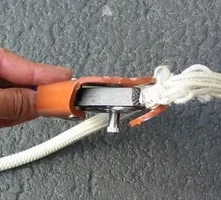
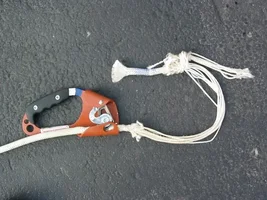
As some have stated, there are pros and cons to both mechanical rope grabs and prusiks. My concern has been in the use of toothed ascenders in rescue systems.

Attached is a picture of a brand new open-shell ascender (designed for one-person use) which severed a brand new rescue rope and partially opened the shell. This ascender was used as the haul grab in a raising system with a litter and attendent on the working end.
 

Attachments

  • 28302-AscenderFailure4.webp
    28302-AscenderFailure4.webp
    31.9 KB · Views: 226
Tom said,
[ QUOTE ]
If a person takes the time to do some simple calculations and has a knowledge of the slipping rate it is fine to use a mechanical.

[/ QUOTE ]
OK, so here you go guys if you'd like to know.
Just received these test results from CMI themselves today, for everyone to know:
This first test showed the failure of Ultrascenders' body:
<u>Report No. ASTM023</u>
<u>Date: 6/11/98</u>
<u>Test Speed: 1"/Min.</u>
<u>Fixturing: Standard CMI</u>
<u>Description of Test: </u> To determine a 3 sigma minimum breaking strength of CMI part number ULT01 Ultrascenders. 3 sigma strength was calculated per formulas called out in ASTM standard F1773-97.
<u>Test Results:</u>
Average Breaking Strength at failure load: 4716lbs.
Standard Deviation: 26.08
Minimum Rated Breaking Strength: 4637.77lbs.
Comments: Body Tore.

This test showed the failure at which point the sheath of the rope was torn:
<u>Report No. ASTM024</u>
<u>Date: 6/11/98</u>
<u>Test Speed: 1"/Min.</u>
<u>Fixturing: Standard CMI</u>
<u>Description of Test: </u> To determine the on rope 3 sigma strength of CMI part number ULT01 Ultrascenders on new 1/2" New England Ropes White Static KMIII. 3 sigma strength was calculated per formulas called out in ASTM standard F1773-97.
<u>Test Results:</u>
Average Breaking Strength at failure load: 1688lbs.
Standard Deviation: 43.82
Minimum Rated Breaking Strength: 1556.55lbs.
Comments: Stripped Sheath.

Copies of the actual tests can be gotten from Kris Kirk at CMI phone 800-247-5901.

Now we have some real life tests by the manufacturer to let us know some of the limits.
 
[ QUOTE ]
Attached is a picture of a brand new open-shell ascender (designed for one-person use) which severed a brand new rescue rope and partially opened the shell. This ascender was used as the haul grab in a raising system with a litter and attendent on the working end.

[/ QUOTE ]

So what happened? There is no way 2 people on a rope did that to the shell. Something must have jammed or they were hauling with the rope running over a round ledge (adding lots of friction)

Dave
 
[ QUOTE ]
This ascender was used as the haul grab in a raising system with a litter and attendent on the working end.

[/ QUOTE ]

Rescue,

Surely you had to know we would want to know more...do you have more details? Without specifics it is just an interesting picture, open to speculation.

Thanks.
 
I'll try to get more information (if those responsible will talk about it). That was 1/2" static kernmantle rope and the ascender pictured was used as the haul cam on a litter raising system. I'm not sure what MA they were using or how many haulers were on the line, but there was another ascender below the haul cam as a brake in addition to the brake (ratchet) cam at the haul anchor.

The rope may have been abraded by a rock edge or by the brake ascender below (speculation). Before it parted, though, there was enough force on the haul ascender to partially reverse the cam, causing the shell to spread. Some of the rope sheath is bunched up behind the ascender cam, indicating that the rope was moving through the cam which was stripping the sheath.

If I can get more details, I'll pass them along.

- Robert
 
Do not fear prusiks

Yes they slip a little; its a good thing. They can even act as energy absorbers in a factor 2 fall, though this should not be relied upon for fall arrest. From tests I've done, the knotted line broke before the prusiks, but others found the prusik caused the line to fail at 50% of tensile, as it pinches the rope. However, they slip a hell of a lot way before failure, eventually seizing/melting onto the line. The french prusiks are especially effective at 'jumping' their way 7cm at a time until seizing. You start to duck and cower way before the failure point. Very impressive really.

Its horses for courses between prusiks and mechanical devices. The biggest draw backs of prusiks are residual strength and correct tying. Toothed ascenders can be a real menace for anything other than SRT ascent, and then they need backing up. I'd never choose one for rescue/work loads where a smooth cam can be applied.

Don't let manufacturers force prusiks into the 'BANNED' sector so they can sell spliced products. They are superior to mechanical grab devices in many areas. Training is key.
 
[ QUOTE ]
Don't let manufacturers force prusiks into the 'BANNED' sector so they can sell spliced products.

[/ QUOTE ]

They are banned in the European Union (CE Standards) for rope access or rope rescue because they cannot be tested and certified since they are site-built. Different sizes and types of cord are used, the knots to form the loops are individualy tied with varying amounts of tail and pretension, and the tying, dressing, and setting of the prusik hitch is operator-dependent.

Hopefully that won't happen (there doesn't seem to be any movement in that direction) in the US, since the humble prusik hitch is one of the safest and most reliable belay, braking, and rope grab devices available.

BUT - the function of the prusik IS dependent on it's being tied and applied properly, with the proper size and hand of cord.

- Robert
 
[ QUOTE ]
Attached is a picture of a brand new open-shell ascender...

[/ QUOTE ]

Do you know the make and model of the ascender?

[ QUOTE ]
a brand new open-shell ascender (designed for one-person use)...This ascender was used as the haul grab in a raising system with a litter and attendent on the working end.

[/ QUOTE ]

The ascender was designed for one person, but how much weight was on the ascender when it failed? There was an attendent and a litter on the working end. Was this a real rescue or practice? Was there a person in the litter? If it was practice was there a dummy in the litter?
 
[ QUOTE ]
Do you know the make and model of the ascender?

[/ QUOTE ]It happened to be a PMI Cat, but any open-shell toothed-cam ascender would've behaved the same.

[ QUOTE ]
how much weight was on the ascender when it failed? There was an attendent and a litter on the working end. Was this a real rescue or practice? Was there a person in the litter? If it was practice was there a dummy in the litter?

[/ QUOTE ]

It was a practice drill and there was a live person in the litter and one attendant. Was the person in the litter a dummy? Maybe, under the circumstances. But the belay held and the team managed to get everyone home safely.

Still waiting (diplomatically) for more information...

- Robert
 

Attachments

  • 28481-AscenderFailure3.webp
    28481-AscenderFailure3.webp
    59.3 KB · Views: 115
Rescue, glad to see you back around!

i'm fan of Prussik, but along with excellent point about pine tar/ice etc. conditions, wonder about the Caveat Emptor (Venditor is much better way to deal!) memorable test reminder; wonder about the pairallel said to specific types of rope constructions.

What about how a prussik chokes the the outer/mantle of a line vs, cam denting (staying clear of toothed). It seems the prussik grabs the total mantle all the way around and spread out over a wider distance, with a soft (cord) device. A cam, dents more across, intensely at 1 point with a hard device; it doesn't give up to allow tension/pressure/'steam' peaks to escape like prussik. But, it does dent across the total line more intensely from the same force powering it (your loadforce).

What about lines that carry 50-95%of the load on the internal/'kern'/core part of the line? Whereby in some rope consturctions and loading ranges, a prussik grabbing a non-load bearing cover, might let it seperate from the core as the sheath/cover/mantle tried to take the weight of load that it is not meant too?
 
Hah! Before reading this thread, a friend and I embarked on a journey to see if we could cause the wild country ropeman to slip. We put a 6:1 (I think it was a 6:1, I'm not good at figuring it out) and tensioned a horizontal rope as best we could with that. We couldn't get it to slip. Then I sat on the rope. That didn't do anything. Then the other guy sat on the rope and it made a loud popping sound. We went and checked where the ascender was attached to the rope. It tore the sheath open (it was a 10mm dynamic rock climbing line), glazed some of the sheath, and pulled some of the core strands out. It was fun to see (in a controlled setting).

The lesson I walked away with: That ascender is good for what it was designed for, but don't try to put more than a few hundred pounds on it.

love
nick
 

New threads New posts

Back
Top Bottom