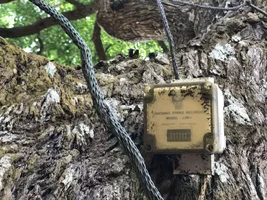
Fuses on Lightning Protection Systems

I've heard that a simple fuse can be placed in a coil of 18 gauge wire adjacent to the main conductor of a tree lightning protection system to show if the TLPS has been struck. This is apparently something that Bartlett has done on their TLPSs (https://www.bartlett.com/resources/Fuses-to-Record-Lightning-Strikes-on-Trees.pdf) Does anyone have experience with TLPS fuses? Do you do it differently than explained in the link above? Have you ever checked on a TLPS and found the fuse blown?
Thanks for any advice.

Patrick
 
There are 100 such systems in Singapore funded by HSBC Bank. The coil/fuse system does not count strikes to the system, it rely s on inspection and fuse replacement. Its a one hit only device. There are digital strike counters that clip to the down conductor with an LED display. they do count strikes.

I employ the fuse type and have found it to be blown on inspection. It is of some importance to get the fuse to coil ratio correct, if it is to work and a quality marine grade fuse holder is also advisable.
 
I've heard of lightning traveling thru a small thermostat wire so it makes me wonder why 18 gauge wire coiled up so many times? Why not 12 gauge with less coils or just one thick wire like 4 which is used for grounding systems? And why use zip ties? Wouldn't using something like split bolts in place of the zip ties make a better connection and still be removable?
 
I've heard of lightning traveling thru a small thermostat wire so it makes me wonder why 18 gauge wire coiled up so many times? Why not 12 gauge with less coils or just one thick wire like 4 which is used for grounding systems? And why use zip ties? Wouldn't using something like split bolts in place of the zip ties make a better connection and still be removable?

Sure you can employ less wire or small gauge, the point is 3 coils per fuse amp + 2 for measure.
If you attach your fuse coil to the conductor with a split bolte or similer metalic conductive devise the fuse will not blow. The pion tof ussing cable ties is so that there is no bond between the conductor and the fuse coil. The electrical energy in the conductor is at a greater electrical potential to the fuse coil, it is the enduced electrical energy in the coil that blows the fuse. If the two are conductavley bonded then no inductance.
 
Sure you can employ less wire or small gauge, the point is 3 coils per fuse amp + 2 for measure.
If you attach your fuse coil to the conductor with a split bolt or similer metalic conductive devise the fuse will not blow. The piont of using cable ties is so that there is no bond between the conductor and the fuse coil. The electrical energy in the conductor is at a greater electrical potential to the fuse coil, it is the enduced electrical energy in the coil that blows the fuse. If the two are conductavley bonded then no inductance.
 
Yes, the coil and main conductor act as a transformer... the cable is the primary winding, the coil is the secondary winding and the charge is electromagnetically induced into the secondary (which is shorted by the fuse, causing it to blow). The gauge of wire, number of turns, and core/form diameter and length determine the output voltage of the secondary winding. The idea is to limit the current flow through the selected fuse to just enough to blow the fuse, but not melt everything. Numerous combinations of magnet wire gauge, form diameter and number of turns are possible... the ones commonly used were probably derived through trial and error.
 
The "heavy gauge" = 54 mm cross sectional surface area. "slender gauge" = 27 mm cross sectional surface area.
Cambridge dictionary: Upgrade, "to improve quality"
Guy please qualify why by reducing the conductor by half = an upgrade.
 
Ok so I'll say it. the change from 54 to 27 is with out doubt a down grade and further more not compatible with standards in Singapore. Singapore gets on average 160 day of lightning activity every year. As a consequence there understanding of the art and science of lightning protection is highly advanced. Talking with my partners over there they consider the 27mm spec conductor sub standard and a main conductor and therefore only employ it as a bonding conductor.
 
Mmmmm well I did not see a written standard to consult--is there one?--but there are several systems in Singapore I saw with my eyes in late July that were 14 gauge.

Reducing the surface area does not proportionately reduce effectiveness. 14 gauge is quite effective, though I'm sure that 54 or 108 would be more effective.
 
So Guy, in your previous posting you claimed
All their newer systems have upgraded to the slender gauge.

Thats not the same as...

-but there are several systems in Singapore I saw with my eyes in late July that were 14 gauge.

If I was asked what is the single most important thing to remember when reporting on observations or research? I would have to say honesty, accuracy and impatiality in my reporting. Its a matter of credibility, once lost its gone forever.

Reducing the surface area does not proportionately reduce effectiveness. 14 gauge is quite effective, though I'm sure that 54 or 108 would be more effective.

This is a misreprosentation of what I said.

The "heavy gauge" = 54 mm cross sectional surface area. "slender gauge" = 27 mm cross sectional surface area.
Cambridge dictionary: Upgrade, "to improve quality"
Guy please qualify why by reducing the conductor by half = an upgrade.

The cross sectional surface area quoted by myself has no relation to your reference to surface area further more I made no referance to it being proportional.

A lightning protection system primery function is to provide a prefered path to ground. It is 101 lightning protection ed. Reducing the conductor specification by half will undermine the credibility of the prefered path and therfor can not be considered anything other than a downgrade. No amount of talk can change that. Speeking of which, this topic is a repeat of a previous thread and I have to question my own wisdom engaging again with you. So for that reason I'm out.
 

New threads New posts

Back
Top Bottom