Friction Hitch

Do you currently live in Southern California?

  • No

    Votes: 0 0.0%
  • Yes

    Votes: 0 0.0%

  • Total voters
    0
Re: various hitches

Bing-

this isn't called the "horse hitch" by the way. currently, the knot isn't named. stay tuned.

also, in closed format, it came out a few years before the Martin, so, it can't be considered a variation of the "Martin" which has been renamed the "Machoen" or something close to that.

look carefully at how the knot functions and you will see some big differences in this and the Blake, and the Martin or "Machoen" that you mentioned. Very significant difference in how they function, although on the surface they may look similar.

The difference is when force is applied, and what is getting pulled on.

I think Tree Spyder provided a good analysis.
 
Re: various hitches

the Martin or "Machoen" is a version of the Blakes in closed format. it is coiled like a blake, and then crossed at the bottom.

I would have to raise some argument as to whether or not a "wrap" is considered a "knot".

lets look up the definition of knot and determine this.

since a closed system wrap ties in itself at two points, usually with a knot or an eyelet that hooks through the caribener, the "knot" definition may not be satisfied. without the tie in points it is unuseable.

therefore, closed hitches may not really be knots at all. they are friction that is occuring between two tie in points....either a knot or an eyelet.

not sure, I am not a knot expert, but it would only make sense to consider something a "knot" it would have to be one pattern, not multiple. if it were multiple, then it is only a combination of its parts, and a variation of those parts. It can't hold its own without the support of the tied in ends. Therefore, it is only a friction wrap, not a true "knot".

That's a big distinguishing factor in an open hitch, such as what I have introduced, and a wrap variation.

I could add another wrap or two to the coils on this knot, but its not necessary. its wasteage. therefore, I also think the least common denominator rule applies here also. If it works with four coils, and you add two more to call it a "variation" it is really just the four coil knot wearing some make-up.

That's my feeling on this.
 
Re: various hitches

A Clove Hitch without it's host/ mount melts to nothing, as does a sling in Basket position/ Closed representation. A single leg Friction Hitch is more like a sling in Choke position(single leg, that is also more bent); which also melts to nothing off of it's host/ mount.

By lingo revealed to me by KN, you would say 4 continuous/ uninterrupted Turns around the life line makes 1 Coil; 3 a Double Round Turn etc.

Your Hitch does have the Coil/ 4 Turn base grab; that most of our closed hitches place a preceding Half Hitch strategy before to buffer the loading to the Coil(so coil is more friendly/ less likely to seize). If buffering on both legs(Knut, TK, Icicle, Sailor's Gripping Hitch) with the preceding Half Hitch strategy and not just 1 leg(Schwab, Distel) of closed and providing stiff Turn underneath usually gives self tending capabilities.

But here i think we see more of the Coil strategy with the bottom 2 Turns interrupted to as well keep the Coil in a 'usable powerband range'; like in the Blake's/ Pro-Grip and Martin/ Machoen Friction Hitches.

Properly(with few historical exceptions), a Knot is rope tied back to it's own self(or lacing in real small stuff)to lock; a Bend is a line extending another line it locks to; and a Hitch is anything else - when line ties to something other than it's own self, nor is used to extend another line.

Orrrrrrrrrrr Something like that
propeller.gif
 
Re: various hitches

point taken. I didn't mean it was a variation in the sense of chronological discovery, I just meant that they had a slightly similar appearance and tying method. It reminded me of it should I say.

I used it yesterday and it does move quite well. Definitly a good option to have.

It does need a name though. Cowboy hitch?
 
Re: various hitches

[ QUOTE ]
I could add another wrap or two to the coils on this knot, but its not necessary. its wasteage. therefore, I also think the least common denominator rule applies here also. If it works with four coils, and you add two more to call it a "variation" it is really just the four coil knot wearing some make-up.

That's my feeling on this.

[/ QUOTE ]

Its certainly not mine. I think Knudenoggin already pointed out that varying loads have varying results. When coming up with a variation on the VT that I coined the 'Eyetie', I tried a 4 wrap version that repeatedly dumped me. And not slowly either. Later on the buzz, I was informed that my version was a 'Martin' or 'Michocan' in 6 wrap version. This was odd to me, as I had already found the 4 wraps to be catastrphic to my 200lbs. That was the first I'd heard of a 'Martin'.

Other considerations apply such as rope types and diameters. Such is the futility of such nomenclature discussions.

Its one reason why friction hitches are generally outlawed in european work at height in favour of predictable 'devices'. However, these themselves have security issues in an industry such as ours without clear guidance, and hitches are still a safe option for DdRT IMHO.

For me, when combining ropes, knots, hitches and devices, the answer is to fully research whatever technique and equipment you intend to operate, and apply it according to how it is intended to be used. The difference between a wrap or two in a hitch, can be very significant to safety.

Because 4 wraps instead of 6 on the same rope and cord works for a lighter climber, doesn't make it so for heavier climbers. Thats a much more serious issue than cosmetics.

Congratulations on your hitch. I often use an open system when tying in to the opposite end of my lifeline. I look forward to trying it out.
cool.gif
 
Re: various hitches

Laz,

This is good point. With gear on, I weigh in at 200lb (135kg) and maybe that is why I enjoy this knot. I find that under my weight load it unlocks quite easily and doesn't jam. I have had issues with the Blake in that regard.

I have run into problems in competition trying to bring the rescue dummy down in aerial rescue due to jammed friction hitches. Seems to tighten up under the continued load and really takes some prodding to unloosen.

I haven't run into that problem with this knot. It parks very well, and is ready to go when cued for forward or reverse.

I agree that "devices" are not necessarily a safer option. I use them, enjoy them, but in a canopy really trust just being on rope in pure form. Devices are great for getting to and from elevations.

Referring to wraps, I think most of them could be considered "braid patterns" in closed systems with two tie in points. The pattern can continue for longer lengths for heavier climbers possibly. I don't trust that however. How is one to know what's good enough? As you found out.

This knot is good for all weight classes as far as I know.

Thanks for the great input. Let me know how it works for you.
 
Shannon hitch

not sure yet what the name will be.

I may name it after a city in Ireland that is an ancient port. The ship riggers used a lot of knots there to ascend and descend the masts to rig sails, make repairs, set masts....etc.

I sail down here a bit on the Atlantic side of the FL Keys when I can escape canopy. I enjoy sailing canopies too though in Atlanta. Sometimes with lines running down out of a massive full canopy I feel as if I am on some huge ship heading somewhere at full sail.

So, with that said, the city in Ireland is "Shannon, Ireland". I would like to name the knot the "Shannon", after that ancient port. This also happens to be my last name, but it is the city it is being named after. Thats where my ancestry originated, so, the knot started there I guess. Gotta credit that.

Still waiting on clearance from a panel of experts to waive it off the launch pad however. Will be compiling data for an upcoming article and presenting it next month.

Thanks for the contributions. I will recognize as much of these contributors as possible. Great information I have been provided with during this forum.
 
Outlawing friction hitches

Why would Europe "generally outlaw" friction hitches? Is this an actual legal action or just professional opinion? Or professional bias?

What sense does that make? Anytime there is such a strong movement against something, it is interesting to see who the proponents of the alternative would be.

In this case: manufacturers of devices, and the government which can then tax the devices. It seems a bit absurd that this would be taking place. What type of research backs this type of legal action up? Can it be demonstrated that friction hitches are less safe than "devices". Maybe if improperly tied, they are less safe than properly tied friction hitches. This doesn't make them less safe than properly rigged devices however. And probably doesn't make them any less safe than improperly rigged devices.

A malfunction against the forces of gravity would seem to present the same downside in most cases....device or hitch. It would be strange if the friction hitch were considered any lesser in safety than any other system if used properly.

To make devices safer, they need to come complete, with all safety components provided. Ascenders need to be sold with back-ups, for example. Prusiks with bull rings should come standard.

The good thing about using rope is that it doesn't rely on metal parts, and it can be inspected easily, and the system is fairly easy to set up and back up.
In tight quarters, a friction hitch is not as likely to be foiled. I personally have had the friction arm of my ascender pop open from hitting a small limb (more than once).

I was backed up....but I think the device needs to be redesigned so that this is not a possibility. It happens more than enough. I consider this "less safe" than a properly tied friction hitch for ascent.

As far as a figure eight on the descent, they can overheat. This can cause rope burn, leading to failure. It can also wear down the metal until it experiences fatigue over time.

Friction hitches do not heat up to the level of a figure eight against rope.
This is an advantage on the descent also. A wrapped caribener heats up also. This cause metal fatigue over time, and the rating on the caribener is no longer accurate.

It seems that anyone wanting to "outlaw" friction hitches would be associated with either manufacturing of devices, issuing taxes, and controlling commerce within arborculture. This is a bunch of hoopla.

I am not advocating useage or speaking from first person experience here, but lets take a hypothetical example:
Marijuana illegalization.

As far as I am concerned, this would rank right up there with the illegalization of Marijuana (once the most successful legal crop here in the USA).The hemp was used for rope, and clothing. The THC containing plants were used for their botanical effects.....until pharmaceutical companies realized they could sell a lot more prescription drugs if people wouldn't have access to pot as easily. Now we got a drug for everything, but all people really needed was just a joint. Their "hitch".....instead, the gov is forcing "devices" on them. Da bastads!

There is more money out there to keep it illegal, than to legalize it. But not more reasoning.

Bumpersticker quote for the day:

"Don't steal. The government doesn't like competition."
 
Re: Outlawing friction hitches

i like knots and basics; but i guess i can see where Europe could have some Californic legislative practices.

i think that with the closed/ 2 leg of support/basket style friction hitches; that one needs to know how to 'tune' them to their style, weight and materials. This could give problems to newbies especially; to tie correctly, tune and not experiment. Also, the cord can be tied many ways; some good, some not; with many people experimenting. Descent on FH's should only be done on DdRT. The hitches need to be loosened to slide; and the 2:1 of DdRT allows the hitch to start with only half the body force and for the weight to be carried by the static/ terminated leg; while the dynamic leg slides thru the hitch (so half loaded hitch is now unloaded enough to slide). So, a mechanical device, especially with SRT considerations could be more predictable especially if SRT descent is a possibility.

i think a metal device forms a heat sink to drain heat away from the friction of rope; especially in a 'jealous' material like aluminum that wants to quickly grab and disperse heat. While rope is an insulator, holding heat at the produced point; while more heat is further produced. The increased heat pointed out in devices; would be a factor of speed as a variant IMLHO, not material or texture(metal being smooth, rope not).
 
Re: Outlawing friction hitches

When I was in Germany a year ago last spring I talked with some of the arbos involved in this issue. Of course there is controversy and misunderstanding. In time the research will be done and some sort of consensus will be reached. Wait and see...

Arbos have a better understanding of rope on rope friction than any other rope discipline. Most other rope access disciplines only allow rope on rope for ascent or anchoring. Overall, arbos have a great track record for developing systems that work.

Be careful about talking about requiring backups for mechanicals. If they become mandatory for ascent then why wouldn't they be required for working? For years I have been an advocate of backups for ascent and for long, single pitch descents. I would not want to see the requirement for backups during work situations. Using DdRT has proven itself as a practical solution. If a regulation were developed that required backups for mechanicals and not hitches there would be a huge inconsistency. I would not like to see that happen.
 
Re: Outlawing friction hitches

Spyder,

Have you had a chance to check this knot out yet? Let me know.

Looking forward to comments from other climbers who have had the opportunity to use this friction hitch and provide their feedback.
 
Re: various hitches

Laz,

I am glad you brought up the debate about friction hitch vs. devices in Europe.

It shows that with current hitch useage, there may be a problem. Maybe its improper useage, and could also be lack of a fool proof knot to climb with.
I think maybe a bit of both.

I would not trade this knot for any devices. It is my all around climbing hitch.

I think this may offer a safer alternative to what's available out there in friction hitches. The design locks the tail between the coils and lifeline when force is applied.

This keeps the tail from being pulled through the coils throughout the climb.

Big advantage over how I see the Blakes perform. Mainly due to the positioning of the line secured to the safety belt. In this knot, it goes directly to the top of the coil and down to the belt. A loop around the bottom of four coils tethers it to the coil. There is no sharp bend over the tail, pulling down on it (as in the Blakes).

This offers a safer alternative to the Blakes simply for this reason. There are other advantages also.

Try it out and take a look at it, let me know your thoughts on how it works for you.
 
Re: Outlawing friction hitches

i've used it; it works fine.

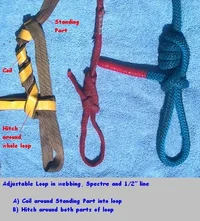
For years the excellent The Lay Hands Knot Site has been putting forward the Adjustable Hitch as the best all around hitch. They might very well be right. The hitch forms a fixed eye; that can shrink or expand on the end of a line. This is a form of that construction to me. But, i don't think the author thought of this type of use! The Adjustable is a very, very good hitch; very well tested; even does it's tricks in (1") flat rope/ webbing very well.

Founder/ 1st president of IGKT, author, updater of the ABOK bible Geoffrey Budworth put the strength of the Adjustable Hitch in the 80%+ class i believe. Usually that category seems reserved seating for the renowned Fig.8 family; with about only splices, Tensionless Hitch and Double Noose/ Scaffold/ Double Fisherperson's/ Anchor to self whatcha-ma-call-it earning higher 'grades'.

This Shannon for climbing does alter the host line tensions that hitch slides on(and adds another turn/ring on tail) compaired to Adjsutable; but perhaps to our benefit. Usually, 1/2 the load weight is on the hitch and 1/2 the load weight is on the line thru and below the hitch(in the direction of hitch pull); and full host line tension above the hitch. So the adjustable pulls into a line 'skinnied' by tension. In this Shannon on DdRT; the hitch only gets 1/2 the loading; but because of the DdRT, not because of pulling into it's own eye. So, the line above hitch is half loaded (instead of full loaded in Adjustable Hitch); and line below hitch, that Shannon pulls downward into has no load/ tension(where the Adjustable has 1/2 tension on that part of the line. So the no tension below Shannon, leaves a fatter line/ shelf to sit bottom of hitch onto to secure; compared to Adjustable Hitch.

Those skeptical about climbing might ask themselves how much tension is on the top tier/ right before the Bitters of MB's Tautline hitch. Most is in the bottom tier/round turn of uninterrupted turns in the same direction. This Shannon like the Blake's/ pro-Grip has 4Turns Continuous (Coil) mechanics that it pulls down into, instead of the 2Turns of the Tautline(so looks like Blake's; disturbs the bottom 2 turns like Blake's; but pulls down into the turns like Tautline, and has more turns). It does secure itself/ siezes it's own Bitters like an Adjustable, at the finish of it's Turns/ with least loaded end of turns(so can be considered s-lightly less secure than Blake's; but anyway a stopper knot makes small point mute i think); whereas the Blake's sit's on it's own Bitter End with the most immediate/ initial/ full loaded turn like a trusty ol'Anchor Hitch ; only after reducing tension in Bitters with 2 more turns (in truer Baby Holding a Bus Imagery)than an Anchor Hitch. Thus a Blake's resembles a 4Turn Anchor Hitch that the Bitter End/Tail is only under the 1st 2 turns; that are the fully loaded/ most securing turns anyway.

i've used Shannon in 1/2" as all-in-one or split tail; even in a selvagee 1/2" (core removed from 1/2" to have minimal drop in tensile; with a flatter/ tighter grip and less leveraged loss of tensile strength, due to less resistance to bending and flatter profile on bent axis around tight bight of diameter of host life line); but then i like 3/8" Tenex for same reasons in a closed hitch.

Shannon worked great, but i always liked the twin leg/closed hitches better personally. It works okay like that too; even self tends some; but not as well as Sailor Gripping/ Icicle etc. if using a closed hitch anyway IMLHO.

Great find!

edit: attatching older pic of Adjustable Hitch in different materials.

 

Attachments

  • 82956-AdjustableFixedLoop.webp
    82956-AdjustableFixedLoop.webp
    102.8 KB · Views: 95
Re: Outlawing friction hitches

[ QUOTE ]
the Adjustable Hitch ... This is a form of that construction to me.

[/ QUOTE ]

I think you are right Spydey. The Shannon has the same form as the Adjustable Hitch.
 

New threads New posts

Back
Top Bottom