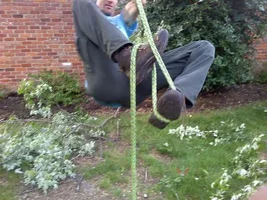
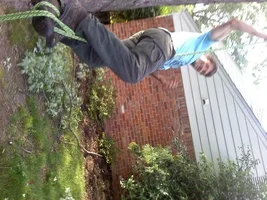
Footlocking technique...

I agree everyone should learn to master the double line footlock technique as well as all the other basic climbing knots/etc. before exploring other gear/ techniques! I would much rather footlock SRT and pick up half the rope weight or srt with two hand ascenders Jumar style or go further and explor all the other options that require less effort, for example who wants to double line footlock up a 100' Euc, when SRT techniques are way less effort! A raptor is even less effort! Why use two lines when one is more efficient!!!!

X-man
 
[ QUOTE ]
...Here's a 'for example'. Ron says [ QUOTE ]
even tried cheating, i.e. an Ascentree and two Pantins, and I was NOT impressed with my perfomance on that.[/i]
Well, that's no surprise. That's predictable. You give up rope control using pantins, especially the first 20 feet and the other reasons blinky mentions....

[/ QUOTE ]

[/ QUOTE ]
My Pantins start to feed within 10 feet. From that point on efficiency becomes interesting. The Pantins require no body rock, less stomach muscle involvement, far less leg and rope coordination.

It took me one try to get the hang of the Ascentree and Pantins; by not being impressed, I meant I saw little, if any advantage over other methods. - I'm still trying to just figure out how to get a secure footlock that won't slip. That has nothing to do with ascenders, hand placement, ascnender configuration, nothing - just hanging on a rope trying to find some way to secure the footlock so I can stand up without slipping. But that's just me; others may have a completely different experience. But from posts of many, a lot of people seem to find footlocking difficult.

So where are we now? We have those that have tried, myself included and numerous times unsuccessfully, some that have been successful at it, but no longer do it because as they say it's too hard, pitted against those that do this regularly and suggest that 'anyone' can do it. The truth is everyone can't; at least I have not been satisfied with my progress so far. I would quickly submit that possibly the desire to succeed at footlocking is diminished significantly by the availability of other easier to learn, readily available methods. I find myself thinking why do I need this when it's easier to use a ____________?
 
[ QUOTE ]
maybe its your boots Ron.

[/ QUOTE ]
LOL - I think it's just me.
tongue.gif
Actually I think Dave mentioned the boots once too.

And I do want to work at it some more (footlocking); it's kind of a matter of finding time when I'm not climbing some other way.

I'd sure impress some of my buddies if I could pull that off though!
 
Seriouly when I first started footlocking I had to do it with boots without mmuch of a heel.After you get the technique down you can probably do it barefoot.
 
[ QUOTE ]
from: Blinky
...
I don't footlock for purity or macho or anything like that (although footlocking is TOTALLY macho and frankly, ropewalking looks kinda ghey) I footlock because it's the fastest, easiest way for me to climb a rope. If I was going a hundred or so feet all the time I'd want to be Wraptoring or ropewalking but going 50' by footlocking with ascenders is quick and easy.

[/ QUOTE ]

Great, great point!!!

[ QUOTE ]
from: Crazy Jimmy

maybe its your boots ...

[/ QUOTE ]

... been following this tread for a long time (with great interest) and have one question that I don't think has been asked. It's about boots. I know, when working, my boots are almost always a mess - covered with chips, bar oil, snow, mud, and on and on ... sometimes even manure!!! For ALL the 'pro' working footlockers (Tree Machine, Blinky, Crazy Jimmy, ...etc., etc.):

How do <u>you</u> deal with the mess that often collects on boots and still footlock???

... and NOT trash your rope???
 
Man Ive had mud,clay,water even dog poop going up my rope and it sucks.Earlier today I was going to footlock up maybe 30 feet and noticed i was in solid mud.What to do, I got a groundman to grab me a ladder I just didnt really wanna deal with it today.I could have put my frog walker on but by the time I did that I would have waisted another 10 minutes diggin it out of my bag and putting it on.Not a very good answer but I really dont know what to say when its muddy its usually muddy all over and I dont like waisting time tweeking with my boots.
 
would the backup in the picture work if one ascender failed while the other one didnt? my understanding is that the prussic would slip if only one ascender held....
 
This is a technique that can be helpful to keep the rope from slipping for beginers. Its an extra lockoff by wraping your toe around the line to double lock your lock. it wont slip anywhere and will help you get more dexterity in your feet so you can play with the rope some.
 

Attachments

  • 231276-footlocklock.webp
    231276-footlocklock.webp
    51.9 KB · Views: 125
[ QUOTE ]
I would much rather footlock SRT and pick up half the rope weight or srt with two hand ascenders Jumar style or go further and explor all the other options that require less effort, for example who wants to double line footlock up a 100' Euc, when SRT techniques are way less effort! Why use two lines when one is more efficient!!!!

X-man

[/ QUOTE ]

Earlier I stated I ascend twin line, unless I find it more of an advantage to go SRT. Well, I've dedicated this last week to climbing 100% SRT. This way, in knowing both modes of ascent, I could pour thought into the pure SRT side and look at where and why an SRT ascent might be less or more of an advantage.

The "GO SRT" guys, it seems, are comparing SRT to the 2:1 DdRT and in all instances I would agree, entirely and without question with SRT being more efficient, but for one reason trumping all others; 1:1 vs. 2:1.

In comparing / contrasting 1:1 twin line vs. 1:1 SRT, however, I feel the "GO SRT" guys might be making some assumptions. X-man asks "Why use two lines when one is more efficient!!!!? Well, because two lines gives the feet twice the rope and twice the friction available for securing. As far as 'weight' and 'lifting', twin line work begs for 11 mm line, as 13 mm just becomes excessive. The difference in weight between single 13 mm and a twin 11 mm really isn't a whole lot and yes, the weight increases the higher up you go, but realistically, you generally only footlock until you get into the crown, then you climb the tree and advance and tend your friction controller along with you as you climb the tree. Efficiency then becomes a matter of how easily slack can be tended.

[ QUOTE ]
I'm still trying to just figure out how to get a secure footlock that won't slip. That has nothing to do with ascenders, hand placement, ascnender configuration, nothing - just hanging on a rope trying to find some way to secure the footlock so I can stand up without slipping. But that's just me; others may have a completely different experience. But from posts of many, a lot of people seem to find footlocking difficult.

[/ QUOTE ]
Many people try footlocking 2:1 DdRT, calling it double line (which means two ropes, not one doubl<u>ed</u> rope) or use the term doubled rope, of which there are <u>two</u> doubled rope techniques, 2:1 DdRT and 1:1 DbRT, also called twin line, or doubled static. In comparing, you need to understand exactly what is being described. If you're having trouble footlocking 2:1 DdRT, that should not be a surprise. In fact it should be expected for two major reasons; the inherent inefficiencies with ascending a 2:1 system, and in 2:1 DdRT it is doubled rope in front and above you, but it is single line as far as your feet go. Unless the climber states they are using a dual ascender, you can almost be assured the doubled rope technique being described is 2:1 DdRT.

Twin line ascent with paired (or) dual ascenders is the only rope technique that offers the advantage of double friction through the feet, but requires a dual ascender. The ascender is nearly friction-free so there is little difference there between twin ascent using duals and SRT using a single ascender. The grip diameter on twin rope, by your hand, is twice that of single line, another plus for many, especially you big-paws.

In my last week of 100% SRT on all climbs, my feet slip more because of half the amount of rope friction I am accustomed to, especially the two day of rain climbs. This means I have had to slow down, focus more and really pay attention to my boots gripping the rope and where the rope was laying across the boots to prevent slipping, which, as far as efficiency goes, is a deal killer. Wet boots and rope made it worse.

Men, I love SRT. But tree work being as hard as it is to begin with, I just can't help but gravitate toward the easier method. I feel that with the single handled dual ascenders I use, I WORK WITH AN ADVANTAGE IN EFFICIENCY AND OPTIONS THAT THE REST OF YOU DON'T. Since I derive all my income from climbing, I should really care less about what the rest of you use. But I DO care. Your frustrations come through. I know how easy footlocking can be, so to read about the problems you experience, I feel the pain. We are all one, in the sense of being a professional community.

And I know that I am one of only a few on this planet mining the benefits of twin-line ascent because the single handled dual ascender does not currently exist in the market. You can cut the backside handle off the Kong Trender, or pair a left and right ascender together yourself, like Blinky has done. Otherwise you simply can't experience these advantages firsthand, I'm sorry to say.

That being said, the 'GO SRT" guys, touting the advantages over twin line, you realistically just can't know the differences.

 
Ron, I'm sorry, I failed to answer your question:
[ QUOTE ]
I'm still trying to just figure out how to get a secure footlock that won't slip. That has nothing to do with ascenders, hand placement, ascnender configuration, nothing - just hanging on a rope trying to find some way to secure the footlock so I can stand up without slipping.

[/ QUOTE ]

Try this, I mean right now, where you are sitting.
Look down at your feet. Place them EXACTLY side-by-side. The inside of your heels should touch and the inside, below your big toes should touch. Now move your right foot a little back and your left foot a little forward. Notice how they 'nest', how the curves of your right and left foot now parallel each other?

That is more or less how the feet should be positioned during the footlock; no high spots, no voids. This allows the rope to pass over your foot anywhere from the front of the ankle to the toe, and you will get a grip. It is up to you to find the 'sweet spot' that offers you the best performance with the boots or shoes you wear.

If your feet are exactly side-by-side, you have two places your feet can clamp rope; up below your big toes and the inside of your heels. The inside of your heels simply is not an option, leaving only the point below your big toes to create pressure, an exact and precise placement. This is possible, but difficult and requires focus and attention.

Stagger feet slightly, it then matters less where the rope passes over and under your feet. Then, with that front-to-back stance, try elevating one or the other of your feet slightly. The down-rope foot being higher will give a more pronounced S-shape to the rope and conversely, if the up-rope foot is slightly higher, then the S-shape passing over the boots is less pronounced.

I use the former with SRT and the latter with twin line ascent. With twin line you can be more sloppy and get the same gain. Remember, 2X the available friction. This is physics talking, not me.
 
the real problem with twim line acent for me is

1)Isolating limbs. that sucks. and is a waste of time.

2)transitioning to work. Unless you work off a prussic with a separate rope in that manner that lots of people do for ariel rescue, it is a pain to Lanyard in, undo yourself from the twin line, pull up the tail of your line, tie your hitches.........


I was sold on SRT after isolating limbs. to hell with all that. After that it has just become a habit. I also like being able to switch quickly from ascent to descent without having to lanyard in and do all kinds of rigamaroll. I like to just be able to step off and go to work.
 
[ QUOTE ]
Isolating a limb can be a hassle. I think Kevin is just saying that not having to isolate your line to ascend is a benefit of SRT.

[/ QUOTE ]

I see it as SRT ascent as a nice option to have if isolating a limb/tracing your line is a hassle, which sometimes it is.

Another beauty of the dual ascenders, twin line or SRT, they go both ways with equal ease. Or 2:1 DdRT or 3:1 Z or any versions or combinations thereof.


I have long felt that tree climbers should be the best climbers in the world. The reason? We do it day after day, all year round. It's not a hobby, or a sport. It's how we make a living. Our climbing opportunities are all around us, close to home and the better we are at climbing, presumably the more money we can make doing it. By virtue of that, we should have more motive and get more practice and than any other climbing discipline out there.

To be the best climbers in the world, I feel it imperative to not only understand the three distinct rope techniques, but be able to utilize each of them and know them firsthand. It's not as much of which is better, but knowing which is better when for the particular tree at hand, and being able to interweave in between them if the advantage calls for it.

This also would allow the tree climber to meld seamlessly into search and rescue efforts, tower climbing, caving, rock climbing and really any climbing/rope work discipline out there. In DdRT, you stay isolated. Everyone else is SRT. To be all three, though, call me crazy, seems to lend an advantage if nothing more than having extended versatility and options.

So, to those resistant to new approaches, I invite you to at least see the sense in becoming versed in how those differences can serve you, and what gear is needed to practice the three rope techniques. There are only three, and a varied array of different versions and modifications within the three. It's not a lot to grasp.

My apologies for diverting from our topic of footlocking, except to say, footlocking can be integrated into any of the three rope techniques.

I hope you can see, this is not about me. This is really about our profession as a whole.
 
if you actually think about it, you lift the rope when your bottom foot pulls up and wraps around the top foot. This becomes very apparent on doing long ascents. The rope becomes very heavy once you pass the 60 ft mark, which only means, by laws of commen sense, that it is heavier all the time. The only disadvantage I see with srt footlocking is you have to be more precise with the art of the footlock, because the lack of friction is an enemy. Overall it can be looked at as a personal preference.
 
[ QUOTE ]
The rope becomes very heavy once you pass the 60 ft mark, which only means, by laws of commen sense, that it is heavier all the time.

[/ QUOTE ]
The question to that point is, what diameter rope are we talking about 13 mm or 11 mm? and are we talking twin or single? Twin 13 mm or single 11 mm are substantially different, weight-wise, regardless of height.

Footlocking up 13 mm SRT is easier than footlocking SRT up 11 mm. That's simply because there's more meat to a 13 mm rope, more rope surface area, that is. Here we compare SRT to SRT and 13 mm vs. 11 mm. We know what we are comparing, a bigger apple to a smaller apple.

Footlocking a twin 13 mm is going to be twice as heavy as a single 13 mm. We know what we are comparing, two apples to one apple.

Footlocking 13 mm SRT vs. footlocking 11 mm twin line really can't be compared, directly (apples vs oranges) since they are different in a number of ways and precise weights of the ropes and total available surface area need to be taken into account for there to be a clear comparison at all. These physical factors would ultimately determine 'personal preference'.

[ QUOTE ]
The rope becomes very heavy once you pass the 60 ft mark, which only means, by laws of commen sense, that it is heavier all the time.

[/ QUOTE ]
Treebeard states the added weight of the rope, the higher you go, becomes heavier all the time, basing it on the law of common sense. Actually, this one follows the law of gravity. Stating the rope becomes 'very heavy' past 60 feet, but we don't know what diameter of rope we're talking about, or is it SRT or twin line? I don't like to assume what exactly we're talking about, but it is safe to say that any rope, regardless of diameter, regardless of whether its wet or dry and regardless of single or twin line, becomes heavier with each and every advance.

Is this good or bad?

Well, definitely good to start out with because we depend on the pressure of the rope over the top of the second foot-and-down to create a downward force over the top of that foot to give that much more friction to the overall S-shape of the footlocked rope. Friction is a direct function of rope surface area touching the boots, and the weight of the down-rope pulling downward over the up-and-over foot which enhances the amount of friction available to that surface area of rope. Weight is an advantage, and can make up for diminished surface area. Again footlocking benefits from additional rope weight below you and the benefit of that increases as you gain altitude. You want the weight, especially during ascent down low. It helps.

At SOME POINT, not necessarily 60 feet, but somewhere, the benefit of the added weight each and every stride is overcome by the disadvantage of the increasing effort of having to 'lift' the rope with your bottom foot. This would be called 'the point of diminishing returns', the point past which the down-rope weight advantage becomes more of a hindrance, erasing the advantage in place of added effort.

This point will not be at any particular height. It will be a factor of a combination of things; twin or SRT, rope diameter, rope wet or dry, type of footwear and mostly, technique. If you're using the exact same foot technique way up high as you did way down low, you're gonna meet the point of diminishing returns somewhere along the line. However, if you modify your footlock to accommodate the added weight (way up high) you can use the added weight to your advantage. Adapt your method. Know that this added weight requires a less full and complete and precise footlock, a shallower S over your feet, easier to apply and faster because of less overall motion.

I would go as far as to say you can get away with a sloppier footlock the higher you go.
 

New threads New posts

Back
Top Bottom