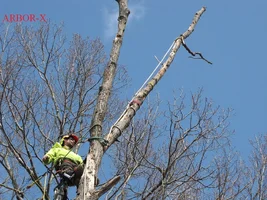
fishing pole

KevinS

Branched out member
Location
ontario
I am working on making some new and different light duty rigging gear.

My question is if i have a 25' eye to eye sling choked low down on a section then marled every 6'-8' then finally the other eye is dropped through a crotch at any needed height would that pull strength from the stem kind of like the fishing pole technique?

Sling lengths could be anything same as distance between marls. Would that spread the load lower down or would it be only as good as the top marl?

I'm trying a knotless approach that is not very gear intensive and thought this has potential but I've only had a chance to use it on very light limbs. Of course there would be a block at the upper eye to run the rope through.

Any comments are welcome

Kevin
 
I just picked up some 2 3/8" steel rings to splice at the ends, rated at 1100 lbs swl I'm going to try.

How long do the slings have to be to make a fishing pole effect? I know more the better but is 8' or 10' long enough?
 
it really isn't going to strengthen the stem any noticeable amount. However sometimes on split trees, like a lightning strike it will pull together a little bit.

however this is great to do on brittle dead trees because you might break out the rigging point or break a limb up that your are Lowering , but the many marls will keep it from falling to the ground if it breaks
 
I am with X on this one.

What spreads the force in a true fishing pole is the fluidity of the lowering line traveling in a path along the stem as opposed to a reaction force in another direction.

Tony
 
There are two different marls. Each has its place depending on what you have planned.

Marline Hitching is a series of overhand knots. This will hold broken pieces together if the limb/tree fails.

Half Hitching will spill if there's a break. The advantage of using HH is that it will tend to snug down onto the limb easier than MH. HH is quicker and easier to tie/dress/set.

Marline or Half???
 
TJ

Read the links. All of the explanation is there. Or get out your. Copy of Ashley's Book of Knots...you do own it don't you? ;) or maybe another knot book. Or, have google help out.

What are you missing? It's hard to guess if you don't ask a question :)

I remember learning the difference by using a pencil
And old shoelaces
 
so marling down the stem with a sling wouldn't help strengthen anything on a solid sturdy tree. so its just as good as a high set chocker?
 
Kevin, it's a nice thought and great that you posted it and was thinking.
But, the tree would likely break and separate before the sling got tight enough.
 
I still do what you explained to a thin rigging point, just in case one day I ever break one out.

Here is something related to it. I do it on brittle pieces that I rig down. That way, if they break up, they still stay together. Do it with crane slings too on crane picks.

371474-IMG_9185Small.jpg
 

Attachments

  • 371474-IMG_9185Small.webp
    371474-IMG_9185Small.webp
    276.7 KB · Views: 33
cool thanks xman one other question for you is your new rings you say not to use a single ring as a rigging point because you've broke ropes but at what sizes and weights did they break at?
 
ridiculously high weights and shock loads. But that's what we had to do to find out where the rigging rope would break. I wanted to see the rope break at the knot or marle, not at a ring. Yes, you are not going to see a rigging rope break at a single ring when taking normal pieces and not shock loading. But me being extra cautious, states; don't use a single ring as a terminal rigging point. Heck, people are using thin steel biners all the time, those are really hard on a rope. An XRR is way wider and nicer on a rope.
 
treestuff.com can send them lickety split all over the world. Try luke at tree stuff. He will get them to you cheap. Tell him theXman sent you.
 
X man wondering do all the rings have the same swl it's just the slings that change or does small or large make a difference?
 

New threads New posts

Back
Top Bottom