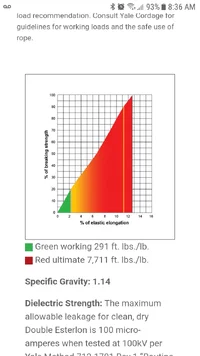
Thanks. Twas very interesting (for a geek) reading. I am reluctant to quibble with Yale, but I really think their approach is a bit goofy. It is certainly possible to state the breaking strength of any rope in terms of energy; you just multiply the breaking force times the distance the rope stretched. But that stretch distance, of course, depends on the rope length, or, in Yale's usage, the weight of the rope. Thus they must end up dividing by the weight.
So (really geeky alert) here is what I think Yale is doing. They have that apparatus that allows them to drop a known weight from a given height. They do that for several thicknesses and lengths of rope and come up with an energy of free fall (in ft-lbs) that breaks each rope and then they divide by the weight of the rope. That's an easy test, and the number can be used in their (misguided imo) calculations so they just state that number.
My big quibble with them is that their calculations (found at
http://www.yalecordage.com/featured-industries/arborculture/dynamic-energy-arborist-rope ) completely ignore the gravitational energy released as the rope stretches. It is MUCH more than the 1% effect that they claim. To see this, take an extreme case. Suppose you tie off a 3000 lb log (which may be below the working strength) such that it did not fall any distance before starting to tension the rope. The energy of free fall is 3000 * 0 = 0, which Yale claims is the same as the rope's energy absorption and which the rope could certainly handle. In reality when you released the log, it would greatly stretch the rope until a restoring force of 6000 lbs was reached, which could be above the working strength. 1% is just silly.
(Finally, Yale's sample calculations are pretty sloppy. They either have serious typos that leave out a decimal point, or they are multiplying by 100 instead of dividing. Their units are wrong (using ft-lb instead of ft-lb/lb) and the data they use for the polydyne rope energy absorption (1040 ft-lb/lb) is inconsistent with the value in the rope specs (576 ft-lb/lb). Not their best engineering foot forward here.)