Fall factors

Tom,

Do you know what the stretch or energy-absorption ratings are for arbo ropes? I've never seen such specs.

I know there is a dramatic difference between dynamic rock-climbing ropes (usually limiting shock load to 9kn) and static rescue ropes (up to 18kn). And that is why all fall arrest systems are required to include a shock absorber.

- Robert
 
You would have to look up the specs on the manufacturers website.

Something that I've wondered when considering FF in a DdRT system is how the impact load changes since the climber is supported by two ropes. Well, two legs of one rope really. I understand how the friction at the TIP changes the load on each leg too.

Let's say a climber is using an ART Rope Guide. With this, the load should be pretty closely balanced on the two legs. Would the final load on the climber after a X? fall factor be different than on a single leg of the same rope?

Another issue is the shock absorbing ability of the friction hitch. There will be a bit of slippage at the hitch which lowers the final load.

Since there are so many variables I wonder if any kind of rule of thumb could be formulated.

All of this is kind of moot though, since most arbos climb with relatively snug ropes. Over the years I've seen very few arbos who leave much slack in their system when they are exposed to a fall or swing. Also, its rare that we climb above our TIP. There are special procedures for setting backups when we do too.
 
My apologies. I obviously do not know how to express myself without sounding offensive. But I need to back out of this discussion since I cannot express my views without offending Tom.
 
</font><blockquote><font class="small">In reply to:</font><hr />
Something that I've wondered when considering FF in a DdRT system is how the impact load changes since the climber is supported by two ropes. Let's say a climber is using an ART Rope Guide. Would the final load on the climber after a X? fall factor be different than on a single leg of the same rope?

[/ QUOTE ]

In a sense your fall factor would be halved because there is twice as much rope in play and, as you suggested, there would be some dynamic slippage of the friction hitch (much like a dynamic belay for a falling rock climber).

- Robert
 
It's very valid to think about energy absorption of all components of our climbing systems. There are lots of common aspects of working on ropes no matter what the discipline.

Did I miss something? Where did RR become wrapped up? Delving into the finer details of our systems should result in a better understanding. Having a non-arbo willing to participate in this discussion is incredibly valuable. At least to me.

Why brow beat and get so upset?

More and more arbos are starting to use non-arbo ropes in trees. This is mostly for access but I have talked with a couple of arbos who use semi-static gym ropes as their climbing line in the tree too. There are some real advantages to using these. Keep an open mind, you stand to learn something here.

I get a chuckle reading threads on AS about modifying chainsaws. People get into very detailed explanations about the power and speed gain from the mods. No doubt the mods do work. But when the same detail is used when examining climbing systems, it gets swept aside as meaningless. Mod'ing a saw so that it will make a cut a fraction of a second faster makes me wonder if maybe life is going by too fast :)
 
Aw come on Rocky, sometimes I think you just like to be argumentative.

How often do you use a 3" branch for a TIP and out far enough that it would have some "spring"?

If you use a crotch as a TIP, then it's little different from a top-rope anchor at a rock climb (which is often tied off to trees on long webbing slings).

And, if you're talking about falling while lead climbing on rock, then there are (should be) numerous intermediate anchor points, each with a webbing sling, to help absorb the shock.

So, if anything, I would say that falling in a tree creates more shock load than falling on rock, and with ropes that are a lot more static. Which is why, I'm sure, you arbos don't generally climb above your TIP. There's also more things to hit on the way down.

- Robert
 
My friends and I climb rock down at the Red River Gorge in Kentucky alot where the rock is really steep. So when we take a 20 or 30 foot lead fall and it is safe to do so the belayer will jump when the climber nears the end of the fall. This helps absorb the fall tremendously and also keeps the climber from swinging into the rock which can sometimes break their ankles. Its always best to reduce the impact of any fall as much as possible.
 
</font><blockquote><font class="small">In reply to:</font><hr />
So when we take a 20 or 30 foot lead fall and it is safe to do so the belayer will jump when the climber nears the end of the fall.

[/ QUOTE ]

Sounds like you're talking about single-pitch leads? And the bottom belayer isn't tied in to an anchor. Sure couldn't do this from a belay station on a multi-pitch route!

So I'm not sure what the point is other than giving the belayer a free ride (I've been pulled off my feet belaying a top-rope climb and almost tossed into the rock face - I didn't let go of my brake hand but it could have been a disaster).

If good belaying technique for traditional multi-pitch routes requires catching a lead fall while anchored into the rock against uplift, then why not practice the same technique for single-pitch leads and top-roping?

- Robert
 
</font><blockquote><font class="small">In reply to:</font><hr />
Isn't this what's called dynamic belaying?

[/ QUOTE ]

Well, yeah, but it's controversial. If you're letting a chunk run, do you hold the rope and leap up in the air toward the Portawrap or do you let some rope slip through your gloved hands?

Well, you can do dynamic belaying just by allowing some rope to slip (if the climber isn't going to bottom out into something). You don't have to take a flying leap.

- Robert
 
Hi Robert my friends and I do not climb trad and also we have never climbed multi pitch. When I am belaying I will sometimes let the rope run like when roping a log but my climbing partners have no tree work experience so after talking to some more experienced rock climbers from the area where we climb I decided to teach my partners this technique for "soft catching" a fall. The Rock we climb on is extremely steep, sometimes up to 50 degrees overhung, so in those situations the belayer doesn't get pulled into the rock face. In fact sometimes the belayer goes up to the first bolt. And as I said we only do it when the situation is warranted and safe to do so. We act similar to a pre climb discussion and talk about the route and any problems we can see or any diffaculties that we know about if we are climbing a route that we have climbed before so the belayer is prepared for using this technique if it is safe to do so.

Brian
 
</font><blockquote><font class="small">In reply to:</font><hr />
In a sense your fall factor would be halved because
there is twice as much rope in play and, as you suggested,
there would be some dynamic slippage of the friction hitch
(much like a dynamic belay for a falling rock climber).

[/ QUOTE ]

There may be twice as much rope in play, but only half the load in
each leg.
 
Something I never see addressed in these hypothetical discussions is anyone accurately describing real-life, realistic situations where a tree climber might fall in such a way as to create a 'fall factor' on the lifeline. The only way for this to happen is on a conifer type tree, where the climber goes straight above his tie-in for an extended distance. I don't have those types of trees here, and have rarely climbed anything where I would be directly above my tie-in instead of off to the side.

A much more realistic situation is losing balance when limb walking and swinging back into the trunk of the tree. In this situation, all the shock absorbing devices in the world aren't going to reduce the impact of your face hitting the tree trunk. None of your injuries will have anything to do with the shock absorbing qualities of your lifeline.
 
</font><blockquote><font class="small">In reply to:</font><hr />
There may be twice as much rope in play, but only half the load in each leg.

[/ QUOTE ]

Actually, the fall factor wouldn't be halved.

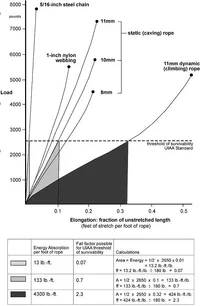
The easiest way to look at this is: you'd be falling on a double rope as if it were anchored at the TIP (for the moment ignoring dynamic slippage at the hitch and the TIP pulley). The double rope would have less elasticity (like a larger rope) than a single rope. So there would be less energy absorption and more shock load on the climber.

The only thing that would reduce the shock is the slippage at the hitch and the TIP. But I don't suspect it would be enough to prevent a very significant shock load.

- Robert
 

Attachments

  • 9845-Fall Factor Impact Loads.webp
    9845-Fall Factor Impact Loads.webp
    38.9 KB · Views: 77
I think that you just nailed it here Rob. I've always had discussions with climbers who would take the position posted earlier- twice the line in the system and half of your weight on each = less shock on the climber. I've always thought that it would be similar to top roping with two separate lines. To me, it would seem that there would be less energy absorbtion by the rope in our case.

If our biggest problem was to absorb energy during a fall, then maybe tree climbing would be better satisfied by using a dynamic 9 mm line instead. It would be very tough to advance up a tree though with all of that bouncing, not to mention impossible to use your hands to acend.
 
On the old ISA forum we thrashed through this subject. One solution to reducing the shock load would be to have a screamer built into the false crotch. It wouldn't be a break away though :)

Or...would it be better to put the screamer between the end of the rope and the saddle.

Or...between the friction hitch and the saddle?

All three would effect the shock load differently.

All of this is a bit academic though since most arbos don't take lead falls. More likely to get banged up in a swing like Rocky said.


Tom
 
Robert--A few years back I was working up some rope comparison info for a US Forest Service training document, and I got some data on elongation under load from several manufacturers. Here are a few examples.

Samson gave me these easy to understand numbers:
Samson True Blue 1.02% under 200lb. load, 1.65% under 400lb. load, 2.24% under 800 lb. load.
Samson Blue Streak 1.1% under 200lb. load, 1.96% under 400 lb. load, 3.25% under 800 lb. load.
Samson Arbor-Plex 1.01% under 200lb. load, 1.75% under 400lb. load, 2.72% under 800lb. load.

Wall sent me a graph showing stretch under 5, 10, 15, 20, 25, and 30 percent of breaking strength of a dozen ropes they make. A couple of arbo ropes, both with 7000 lb. breaking strengths, are included. A bit of interpretation was required as the graph was small, but it worked out to about the following:
Wall Tree Pro 1.0% at 350 lb. load (5% of bs), 2.0% at 700 lb. load (10% of bs).
Wall Tree Perfect 1.75% at 350 lb. load, 3.25% at 700lb. load.

Yale sent me a hand written fax that was confusing to me in some regards, but likely makes sense to the rope techs out there. I'll just quote it, and hope for a full interpretation from you.

"--Yale XTC--34% elongation at break
--Initial stretch--2.7% at 200 lbs.
--at 50 lbs with permanent elogation 7.6%
--at 200 lbs. after perm. elong. 7.9%-7.6%=0.3%
200lbs. after elongation=0.3%"

 
Tom,

If you're talking about a Yates Screamer, designed to limit the shock to anchors, I'd recommend instead an OSHA approved fall-protection shock absorber (like in attachment) designed to limit impact force to 900 lbs.

They are available either integral to fall-arrest lanyards (but those are generally 6' long - could be used as false crotch?) or seperately with snaps or webbing loop terminations (about 16"-22" long).

I would think that placing them between the harness and rope end would make the most sense, because it would absorb shock on the fixed end while the hitch absorbed shock on the falling end.

- Robert
 

Attachments

  • 9853-shock-absorber.webp
    9853-shock-absorber.webp
    1 KB · Views: 36
Also, I want to throw in with Rocky J here on real life tree climbing falls. Even in conifers, which are my nearly exclusive domain, a true free fall from above your TIP would be very unlikely. As Robert correctly observed, you hit things on the way down, and usually would start hitting limbs right away, never really doing much free dropping until your lifeline hauled you to a stop.
I'll also back Rocky in agreeing that in his type of tree, he will indeed often be tied into a springy TIP, and will get relief from shock from it. There is no comparison between the solidity of a rock anchor and the bounce in a tree TIP of this character. In this respect I think Robert is incorrect. None of this keeps me from making the choice, as I most emphatically do, to use a fully dynamic rock climbing kernmantle as my lifeline in all climbing above my bombproof TIP. I want as many factors leaning in my favor as I reasonably can :).
 

New threads New posts

Back
Top Bottom