TheTreeSpyder
Branched out member
- Location
- Florida>>> USA
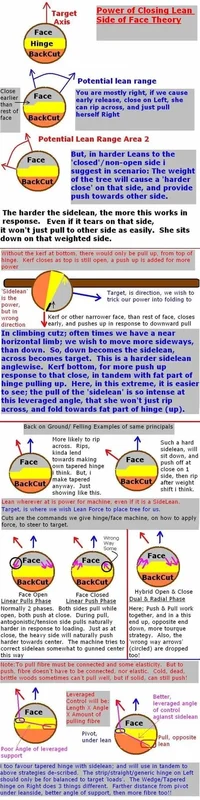
This started as discussion betwixt Mr. Burnham and mys-elf about closing or ripping Lean side of Face before/across to the other.
It takes force to steer a tree or branch. All forces are either pushes or pulls. Mostly we seem to capitalize on just pulls, as push comes at close; often too late in the motion for a lot of help. This asks how to capitalize on push too, then how to use push and pull in tandem to target, not seperately. Then like a rowboat, can i push on 1 side, while pulling on the other, for more of a powerfull tourque than just linear input of forces from my efforts. Linear is more direct, shortest distance; tourque always takes a longer route, engaging distance multiplier to your input.
Employing more power like this, also calls for more cautions. Though i express in mostly felling, as hinging is generally shared; i use more in climbing. this gives more severe angles of sidelean (horizontals; making strategy work better), are lighter/safer loads, and more chance that load is going to move away from you(horizontals), not be over you. Barber chair is usually from a push back across full face, this strategy i present just pushes back on one side, offering other side as releif (which tree will sense and move towards, as it seeks path of least resis-stance).
Barber Chair warning and more on this type of strategies
More Theories
It takes force to steer a tree or branch. All forces are either pushes or pulls. Mostly we seem to capitalize on just pulls, as push comes at close; often too late in the motion for a lot of help. This asks how to capitalize on push too, then how to use push and pull in tandem to target, not seperately. Then like a rowboat, can i push on 1 side, while pulling on the other, for more of a powerfull tourque than just linear input of forces from my efforts. Linear is more direct, shortest distance; tourque always takes a longer route, engaging distance multiplier to your input.
Employing more power like this, also calls for more cautions. Though i express in mostly felling, as hinging is generally shared; i use more in climbing. this gives more severe angles of sidelean (horizontals; making strategy work better), are lighter/safer loads, and more chance that load is going to move away from you(horizontals), not be over you. Barber chair is usually from a push back across full face, this strategy i present just pushes back on one side, offering other side as releif (which tree will sense and move towards, as it seeks path of least resis-stance).
Barber Chair warning and more on this type of strategies
More Theories