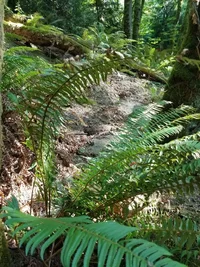
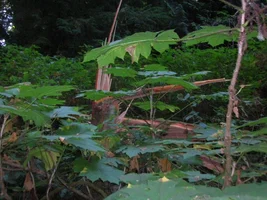
Exploding alder

Hiking up the S. Canyon trail at St. Edwards outside of Seattle, I heard a gunshot or a firework but saw a tree coming down abruptly and near vertically. Weather was clear and about 75 F. The 18" Alder did fall across the trail. The Park personnel are at a loss to explain why a tree would explode at its base. My buddy spent a career in forest management and has no explanation. Apologies, I'm not an arborist although I've employed enough of them in my time.DSCN1400 (Medium).webp
 
Could have been damaged by a falling tree, but stayed upright, and gravity continues 24/7.

I worked on a maple that had a huge lower trunk that I didn't know until mid-removal to be damaged from an upper leader blowing out 5 months beforehand. Standing damaged. That tree had a huge included bark leader blow off unexpectedly, 30 minutes after the baby had been swinging in it. Gravity plus defect, possibly with Sudden Limb Drop tendencies.
 
Clear weather lights IMG strike? I observed this happen one time. Lightening struck tree then flashed to the house and caught it on fire. Absolutely clear day.
I saw and heard the alder fall. The explosion I heard could well have been lightning but there was no flash reflected off the ground I was facing. The steep slope has an elevation gain of 450' from the Lake and this alder was only 50' or so up. I inspected the following day but the portions on the trail had been cut away. I observed no charring in what I could see. Arguably, the sap and moisture in the base was electrically heat flashed into expanding steam and it blew up. While this is a very good theory, lightning is not a recognized hazard or source of reported injury on a clear day. What is "IMG"?
 
Thank you sir! Your observation and mine sustain the existence of the clear sky lightning phenomenon. My secondary theory of invisible space alien big game hunters with energy weapons but poor accuracy only relied upon the old Schwartzeneger movie, Predator. (Although it was spooky enough that I took a different trail up.)
 
Talked with a Park Ranger and he was confidant of his theory. We had a dry hot spell of 50 days with a light morning rain two days before the tree came down. He said there was another felled nearby. His theory wasn't logical but has the weight of experience and observation. He said the isolated rain was quickly absorbed by the dry crown and drawn down to the base where it exploded because it had not been "backstopped" by more rain. Guy's got a uniform, badge, radio, equipment/pistol belt, and long familiarity with the park; he must be right. I've got to take a look at the 2nd stump as that would rule out lightning. Trail is closed for a week "to remove hazardous trees."
 
Someone please explain the physiology behing exploding trees and rain events.

Theory involve embolism from drought or something? I'm gussing Sudden Branch Drop may be involved but this sounds almost ridiculous.
 
Someone please explain the physiology behing exploding trees and rain events.

Theory involve embolism from drought or something? I'm gussing Sudden Branch Drop may be involved but this sounds almost ridiculous.
What I have heard, is that moisture in the tree turns to steam instantly causing the tree to explode.
 
Mountain beavers [but not like The Sound of Music]
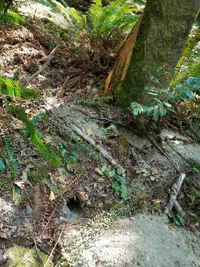
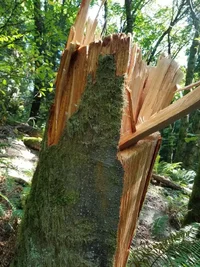
Terry, a gentleman with some expertise has further investigated and I have attached his photos depicting rodent burrows and a close-up of the stump. The Predators here are mountain beavers but there is an issue as to how they felled the tree. To me, it looks like they cut it down. He has a theory in which the burrowing beavers deprived the tree of support. Terry, an architect, writes:
"Keep in mind that mountain beavers are not like the more common beavers in
that they are not evolved to cut down large trees. They live on leafy
vegetation and consequently do not have the teeth for cutting through very
thick wood.
The tree broke off maybe 4 or 5 feet above the ground. I saw no evidence at
the place where it broke off from the stump of any saw, tooth, of axe marks.
There was no rot evident there either.
Mountain beavers are about the size of a big rat. The tunneling under and
all around the tree is very typical of mountain beavers, and the fact that
the tree stump is leaning in the direction of top of the tree that came off
of it makes me pretty confident in my description of what happened: they
undermined the tree causing it to lean downhill. When the lean was far
enough, the tree trunk was no longer strong enough to support the top of the
tree, causing it to break. If you get a chance you might ask one of the park
rangers what they think happened to the tree. I think they will agree with
me. Mtn beav info: http://wdfw.wa.gov/living/mtn_beavers.html "
I suspect any Park Ranger would have a theory minimizing the potential liability of the Park and maximizing his own diligence but I have had the photos printed and will ask.
Watson_Stump.webp Watson_beaversr.webp Watson_burrow.webp
 
Last edited:

New threads New posts

Back
Top Bottom