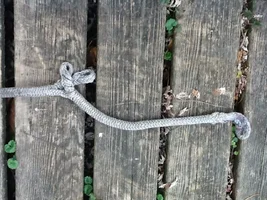
Waldo, I made this sound simpler than it really is. There is an experimental side to my method and a speculative side. And a practical side: I actually have several loops made as I describe, including a some small 1/4-inch Amsteel Blue tethers for hand ascenders which I use all the time.
The speculative part has to do with the manufacturers' splicing instructions. Nowhere do they guarantee that a splice made to specs can never come apart, but I assume that most of us believe that that is the case. They know we rely on their specs, that we hang on these splices, that people use them in ways they never imagined, underwater, in tanks of oil, whatever. It would be very bad press for them if splices started coming apart, so they made the specs so conservative that even under the worst possible scenario a proper splice should hold.
What is the worst possible scenario? This is where the testing comes in. Imagine a proper splice that creates a large eye about a foot long. If you were to test the splice by pulling on the eye with a carabiner or a shackle, each leg of the eye would bear about 1/2 the total tension, meaning only half the total tension is actually trying to extract the bury from the cover. But if you were to sever the cover leg of the eye very close to the throat, then you could pull directly on the bury leg. Now the full tension on the rope is trying to extract the bury, the worst possible scenario for the splice to withstand.
This was the setup I used when I wanted to test splices because this was a pure test of the splice without any interference (and help) from the shackle pin. Whenever the splice was made to spec it never failed by coming apart--the rope always broke first. In order to get the splice to fail I usually had to make it much shorter than spec. And remember, we're talking about the extreme case in which we're pulling directly on the buried core.
From this I concluded that the official specs really are designed to cover the extreme case I described. But we don't know for sure.
Using only one full bury in a loop is a case of the worst possible scenario because the full tension in the rope is trying to pull the splice apart. For the short bury I use whatever is convenient to handle, say half a fid. I thoroughly stitch the throat area of both buries so that even the short bury can hold a lot of load.
Since the official specs don't guarantee us anything, and the manufacturers don't tell us how conservative the specs are, it is up to us to figure this out for ourselves and use our own best judgement.