electric shock

Location
virginia
few weeks ago a climber was shocked to death when his rigging line and limb made contact witha 3 phase overhead. the man was not working for a line clearing company, but doing "side work". he was the 5th climber to die in Va. this year. 4 of those 5 have been in my local area. 3 of those 4 happened after Hurricane Isabel. The news mentioned nothing about the importance of hiring professional arborists to perform safe and proper tree work.

 
Yeah, open the attatchment; take a goood look, lest it happen again...

Originally posted by Dobber
This a pic of an untrained worker after an accident. Look his name up if you like, there is lots to see if you feel like reading. his name was Lewis Wheelan, just started a summer job with a friend of his fathers who owns the contracted company. Took a hit from a fallen conductor, lost his right arm and part of both legs, due to all the scar tissue his body couldnt keep it self cool without air conditioning. When the 2003 black out happened he lost the air conditioning, causing him to slowly overheat untill he passed out and never woke up.


Originally posted by Crofter
I posted this a while back regarding the same incident.

Liability for ensuring Sub Contractors Work Safely

A local utility company was fined $250,000. for failing to ensure that a subcontractor was providing adequate training and following safe work practices. An 18 year old on his second day on the summer job was electocuted when a tree was felled across power lines bringing them down on him. He lost both legs, one arm plus fingers from the remaining hand. He died a year later. The person running the saw for the Neat Site brushing company is on trial for unsafe cutting practices. Tree lean or wind bound the saw and he called two co-workers to push the tree. (no ropes and cutting within 6 feet of other persons) As they pushed he cut some more and I suppose cut the hinge completely off and the tree came over backward taking the lines down on top of the brush dragger. The company was originally hired just to brush but were later given the nod to take down hazard trees.
So I guess just making sure that your sub. has insurance doesn't get you off the hook if $hit hits the fan.

Frank
 

Attachments

  • 8937-Lewis Wheelan.webp
    8937-Lewis Wheelan.webp
    10.5 KB · Views: 175
Some of the safety comments/tips from those who know, respect high power whether that be in tons of wood, or electricity; having worked with both.:

Originally posted by Tom Dunlap :
"A clean, dry rope is not conductive?".<-You'll never get a rope manufacturer to vouch for that!! Over the years of helping at EHAP training I've asked every journeyman lineman if he would ever use a rope or throwline to move a wire. They have all looked at me with "What-are-you-stupid?" eyes. None of them would ever do it so I won't either. This is the best Suspension Trauma (a companion risk to electrical shock) article that I've ever read. This one gives some ideas for rescuer and patient to consider. An arbo buddy who does tower work sent this to me: Mike Holt- "Will Your Safety Harness Kill You" -Tom


Originally posted by Crofter:Something I found interesting at a safety course put on by Ontario Hydro was the fact that electrical lines can move up and down 5 or 10 feet over a short period of time due to load changes on the line. The difference in temperature due to load can change the tension that much. Where you had enough clearance in the morning could put you dangerously close later in the day. Over a certain voltage requires a continuous spotter. -Frank

Originally posted by netree:
That's why lines strung in the summer are deliberately left with some slack, so the line can contract in cold weather without breaking from too much tension. The electrical resistance of the line converts power into heat. This is why energizing a line is called "heating it up" in linemans' slang. How much the line will lengthen/shorten with varying load depends on alot of factors, such as length of span, conductor material, conductor diameter, ambient temperature and the actual load applied.

Lines will tend to lengthen with: Higher ambient temps, Aluminum conductors, High electrical loads, Smaller diameter lines (which have a higher resistance)...and shorten when the reverse is true.

Ropes should NEVER be relied upon to insulate you from electricty. NEVER NEVER NEVER!!!...Dealing with power lines requires special tools, and specialized techniques and training to do it safely. It is a task best left to those qualified to do it. PERIOD.
>It only takes one hundredth of an ampere at less that 1 volt to stop your heart. Keeping that in mind, remember that materials such as wood and rope aren't necessarily INSULATORS, but more usually RESISTORS... cutting the flow of electricity down, but not eliminating it. I can't stress enough how important the right tools and training are required to work around power lines.
>I just think it's far safer to treat anything not specifically marked as being dialectric as a possible conductor......While I have it in mind, alot of guys are under the impression that the black coating on some primary lines is insulation............-->It's not!!! It's only a weatherproofing, and is neither intended as an insulator, or to be relied upon as such. -Erik


Originally posted by the Big Guy- John Paul Sanborn:
Allways tie in so you will swing away...To reinfocre a point from John Ball's lecture on injuries and fatalities. Many that had electrical contact had a rescue of the initial victim, and recovery of the crew member who atempted rescue..

Originally posted by topnotchtree:
I have witnessed an arching demonstration put on by the utility co and the union where the guy drew current through a kite string. He also stuck his hand in a rubber glove and rubbed it all over a conductor, then removed his hand and shoved a raw hot dog in a finger of the glove. Then he poked a hole in the glove finger with a sewing needle. Then touched the conductor with the glove. The hot dog was burnt to a crisp. The voltage was 4800. Line clearance guys do some crazy things, but most of us know what we can get away with safely. First of all we know how to ID the lines and get a pretty good idea of the voltage we are working with. I read somewhere in this thread where someone suggested using a handsaw to remove a hanger from a wire. Although the wood handle on the saw may not conduct, the screws on the handle that hold the blade in will get ya.....As a general rule, the bigger the insulators the more power.

Originally posted by MidwestTree : If you have any questions about powerlines it is useful to attend a class. The power companies give these all the time. Alot to local (volunteer) fire depts. They usually are good programs and you might learn just one thing that could save your life. Even guys that work around them all the time should step back and rethink what they are doing.

Originally posted by ORclimber :It is best to assume you will (get shocked/killed). There are many variables involved....Electricity follows the easiest path to ground. If going through the branch and climber is the easiest path to ground....zap! - Eric


Originally posted by Dobber:There are procedures in place to trimming near energized conductors, If you are not familiar with them then you should not be in the tree.

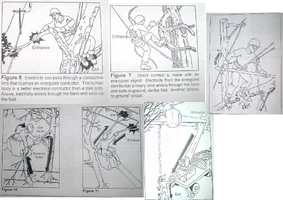
The drawing collection in the attatchment is from the US Dept. of Labor Corp's Urban Foresty Manual, by ACRT. A very good manual for all tree work IMLHO; i think i have missed recomending it when we were talking recomended reading.
 

Attachments

  • 8938-The Human Conductor.webp
    8938-The Human Conductor.webp
    223.9 KB · Views: 132

New threads New posts

Back
Top Bottom