eab for climbers

joe

New member
[ QUOTE ]
[ QUOTE ]

Since you're from Michigan and working in Ash trees killed by eab, how about sharing some of you're experiences with those of us who're just starting to face this problem. I'm looking at things from the climber's perspective as are others. Some things I'm interested in knowing are: the trees reaction to rigging once dead; were there any experiences you had which caught you off guard like limbs breaking or limbs not breaking when rigging? Does the bark peel off the trees when rigging or spiking them? Do the infestations kill the lower or upper part of the tree 1st in many cases? How does this affect our abilities to rig over obsticles? A new thread needs to be started to keep our experiences documented and easily accessible.


[/ QUOTE ]

X2.
Yes please. EAB is about 20 miles away here...

[/ QUOTE ]
 
[ QUOTE ]
I feel like dead ash trees are just dead ash trees to me now. I dont trust them any further than I can throw them, and I cant pick them up. The bottom is attacked first, sometimes you wont have any bark at the base of the tree untill 20-30ft up. Its not to bad spikeing threw the bark because its thin enough. I usally dont venture to far from the trunk or main limbs, because even limb walking...the tip your tied into isnt the most ensureing thing! When theres any movement from rigging or dropping they just blow up and make a mess. If you ever rig a decent log and slap them against the trunk take cover because the tips always break off and shower you. A couple of the bigger outfits around here have policies that prohibit a climber in any ash tree thats been dead longer than 2years, there was some info(I forgot where) about cases where the ash trees where breaking off about 4-5ft from the base! Most people dont have you cut them down when there dieing, they wait for a couple of years! I just did 12 dead ash trees on thursday last week. You'll get alot of apt complexs and condos wanting all there dead ash taken down, not uncommon to have between 100-200 dead ash trees in a week to cut down on those jobs. I have a few good pictures of dead ash trees. One with a huge tree house 30ft up with no bark and a deck around it, with nothing in the tip to tie to. Used a crane for that one, I was suprised how far I could walk out on the dead limbs(knowing I was tied into the crane)....but i learned my lesson on day one about posting pictures on here lol...so in short you probaly wont cut many that are dieing, you'll cut alot when they have been dead in 2-3years.

[/ QUOTE ]
 
[ QUOTE ]
Also the city of East Lansing, MI home of MSU college has a great cert arbos and forestry program, the city I heard is now writing tickets to home owners for dangerous dead ash trees. So things are picking up there. Also if you get to the 4-5year dead ones, expect to bottom out your spikes in them, there nasty. FYI im sure to someone on here I have no idea what im talking about, and im 100% wrong! So skip the bad mouthing, because it really dosent encourage anyone to respond or share info (which i thought is the reason there are forums?) Im willing to share any info deemed valuable to those that are interested. Thanks.

[/ QUOTE ]
 
[ QUOTE ]
the roots rot out on the ashes and they fall right over. I haven't done an ash almost all year now. the ones that are left are too sketchy.

[/ QUOTE ]
 
[ QUOTE ]
[ QUOTE ]
the roots rot out on the ashes and they fall right over. I haven't done an ash almost all year now. the ones that are left are too sketchy.

[/ QUOTE ]

[/ QUOTE ]

I truly appreciate the strength and experience you Michigan tree climbers possess when it comes to working with trees infested by eab. I'm trying to be pro-active and asking people to remove trees while they are structurally sound and predictable. I've not heard of trees falling over from decayed root systems. Does anybody from Michigan have any insight that may help to predict a failing root system?

Everything you guys post will help your comrads. We appreciate the heads up.

Joe
 
Seems like the sales people should be sure to indicate to people requesting bids that the price goes up with trees' decay. I'm sure that a lot do this.

Somehow some people figure that it will be cheaper to have the tree removed if they rake up all the leaves as they fall off the dying tree, so that there will be less clean-up. Might as well wait until there are no leaves to clean-up.


Is there any governmental cost-share for removing EAB killed trees? Not suggesting that there should be, but there are cost-share programs for fuel reduction, but that is to offset fire suppression costs.
 
Near the end of May, I removed a tree that was being killed by eab. It still had a hint of life to it. What I found was the tree was easy to remove. There were no signs of excess decay or dead and unstable branches. The D-shaped exit holes weren't detected until I removed 1 of 2 co-dominant leaders. The eab adults were just starting to emerge so their heads were filling the holes. I cut a notch in 1 stem and 1 of my co-workers picked it up showed me an intact adult eab in it's chamber before it's d-shaped exit hole was made. It was strange to view it.

I detected a new eab infestation at the beginning of June in a larger tree, about 70-80 feet tall, that was starting to decline. I seen a couple of verticle splits about 3 inches long near the top of the tree. I found these splits in the healthiest part of the crown. Removing loose bark showed the serpentine galleries typical of eab. I did find native borer holes in this tree. I think this tree will be removed within the next couple of years.

Joe
 
EAB is about to hit here.
I'm wondering if there are any special concerns specific to dead EAB ash trees as opposed to the typical dead tree removal.

Is it just the time a tree is standing dead? If the tree is dealt with fairly quickly is it not as much a concern?
Or is there inherent structural problems from the start of the infestation due to the way the borers tunnel?
Does it all happen within a single year or season?

The ashes I am responsible for I can deal with fairly quickly, certainly within a year. Not a big deal then?
(but the side jobs will be another story...
tongue.gif
)
 
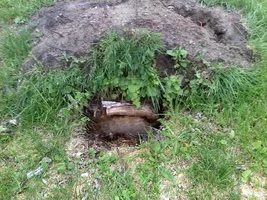
the roots fail. the wood stays strong and holds its hinge well for a long time. thats why its good for bats. here is a pic of a tree I gave a bid on for removal with a crane. I was planning on being in and on the tree down low. They hemmed and hawed about it and then two weeks later they called me and said it fell over. when I cut the trunk the stump literally rolled over in its socket. glad i didn't get near it while it was up. none of the tips had broken off and the bark wasn't completely exposed. Someone was looking out for me though on this one.
 

Attachments

  • 233466-flippedashstump.webp
    233466-flippedashstump.webp
    76.3 KB · Views: 117
Usually when you cut the stump of a fallen tree it springs back up. this one just rolled right over. It could be scooped out with a loader leaving a perfectly round crater.
 
I will also say that there is quite a few ashes that are still kicking surving on sucker growth. There are huge amounts of city trees that still have not been cut due to a broke city. I think this is a very interesting case study of what happens and the varying degree of hardiness. Many of the trees are stone dead and very hazardous. others have died back to a core of sucker growth that in many cases has grown almost to the point of obscuring the dead wood. There are some smaller trees that seem to be very healthy, like they were too small when the main infestation hit and now it has passed and they are growing up and they seem to still be fine. On a whole block there will be all different examples. European ashes seem to get hit but withstand it better.

The tree that rolled over was stone stone dead, there are a lot of those. I think if there is any kind of sucker growth it implies some sort of root activity.
 
almost all the older larger mature trees were completely wiped out. I dont see many survivors. I do think there is something to the infestation numbers though. It was a literal plague fed by the large scale monoculture of city ash trees. I feel like this led to unnatural numbers leading to such devastation. I believe that it wont be a consistent threat and ash trees will once again be able to get big. just not in such population density. These are just random thoughts and hopes. Nothing scientific.
 
. I'm pruning two ashes next wed. Tree Rat pruned them too a few years ago. the owner swears they are not treated. I am not so great at ash ID. I always muddle green and white. I didn't even know about blue. they do seem a little different though. I'll get some pictures.
 
The information people share here are valuable to those of us who have yet to face disposal of these trees. I'm not with a municipality, so, my experiences should be behind their encounters. I did remove a tree today before it died. I cut a cross section from a scaffold branch and used it to support my bosses decision to recommend the tree be removed. This particular sample allowed me to not only show, but to explain to the client the reason this insect was so destructive to the trees. Looking at the cross section gave me a perspective I wasn't looking to find. I seen where the cambium had been mined by the borer. There was a break in the cambium. It looked like some one had removed a small section in the area where the cambium existed and hollow it out. There was bark, then a hollow space about 1 inch of curvature in a section about 6 inches diameter, then the xylem.

For those who've yet to face this problem, get 2 different samples to show the different perspectives of the damage this insect inflicts in these trees. The cross section definitely enhanced the standard sample used as a visual aid to show clients how eab kills Ash trees.

Joe
 
This is a good thread that I have not seen elsewhere. There is some correct info and some not so accurate (experts opinions not mine) stuff. Example....Green Ash are more likely to be attacked first than others.

In getting the homeowners or even the city to comply with common sense and remove dead or dying trees early one only needs to take pictures that are dated and maybe even have them notarized and then explain to the offending party that if the tree hurts other's property or a person then they will not have a leg to stand on in court (negligence). People have become conditioned to some extent through storms with getting away with a tree (live) falling on another person's property and getting away scott free.

Also there is good money to be made with treatments before the tree becomes substantially infested that DO work in prevention. University experts are becoming more and more confident in the efficacy of these treatments.
 
While I was in Michigan I experienced many of the same things Bing did with regards to the eab but never a roll over like that. When I did see that kind of thing, closer inspection of the socket revealed hardware or cage or something. When it first came on it was hard to believe we were really going to lose them. Then there were a couple treatments that were somewhat successful but at what expense to the foodchain. Not knowing enough about that was enough to get me to start asking as many people in the know as I could corner. When I asked one Michigan arborist about treatment in 1999 she whispered..."don't bother, Kristian. It's over." Getting some people to act on Ashes that were clearly hazardous was like pulling teeth. Getting a decent wage for doing a large removal was sometimes a challenge too. Sometimes I kept VERY vertical loads on them when climbing in that I didn't care to get too far out of my folcrum point. Sometimes they were just crispy. I'm kind of glad not to be doing them now. I JUST got the last of the ash dust out of my nose and I've been gone 3 years.
 

New threads New posts

Back
Top Bottom