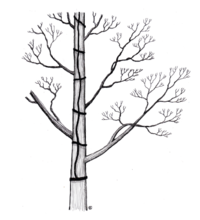
Right, but they are only intended for a fall factor that is very close to zero, meaning that the cable is already supporting some of the limb's weight, and when the limb fails, it doesn't really fall, the cable just ends up supporting all of the weight. In my case, the top would have a fall factor of two which would cause some serious shock loading.
Because:
1) a 5 year old tree can't provide the benefits that an 80 year old tree can
b) That's what the customer wants
iii) I'm not asking if this tree "should" be removed, I'm trying to have a discussion about creative and effective mitigation options
IV) I can make more money mitigating the hazard this year and then removing the tree in 10 years when a different defect that can't be mitigated increases the tree's risk.
V) Because it's the owners/tree managers tree, and the decision to retain or remove ultimately rests with them. If an arborist is acting in an advisory capacity, then they cannot ethically put their thumb on the scales. Making recommendations makes you an advocate, rather than an expert consultant.
When a consultation client asks for a recommendation, an ethical consultant can translate that to mean that the client still doesn't have enough information to comfortably make an informed decision. The consultant can then try to find out what information or clarity they're missing, and add that to what information has already been provided. After being fully and objectively advised of the condition and risks embodied in the tree, should the tree owner/manager wish to retain the tree and take steps to mitigate risks related to structural issues, then that's what should be delivered to them.
If the arborist is not confident of their ability to competently deliver what the client asks for, then it's time to suggest a referral to a provider who has that skill set squarely in their wheelhouse, or to decline the assignment.
A quick knee-jerk recommendation to remove/replace as the only option, is not ethical consulting. Unless the tree presents in imminent risk of failure with serious consequences to high value targets which cannot be moved, there are always other options, depending upon how the client feels about the tree, and how much they're willing to invest to keep it. For an example, do an internet search for the Anne Frank Horse Chestnut Tree Ganoderma Mitigation in Amsterdam. I often use this tree as an example to put options into perspective for clients when discussing mitigation techniques, with removal at one end of the spectrum and Anne Frank style tree mitigation at the other.
From what I've read of their posts and replies in this thread,I think the OP is doing a good job of staying in their lane as a consultant.