- Location
- Santa Cruz, CA

Navigation
Install the app
How to install the app on iOS
Follow along with the video below to see how to install our site as a web app on your home screen.
Note: This feature may not be available in some browsers.
More options
You are using an out of date browser. It may not display this or other websites correctly.
You should upgrade or use an alternative browser.
You should upgrade or use an alternative browser.
Dynamic loads
- Thread starter ptar
- Start date
- Location
- Santa Cruz, CA
- Location
- Santa Cruz, CA
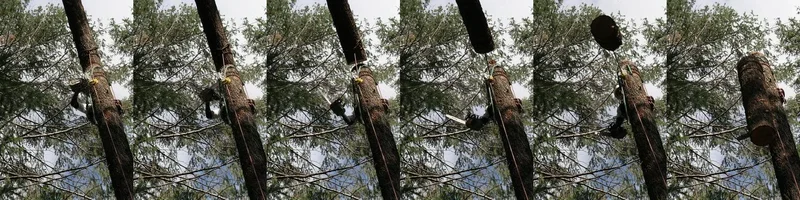
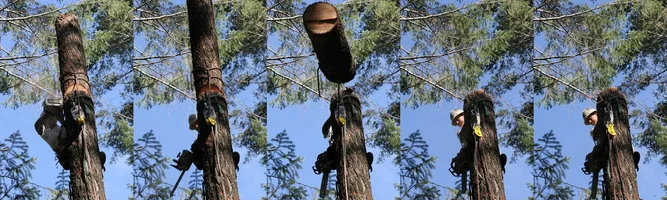
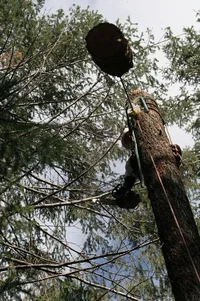
One more shot.
We had a dynamometer connected to the block.
Here are some results:
Douglas Fir 9"dia x 8"dia 6'1" long, Tied off.
Chunk weight: 90 lbf
Peak force at the block: 948 lbf
Douglas Fir 12"dia x 14"dia x 6'1" long, Tied off.
Chunk weight: 206 lbf
Peak force at the block: 2040 lbf
Douglas Fir 14.1"dia x 14.3"dia x 6'1" long, Run.
Chunk weight: 260 lbf
Peak force at the rigging point: 1444 lbf
You can sign up for the workshop at:
http://www.cal-arb-association.com/workshop.html#CRANE
We had a dynamometer connected to the block.
Here are some results:
Douglas Fir 9"dia x 8"dia 6'1" long, Tied off.
Chunk weight: 90 lbf
Peak force at the block: 948 lbf
Douglas Fir 12"dia x 14"dia x 6'1" long, Tied off.
Chunk weight: 206 lbf
Peak force at the block: 2040 lbf
Douglas Fir 14.1"dia x 14.3"dia x 6'1" long, Run.
Chunk weight: 260 lbf
Peak force at the rigging point: 1444 lbf
You can sign up for the workshop at:
http://www.cal-arb-association.com/workshop.html#CRANE
Attachments

TreeCo
Carpal tunnel level member
Really neat data. It's a shame the dynamometer adds so much to the drop distance. It looks like it adds at least one ft.
Dan
Dan

Norm_Hall
New member
- Location
- Wauconda, (Chicago),IL,USA
That's the coolest picture sequence. How do you do that? We also used the dyno to show forces generated at the block at our annual IL trade show and conference a couple of weeks ago. It really opens up the attendees eyes. Our range was 10 to 12X the weight of the log. Dan is right, the dyno does add approx. 1 foot to the rigging system. We're trying to figure out a way to rig the dyno up differently to simulate just a drop on the sling and block.
Great info to pass on the BUZZ. Thanks.
Great info to pass on the BUZZ. Thanks.
- Location
- Santa Cruz, CA
Norm,
I used a Canon 20d with an f2.8 100mm macro lens on a tripod.
Press and hold the shutter button and the camera will
take up to 5 pictures/second (I think).
Rob took a 25 pictures sequence at one point.
I used a Canon 20d with an f2.8 100mm macro lens on a tripod.
Press and hold the shutter button and the camera will
take up to 5 pictures/second (I think).
Rob took a 25 pictures sequence at one point.
- Location
- healdsburg, CA
What was being used to brake the rope/logs?

- Location
- Retired in Minneapolis
I've done the same demo using a 100# game scale and a block of firewood. It isn't necessary to do big dumps to get the point across. But...it sure is more fun! 

we have just been disscusing some interesting rigging scenario's here.... would be cool if you could test something like that at your workshop. The question is if you have a piece of wood weighing 100kg and its only a foot long, what would the diffence in force be on your system/rigging point with a piece of wood also weighing 100kg... BUT being 3 foot long? That is if the drop is the same lenght, tied off ect...
jelte
jelte
- Location
- Santa Cruz, CA
Frans, We used my shiny GRCS.

Treespotter
New member
- Location
- Houten, The Netherlands
Try this one.
http://www.treespotter.nl/images/link09_klimmershoek_4.pdf.pdf
What is the total drop and which one gets the biggest hit (lets assume the rope and catch are static) and why.
http://www.treespotter.nl/images/link09_klimmershoek_4.pdf.pdf
What is the total drop and which one gets the biggest hit (lets assume the rope and catch are static) and why.
TreeCo
Carpal tunnel level member
The 500cm long chunk produces the biggest hit because it's center of mass drops further than the 100cm chunk. The 500cm long chunk's center of mass falls 300cm before pull tight while the 100cm long chunk falls only 100cm at pull tight.
Longer falls produce higher shock loads.
Longer falls produce higher shock loads.

- Location
- Home of the New Jersey Devils
Great point Dan. I'd agree to that.

- Location
- magalia california
Cool pics Ptar and thanks for those stats.
Greg
Greg
- Location
- magalia california
Yeeessss Frans, we had to bow down and use pierre's new spiffy GRCS. Got to dirty it up for him a bit and leave some rope fiber on the spoole...lol.
Greg
Greg
- Location
- healdsburg, CA
Boy, your workshop sounds like a Winner! Wish I could be there but am going to TCI
- Location
- NW Oregon Coast Range
Here is a simple quantitative analysis of the problem. The energy we are dealing with here is potential energy (m*g* delta y). Since m (mass) and g (gravity) are the same for both sections of log we only have to look at the delta y of the CM (center of mass) to determine which is bigger and by how much. The small square block CM falls 200cm before it starts to tighten the rope. The long log CM falls 1m before it starts to tighten the rope (180 degree rotation assumed). This means the long log will place about 5 times the dynamic load on the rigging system.
Hmm, I'm not sure where that 1m came from! Make that 600cm for about 3 times the dynamic loading. I guess I was in too much of a hurry this morning and forgot to double check the answer.
Cary
Hmm, I'm not sure where that 1m came from! Make that 600cm for about 3 times the dynamic loading. I guess I was in too much of a hurry this morning and forgot to double check the answer.
Cary
- Location
- magalia california
oh hmm ....lets see ...if I had a choice? I think I might go to the TCI also ...
Yep!
Long logs = high forces. I use a rule of thumb based on a uniform log length of 4 feet. That way, as the the diameter of the log increases, the diameter of the rope increases - both are exponential. I put the rules of thumb into the rigging 1.0 programme, and it verified them with between 40ft to 50 ft of rope payed out. I only take long logs of small diameter with a rope of a large diameter. Just by increasing the rope payed out (running between a couple of pulleys on the ground) an extra 10 feet reduces the fall force substantially. Failing this, a high stretch rope will help, especially if targets are ground based eg. nice lawn, pond, sloping ground.
Long logs = high forces. I use a rule of thumb based on a uniform log length of 4 feet. That way, as the the diameter of the log increases, the diameter of the rope increases - both are exponential. I put the rules of thumb into the rigging 1.0 programme, and it verified them with between 40ft to 50 ft of rope payed out. I only take long logs of small diameter with a rope of a large diameter. Just by increasing the rope payed out (running between a couple of pulleys on the ground) an extra 10 feet reduces the fall force substantially. Failing this, a high stretch rope will help, especially if targets are ground based eg. nice lawn, pond, sloping ground.
- Location
- NW Oregon Coast Range
[ QUOTE ]
... both are exponential. ...
[/ QUOTE ]
I think you will find both log weight and rope strength are quadratic (square) not exponential with respect to diameter/radius.
You are absolutely correct in that how you control the rope as it starts to take the load makes a huge difference. You want to dissipate the potential energy over as much time as possible to reduce the dynamic spike. The shorter the time the higher the spike. In an ideal situation the rope should be tight or tightened as the log releases to minimize the energy created by the free fall. As the rope takes the weight a light hand should be used to slowly stop the falling log. The ideal stopping point is just as the log hits the ground.
Cary
... both are exponential. ...
[/ QUOTE ]
I think you will find both log weight and rope strength are quadratic (square) not exponential with respect to diameter/radius.
You are absolutely correct in that how you control the rope as it starts to take the load makes a huge difference. You want to dissipate the potential energy over as much time as possible to reduce the dynamic spike. The shorter the time the higher the spike. In an ideal situation the rope should be tight or tightened as the log releases to minimize the energy created by the free fall. As the rope takes the weight a light hand should be used to slowly stop the falling log. The ideal stopping point is just as the log hits the ground.
Cary
New threads New posts
-
test
-
What's on your mind? TCI Magazine wants to know
- Started by Tree Care Industry Assoc.
- Replies: 9
-
 Apr 09 (Free CEUs) & May 07 - 'Urban Forestry Today' Webcasts @ Noon (Eastern)
- Started by UFT
- Replies: 0
-

-
-

-


