
I have a DownRigger, but have only used if a handful of times so don't have wide experience, and no experience with the Rigging Wrench. Given the DRs design I can certainly see where pitch could become an issue. That said, my limited use with it has been great, and it's a pretty slick and robust piece of kit, as all Rock Exotica's hardware tends to be.

Navigation
Install the app
How to install the app on iOS
Follow along with the video below to see how to install our site as a web app on your home screen.
Note: This feature may not be available in some browsers.
More options
You are using an out of date browser. It may not display this or other websites correctly.
You should upgrade or use an alternative browser.
You should upgrade or use an alternative browser.
DownRigger, Rigging Wrench (or Scarab, or....)??
- Thread starter ATH
- Start date

Mick Dempsey!
Branched out member
I will make one post, cos I cannot read much more.
Natural crotch with stubs, in other words, ready made lowering devices, all over the tree.
Here’s an explanation…
Natural crotch with stubs, in other words, ready made lowering devices, all over the tree.
Here’s an explanation…

ATH
Been here much more than a while
- Location
- Findlay, Ohio
I'm susceptible to being talked into the right device! I'll look at the Scarab again. I like simple... don't need moving parts.Not to talk you into the device, but with the scarab you don't need to pull it back though. Take it out and reattach when everything is set. The nice thing with it, is that you do not need to disconnect the scarab from the sling in order to take the rope on and off.
Last edited:


I have and like the Scarab. I also have two co-workers who each have a Morgan Block(Downrigger) on a sling and we use them regularly. Great for a butt control line on big pieces you don't want to take a big swing and easily managed by the climber/cutter. Compact, one piece, etc. Right tool for the job, all of them work well. There aren't always stubs but when there are, they are free.
... There aren't always stubs but when there are, they are free.
If your cutting off a branch there will be a stub available for friction even if it's not useful for the lowering point. I am thinking in the context of pruning not removals.

Muggs
Been here much more than a while
- Location
- Canuckistan
Natural crotch has always been my go-to. I use my 3-strand more than any other line. But a device can handle more weight, by hand, without adding friction down low.
I found myself in a big walnut a couple years ago, side job for my wife's cousin, no cleanup, no crew to help, just me and the homeowner trimming a lead over the house. Using my homemade thing he was able to control them easily from the ground, then transfer the load to me so he could land them. Couple big horizontals, couple tops, few chunks of wood. Nothing crazy, but definitely bigger than he could have handled by hand on natural crotch, no question. The simplest solution is the best solution, but there's a time and a place to add some complexity to the mix.
I found myself in a big walnut a couple years ago, side job for my wife's cousin, no cleanup, no crew to help, just me and the homeowner trimming a lead over the house. Using my homemade thing he was able to control them easily from the ground, then transfer the load to me so he could land them. Couple big horizontals, couple tops, few chunks of wood. Nothing crazy, but definitely bigger than he could have handled by hand on natural crotch, no question. The simplest solution is the best solution, but there's a time and a place to add some complexity to the mix.

southsoundtree
Been here much more than a while
- Location
- Olympia, WA
More than a turn or round turn are in order for extra fruction. A sling or two with biners for extra direction-change/ friction works well.
Stubs can be used as a tie-off for the rope, as well.
If solo, a nice stub with several wraps allows a partially-lowered piece to be held in place until its ready to be lowered.
If you are descending to the ground, you can flip a couple wraps off the stub to reduce the friction to be able to lower the piece.
I've had 8 pieces on three ropes suspended (end-line and mid-line), lowering each to the chipper tray after I'd chunked some wood and descended to the ground.
Free and easy.
Graeme McMahon had a NC video on big Euc, with a round-turn on the terminal rigging stub.
Wood sometimes warrants a device.
Stubs can be used as a tie-off for the rope, as well.
If solo, a nice stub with several wraps allows a partially-lowered piece to be held in place until its ready to be lowered.
If you are descending to the ground, you can flip a couple wraps off the stub to reduce the friction to be able to lower the piece.
I've had 8 pieces on three ropes suspended (end-line and mid-line), lowering each to the chipper tray after I'd chunked some wood and descended to the ground.
Free and easy.
Graeme McMahon had a NC video on big Euc, with a round-turn on the terminal rigging stub.
Wood sometimes warrants a device.
Muggs
Been here much more than a while
- Location
- Canuckistan
I often use an x-ring in the lower third of the tree, to improve rope angles and add extra friction in natural crotch rigging. Nothing to retrieve up top, the low ring is easy to retrieve before coming down.
I love that old video with McMahon. Beranek also covers this technique in The Working Climber. This is great when just straight down-rigging, you always have access to adjust the rope as needed at the stub.
If I'm rigging from a remote overhead position, this is not available to me. If my rigging point is 30 ft above and 15 ft to the side of the horizontal limb I'm taking out, I'm not going to take the chance of a round turn on a crotch up top. For one, it ruins my chances of any decent amount of tension in the line before the cut, and two, if it ends up being too much friction then I'm stuck.
I've had situations where I'm trimming a tree on a fence line, where the trunk is on the side opposite to the work coming down. If I'm doing some heavier stuff, I have no place for a bollard, without taking my ground guy and placing him on the wrong side of the fence. This puts him out of the mix for landing pieces, dragging brush, and helping out in general. With a small crew this can be a real problem. I usually just go natural crotch anyway, and we can handle most things this way, but there are times where the pieces are just going to be the size they are, not always much option to cut them smaller. In these cases, which are rare, an aerial friction device can be the ticket. I use my homemade thing maybe 3-4 times a year, which annoys me because I haul it around to every. single. job. all. year. long.
This is not directed at anyone in particular, but if you can't think of a single situation where an aerial friction device would make sense, then you're not using your imagination...
I am still hoping someone can chime in on the pre-tensioning ability of the DownRigger. It's way too expensive for me to even consider it, but I'm interested to know...
I love that old video with McMahon. Beranek also covers this technique in The Working Climber. This is great when just straight down-rigging, you always have access to adjust the rope as needed at the stub.
If I'm rigging from a remote overhead position, this is not available to me. If my rigging point is 30 ft above and 15 ft to the side of the horizontal limb I'm taking out, I'm not going to take the chance of a round turn on a crotch up top. For one, it ruins my chances of any decent amount of tension in the line before the cut, and two, if it ends up being too much friction then I'm stuck.
I've had situations where I'm trimming a tree on a fence line, where the trunk is on the side opposite to the work coming down. If I'm doing some heavier stuff, I have no place for a bollard, without taking my ground guy and placing him on the wrong side of the fence. This puts him out of the mix for landing pieces, dragging brush, and helping out in general. With a small crew this can be a real problem. I usually just go natural crotch anyway, and we can handle most things this way, but there are times where the pieces are just going to be the size they are, not always much option to cut them smaller. In these cases, which are rare, an aerial friction device can be the ticket. I use my homemade thing maybe 3-4 times a year, which annoys me because I haul it around to every. single. job. all. year. long.
This is not directed at anyone in particular, but if you can't think of a single situation where an aerial friction device would make sense, then you're not using your imagination...
I am still hoping someone can chime in on the pre-tensioning ability of the DownRigger. It's way too expensive for me to even consider it, but I'm interested to know...
ATH
Been here much more than a while
- Location
- Findlay, Ohio
My biggest concern with natural crotch rigging is damaging thin bark trees. Not a problem when using a stub, but not always ideal to use a stub...that will likely continue to be primary go to.
ATH
Been here much more than a while
- Location
- Findlay, Ohio
I decided on the Scarab for specific uses I have in mind. I like that I can add or remove friction easily and that it is actually rated for the 3/8" rope I want to use in it. Wesspur is out of stock, but one listed as new on eBay for $108 shipped.
Thanks @Jehinten for introducing that into the thread!
It's been great discussion and hope it continues so we can all keep learning! (But not too much because I don't need to be talked into spending more money LOL)
Thanks @Jehinten for introducing that into the thread!
It's been great discussion and hope it continues so we can all keep learning! (But not too much because I don't need to be talked into spending more money LOL)
Muggs
Been here much more than a while
- Location
- Canuckistan
I also got sucked down the scarab rabbit hole on here yesterday, now I want to try it in place of my mini porty in the tree for drifting
ATH
Been here much more than a while
- Location
- Findlay, Ohio
I'll let you know when it gets here...you can come to OH and give it a try. Actually, my helper is moving out of town so you can stick around all spring/summer/fall to make sure you get a good feel for it!I also got sucked down the scarab rabbit hole on here yesterday, now I want to try it in place of my mini porty in the tree for drifting

ATH
Been here much more than a while
- Location
- Findlay, Ohio
Pretty cool technique in video...you ever not been able to get the hook off? I could see it laying just the wrong way and being stuck.I've been using a scarab for a couple of years. Doesn't come out often, but when it does it's a great tool.
Hasn't happened to me yet, but even if it did it's an excuse to go down and clean some stuff up. The joys of working alone.Pretty cool technique in video...you ever not been able to get the hook off? I could see it laying just the wrong way and being stuck.

Jehinten
Been here much more than a while
- Location
- Evansville
I've been using that set up for a while now when it's called for, since 2018.Pretty cool technique in video...you ever not been able to get the hook off? I could see it laying just the wrong way and being stuck.
It is possible for it to not release, typically it happens in something like pin oak when the twigs tangle the sling and prevent the hook from slipping. Once you realize the potential for that to happen, you can clear those twigs with your handsaw before you rig the piece.
This is actually the first test system, using items I had on hand. Much heavier duty (and clunkier) than you see in the video.
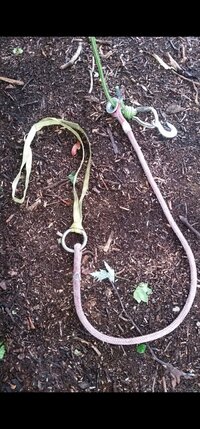
@Boomslang thats a great video showing the technique, I've shared your video from YouTube several times in the past when explaining how it works to others. Thanks for taking the time to record that. Quick question, what sling are you using for the scarab with the pockets? I've seen similar before, but they always looked bulkier than that.
ATH
Been here much more than a while
- Location
- Findlay, Ohio
'nother question: 1:04-1:05. If that hook was facing up wouldn't that make it much less likely that the sling would come off the hook?Hasn't happened to me yet, but even if it did it's an excuse to go down and clean some stuff up. The joys of working alone.
@Jehinten it's a Metolius Ultimate Daisy Chain.
 vpo.ca
Not the longest sling, but the whole point of this setup is light and compact.
Shop Ultimate Daisy Chain 11mm x 45" | VPO Canada
The only daisy chain to pass the CE/UIAA sling standard, the Ultimate Daisy has a strength of 22 kN in any configuration thereby eliminating the potenti...
vpo.ca
Not the longest sling, but the whole point of this setup is light and compact.
It's a practical reason for the hook facing down. If the hook is above or perpendicular to the rigging point, when you're setting up the scarab there's some slack in the rope. With the hook facing up it's more likely to drop off the sling from that slack. It can be annoying if the sling isn't within arm reach.'nother question: 1:04-1:05. If that hook was facing up wouldn't that make it much less likely that the sling would come off the hook?
Last edited:


