Evo, I'm going to agree but qualified.
In the case of letting it run, equally, the run profile determines the forces. All good.
In the case of a catch shock load, we're familiar with keep the rigging tight to the cut to keep the free fall drop distance as small as possible. Let's agree that the same success/drop distance is achieved in traditional -ve riig as double whip tackle.
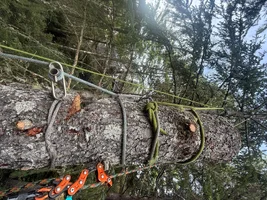
Here's two cases. a) normal -ve rig with a groundie down rope leg locked off at the bottom or b) dwt with a groundie down rope leg locked off at the bottom. in a) there's one short leg of rope to the log and one long leg of rope going down the tree base. That rope goes through one rig tip pulley/xring whose losses lessen the transfer of stretching force to the down leg which does a lot of the shock absorbing. In b) a little less than half the log's shock force comes back up the 2nd short rope segment to the dwt rig tip pulley/xring and that tension gets reduced again before going into the long down leg which again does a lot of the shock absorbing.
Having written it out, it seems to me the on-the-log's dwt pulley/xring/biner does a force dropping just like for SRT base tie tip force (it's the same, upside down!) - the two short legs aren't 50-50 of the log's weight, they add up to less - so it's an advantage that way. It does drop the down leg force a bit extra too. So at the rig tip a) has log weight + bit less than log weight in down leg. b) has 1/2 log + bit less than 1/2 log + bit less than ( a bit less than) 50% log weight in down leg. So roughly 2x log vs 1 1/2x log - a clear win for dwt.
There's a good chance that the long down leg will absorb better at lower loads too.
Where you can milk this is using xrings or biners at the rig tips including the log. Rope tensions get lower. Any extra stretch in the one extra short rope leg at the top is negligible vs the long down leg.
Overall a bit more margin to cover for errors in let it run execution.
If the spar is in question - a normal or dwt -ve rig is going to sledge hammer the side of the spar. You might want to reconsider -ve rigging.
edit- y'all know that I used 1G or weight for the analysis, but a real -ve rig log spikes 5G giving about 10G or 10x at the rig tip, normal -ve rig locked/catch-stop