












Navigation
Install the app
How to install the app on iOS
Follow along with the video below to see how to install our site as a web app on your home screen.
Note: This feature may not be available in some browsers.
More options
You are using an out of date browser. It may not display this or other websites correctly.
You should upgrade or use an alternative browser.
You should upgrade or use an alternative browser.
Documenting my hand-sewn eye process
- Thread starter moss
- Start date

needles that should fit SS
1.98mm shank -needle: 29x3; 16x99 -sizes up to 180 / singer 24 -(i bought these but other systems should work as well)
1.99mm shank- needle:190R; MTx190; SY755
2mm shank- needle: 135x7; 135x5; 134R- sizes up to 200/ singer 25
full chart http://ismacs.net/needle_and_shank/needle-cross-reference-chart-round-shank.html
1.98mm shank -needle: 29x3; 16x99 -sizes up to 180 / singer 24 -(i bought these but other systems should work as well)
1.99mm shank- needle:190R; MTx190; SY755
2mm shank- needle: 135x7; 135x5; 134R- sizes up to 200/ singer 25
full chart http://ismacs.net/needle_and_shank/needle-cross-reference-chart-round-shank.html
Thank you for this thread guys.
When researching Maxijacket i found this
https://www.practical-sailor.com/issues/37_66/features/Sewn-Splices-Two-Year-Followup_12018-1.html
different stitch looks "funny" but still claims 85% of the rope strength
When researching Maxijacket i found this
https://www.practical-sailor.com/issues/37_66/features/Sewn-Splices-Two-Year-Followup_12018-1.html
different stitch looks "funny" but still claims 85% of the rope strength

Marsupilaami
New member
- Location
- Norway
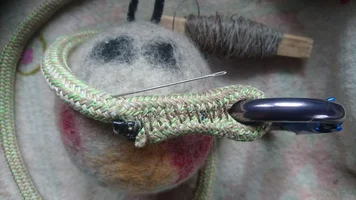
Your seams are all much nicer than mine. I use 90kg fishing dyneema, and ordinary needle without lock stitches, and pliers. This is an i2i. In other applications I use a bit longer seam.
Three passes, the first gets hidden. Don't know how you guys get so dense stitching in there.
Feel free to slaughter it.
Three passes, the first gets hidden. Don't know how you guys get so dense stitching in there.
Feel free to slaughter it.
Attachments

moss
Been here much more than a while
- Location
- Carlisle, Massachusetts, U.S.
Your seams are all much nicer than mine. I use 90kg fishing dyneema, and ordinary needle without lock stitches, and pliers. This is an i2i. In other applications I use a bit longer seam.
Three passes, the first gets hidden. Don't know how you guys get so dense stitching in there.
Feel free to slaughter it.
Visually doesn't inspire confidence ;-) Have you broken any to see how strong they are?
With a sewing awl it's relatively easy to get a dense stitch pattern.
-AJ
Marsupilaami
New member
- Location
- Norway
Thanks moss, appreciated - I agree. I'll order an awl and maybe thinner thread ASAP. It's just that one can't buy hardly anything this part of the world, and shipping a small package from the US for instance costs 40-80$ usually, from stores, plus tax and customs on top.
Will do some proof testing with mechanical advantage in the mean time, plus send one for break test, eventually.
Will do some proof testing with mechanical advantage in the mean time, plus send one for break test, eventually.
- Location
- Massachusetts
A message landed in my e-mail inbox that came from this buzzboard thread, and I had a few (random-ish) thoughts of my own, and reply. I have wasted a bit of my life bouncing up and down on the ocean in sailboats, so I have some experience with salt, sun, corrosion, ropes, uv degradation.
I continue to agree that testing rope splices is a great idea, but I have at the moment only a 1200 lb load cell (and most of what I would test would go higher than that) so, yes, I have hydraulic cylinders etc. but... time,time,time
That said, I think part of the idea in making things that are good has to do with thinking hard about and solving the problems and issues entailed in the design. (Or, using the stuff in question.) There are some clever ways of doing things for rigging sailboats (and a small few that remain kinda dumb -- but so what). Many of them can be cloned / imitated / adapted valuably. On the other hand, salt and UV are much smaller issues when trees are concerned, and the regular proximity of saw teeth, for one example, certain shock loads when weight is dropped onto rigging, for another, etc. are more significant in tree work.
Which gives a place to thinking and calculating. One of the first parts of thinking comes from a general understanding how some mechanism, even a simple mechanism, ends up working. For example, in sailing, there is a bit of "seizing" -- wrapping cord/wire around two pieces of line/cable laid parallel to each other. Seizing has to be f..in' tight, because each of those two lines laid parallel will narrow, lose dimension, as it is pulled on (at an eye end, for example) even to the extent that the seizing won't hold, and the thing pull apart.
I believe something related can be said about tight eyes and sewing. I happen to use 300 lb dyneema. (in fact, I tested that stuff, just for jollies, and it holds more than that when fresh off the roll.) If I cross the parallel lay 20 times up and back each, that's 40, that's 12,000 lb of "gross" fiber strength in the attachment. Yuh, it is bending where it turns into the rope lays, at the stitch knot, etc. etc. But, it is a woven material... etc. etc. In any case, the chances are pretty good that I have gotten beyond the point where the sewn splice is going to fail at the sewing.
That doesn't mean it is never going to fail Just that the two "issue" places, really (once you've done a good enough job attaching the parallel lay) are a) the turn in the eye, and b) where the splice becomes the single rope again. The turn in the eye 1) is inevitable --- that is why you made the eye, to have a turned end, and 2) will be subject to the radius profile of the 'biner / whatever you are using. So, try to use good carabiners that have a little round to them, etc. And then just keep on smiling...
The "top" end of the splice is an issue somewhat similar. One of the reasons that I think tight is good, but that there is such a thing as "too tight" in sewing up things like an eye, is that fiber strength (many fibers) is a 'collective' phenomenon, and that discontinuities in a loading path can often be sites of rupture. (In other words, if the splice area is rock hard, and the rope is soft...there you have an opportunity for load continuity to be ...'interrupted'.) And some regard in using the rope end, e.g. not having some kind of a hitch/knot event 'break'/sharply angulate the rope right at the top of the splice, is better practice. Etc. And then, again, you just gotta get through life, and every end will become a single line at a point and don't be too foolish trying to break things when using them.
My view .. all of course are free to disagree.. would be that manufacture and use are two interrelated parts of having some thing work well.... Sailing stuff is great. I love it. I have a genny winch that I use as a lowering device for tree work -- much cheaper, much better, than much of the load lowering stuff that is sold for arborism (I make my own port-a-wraps and yes, use them, but sometimes, it is just so nice to have a winch...) But sailing stuff also typically first considers sailing issues....
I continue to agree that testing rope splices is a great idea, but I have at the moment only a 1200 lb load cell (and most of what I would test would go higher than that) so, yes, I have hydraulic cylinders etc. but... time,time,time
That said, I think part of the idea in making things that are good has to do with thinking hard about and solving the problems and issues entailed in the design. (Or, using the stuff in question.) There are some clever ways of doing things for rigging sailboats (and a small few that remain kinda dumb -- but so what). Many of them can be cloned / imitated / adapted valuably. On the other hand, salt and UV are much smaller issues when trees are concerned, and the regular proximity of saw teeth, for one example, certain shock loads when weight is dropped onto rigging, for another, etc. are more significant in tree work.
Which gives a place to thinking and calculating. One of the first parts of thinking comes from a general understanding how some mechanism, even a simple mechanism, ends up working. For example, in sailing, there is a bit of "seizing" -- wrapping cord/wire around two pieces of line/cable laid parallel to each other. Seizing has to be f..in' tight, because each of those two lines laid parallel will narrow, lose dimension, as it is pulled on (at an eye end, for example) even to the extent that the seizing won't hold, and the thing pull apart.
I believe something related can be said about tight eyes and sewing. I happen to use 300 lb dyneema. (in fact, I tested that stuff, just for jollies, and it holds more than that when fresh off the roll.) If I cross the parallel lay 20 times up and back each, that's 40, that's 12,000 lb of "gross" fiber strength in the attachment. Yuh, it is bending where it turns into the rope lays, at the stitch knot, etc. etc. But, it is a woven material... etc. etc. In any case, the chances are pretty good that I have gotten beyond the point where the sewn splice is going to fail at the sewing.
That doesn't mean it is never going to fail Just that the two "issue" places, really (once you've done a good enough job attaching the parallel lay) are a) the turn in the eye, and b) where the splice becomes the single rope again. The turn in the eye 1) is inevitable --- that is why you made the eye, to have a turned end, and 2) will be subject to the radius profile of the 'biner / whatever you are using. So, try to use good carabiners that have a little round to them, etc. And then just keep on smiling...
The "top" end of the splice is an issue somewhat similar. One of the reasons that I think tight is good, but that there is such a thing as "too tight" in sewing up things like an eye, is that fiber strength (many fibers) is a 'collective' phenomenon, and that discontinuities in a loading path can often be sites of rupture. (In other words, if the splice area is rock hard, and the rope is soft...there you have an opportunity for load continuity to be ...'interrupted'.) And some regard in using the rope end, e.g. not having some kind of a hitch/knot event 'break'/sharply angulate the rope right at the top of the splice, is better practice. Etc. And then, again, you just gotta get through life, and every end will become a single line at a point and don't be too foolish trying to break things when using them.
My view .. all of course are free to disagree.. would be that manufacture and use are two interrelated parts of having some thing work well.... Sailing stuff is great. I love it. I have a genny winch that I use as a lowering device for tree work -- much cheaper, much better, than much of the load lowering stuff that is sold for arborism (I make my own port-a-wraps and yes, use them, but sometimes, it is just so nice to have a winch...) But sailing stuff also typically first considers sailing issues....
They tested different sewing pattern but i think it's worth a thought especially where abrasion is not a serious threat.
Quoting from the first article in the series:
https://www.practical-sailor.com/issues/37_46/features/Stitching-Instead-of-Splicing_11521-1.html
"We did not like Dyneema thread for stitching polyester or nylon; polyester twine performed much better. Dyneema twine is the right choice for sewing Dyneema products...."
"We tested high-strength Dyneema and Kevlar twine, but we found an increased tendency for the twine to cut through at high loads. The resistance to stretching resulted in splices that were 10- to 20-percent weaker than if they were sewn with the same diameter of polyester twine".
(perhaps they meant same strength not same diameter?)
Quoting from the first article in the series:
https://www.practical-sailor.com/issues/37_46/features/Stitching-Instead-of-Splicing_11521-1.html
"We did not like Dyneema thread for stitching polyester or nylon; polyester twine performed much better. Dyneema twine is the right choice for sewing Dyneema products...."
"We tested high-strength Dyneema and Kevlar twine, but we found an increased tendency for the twine to cut through at high loads. The resistance to stretching resulted in splices that were 10- to 20-percent weaker than if they were sewn with the same diameter of polyester twine".
(perhaps they meant same strength not same diameter?)
moss
Been here much more than a while
- Location
- Carlisle, Massachusetts, U.S.
They tested different sewing pattern but i think it's worth a thought especially where abrasion is not a serious threat.
Quoting from the first article in the series:
https://www.practical-sailor.com/issues/37_46/features/Stitching-Instead-of-Splicing_11521-1.html
"We did not like Dyneema thread for stitching polyester or nylon; polyester twine performed much better. Dyneema twine is the right choice for sewing Dyneema products...."
"We tested high-strength Dyneema and Kevlar twine, but we found an increased tendency for the twine to cut through at high loads. The resistance to stretching resulted in splices that were 10- to 20-percent weaker than if they were sewn with the same diameter of polyester twine".
(perhaps they meant same strength not same diameter?)
I think they meant same diameter.
-AJ
moss
Been here much more than a while
- Location
- Carlisle, Massachusetts, U.S.
Great article by the way, love this quote: "The sewn eyes found in commercial use are often protected with heavy heat-shrink tubing and generally last as long as the line. While these eyes are sewn by machine, we wanted to see whether hand-sewn eyes could match machine-sewn eyes in attainable strength."
-AJ
-AJ
moss
Been here much more than a while
- Location
- Carlisle, Massachusetts, U.S.
In the Practical Sailor they mention that precompression does not increase the strength of a sewn eye. Previously I've used precompression on the advice of a tester who broke my first generation sewn eyes. Next time I make some eyes I'll try without precompression. I'm using stronger thread than I did for the tested eyes so that alone may make enough difference.
They also mention that polyester thread is superior to nylon. The reason being that nylon stretches and loosens the stitching. I often use nylon thread when I'm sewing 11 mm or greater cordage. I haven't seen any loosening of the stitching throughout the life of the eyes. It may be because I'm lock-stitching, for the Practical Sailer eyes they were not lock-stitching.
I've got some used 2nd generation method sewn eyes from retired ropes out for break testing. There are a variety of cordages involved, 10mm Globe 3000, polyester thread (retired after serving a long life as a harness bridge), 10mm Reep Schnur, nylon thread and 11mm Velocity sewn with nylon thread. It will be interesting to see how they all do.
-AJ
They also mention that polyester thread is superior to nylon. The reason being that nylon stretches and loosens the stitching. I often use nylon thread when I'm sewing 11 mm or greater cordage. I haven't seen any loosening of the stitching throughout the life of the eyes. It may be because I'm lock-stitching, for the Practical Sailer eyes they were not lock-stitching.
I've got some used 2nd generation method sewn eyes from retired ropes out for break testing. There are a variety of cordages involved, 10mm Globe 3000, polyester thread (retired after serving a long life as a harness bridge), 10mm Reep Schnur, nylon thread and 11mm Velocity sewn with nylon thread. It will be interesting to see how they all do.
-AJ
In Practical Sailor they concluded that precompression doesn't change much, but one has to remember that as it seems most of the testing was done when using round stitching.
Some information due to the nature of publication is kind of buried, sometimes with links to the other pages which are not obvious.
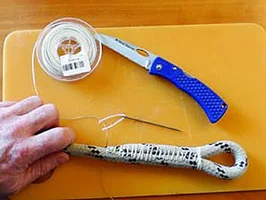
In round stitching long needle passes through both parts of the rope forming the eye. First they start at the end and go towards the neck, than on the other side from the neck back to the end.
Doesn't look like much but is faster ( they use doubled twine = so 4 x single ) and still they claim 85% of the rope strength.
I'll try to enlarge the picture of what was shown as an example ( v.small )
Some information due to the nature of publication is kind of buried, sometimes with links to the other pages which are not obvious.
In round stitching long needle passes through both parts of the rope forming the eye. First they start at the end and go towards the neck, than on the other side from the neck back to the end.
Doesn't look like much but is faster ( they use doubled twine = so 4 x single ) and still they claim 85% of the rope strength.
I'll try to enlarge the picture of what was shown as an example ( v.small )
This is about round stitching (technique)
https://www.practical-sailor.com/blog/When-Splicing-Isnt-an-Option-11486-1.html
https://www.practical-sailor.com/blog/When-Splicing-Isnt-an-Option-11486-1.html
hand stitching nylon webbing
https://www.practical-sailor.com/is...ched-Nylon-Webbing-Strong-Enough_11663-1.html
https://www.practical-sailor.com/is...ched-Nylon-Webbing-Strong-Enough_11663-1.html
Thanks pavve for posting those links. The last picture posted doesn't look like it is the same as the previous article descriptions, or it's picture of a partial splice, which shows the needle going through, top to bottom, not through the sides.
It's an interesting approach to sewing, not real attractive, plus it sounds like it requires an effective seizing to keep the eye together.
It's an interesting approach to sewing, not real attractive, plus it sounds like it requires an effective seizing to keep the eye together.

Birdyman88
Branched out member
- Location
- Arlington
I just sat here on my throne (recliner) and read this whole thread. The cat is twitching and snoring now - not sure if he's having nightmares about the possibilities of me hand sewing some splices.
I just wanted to express my support for the open exchange of info on this subject. I'm an older fart, an engineer, and a damn good craftsman. I've spent my entire life building stuff, some of which they thought I could never pull off. With that, I will say this ... I have spent the last I don't know how many years listening to the "experts" say how superior they and their methods are. But, I have learned that at the end of the day, the only things that matter are whether the design is sound, whether a sound repeatable build process is used, whether high quality materials are used, and whether all the known variables have been contemplated, understood, and planned for. I have run into too many "professionals", that behind the pretty uniform and big advertising, is just another dumbass who may not know much more about the subject at hand than you, and may care even less than you. But he's got some cool tools to make up for some of it.
I can assure you that any engineer, technician, manager, or machine can have a bad day, or worse just act stupid on a regular basis. I know because I'm the guy they usually called to straighten things out when well thought out manufacturing processes went awry. I could talk all day about how the shitstorm of variables with employee compensation, vacation time, insurance, weather, home life, company profit goals, sun spots, religion, stock market price, and everyrthing else that has nothing directly to do with making a fine product resulted in call to my phone. With that said, I will never discount the ability of a true craftsman as they are usually obsessed enough to not let such petty things keep them from their goal.
I share the concern of some industry leaders that hand sewn terminations on rope can be dangerous, as can a bad splice. However, I would also gander that those same vocal people have texted while driving, driven under the influence, taken expired medication, left their house unlocked at night, carried a loaded weapon (no, that permit class we both took ain't really enough), one handed a chainsaw in an unacceptable circumstance, not bothered to do an appropriate shock load calculation on large log/limb, and so on. So please ...
I just want to thank moss, oceans, and others for keeping this going. Honestly, if the people concerned really cared, they wouldn't be charging $15-$20 for a single sewn eye in rope that you bought from them. Amazing how they all have exactly the same overhead. Oops, sorry, didn't mean to cross that "c" line, I was only talking about "c"aring.
Please, indulge me as I complete my rant. Let's get back to the "c"aring thing. I recently found an inconsistency in the way various manufacturers advise their swivels be used. Specifically, how to calculate the max load and swl when connecting multiple lines/loads to one eye of the swivel. One manufacturer blew me off and said don't connect more than one line to an eye, even though their user instructions showed multiple connections. The arborist supply company well represented on this board said i could, until i told them what the manufacturer said, then the supplier said NOT to connect multiple lines - but they still say it's okay on their website. Another swivel manufacturer advocates connecting multiple lines to an eye, but, as an engineer, I believed the user instructions to be wrong when showing how to calculate max load/swl. I took this up with that manufacturer, and went ahead and extended the conversation to included all "rings" in general. I initially got a very involved discussion with their head tech guy, but that soon faded as apparently the calculations in ring stress get pretty hairy and nobody wants to ( or can) figure it out. I still do not have any clarification from them, and the emails have dried up. Sooooooo ... I say go sew those terminations and hope you know what you're doing. Frankly, I'm just as concerned that the "experts" still haven't figured out how to calculate the max load of a metal ring .. or care enough about all of us to publish consistent data.
Cheers.
I just wanted to express my support for the open exchange of info on this subject. I'm an older fart, an engineer, and a damn good craftsman. I've spent my entire life building stuff, some of which they thought I could never pull off. With that, I will say this ... I have spent the last I don't know how many years listening to the "experts" say how superior they and their methods are. But, I have learned that at the end of the day, the only things that matter are whether the design is sound, whether a sound repeatable build process is used, whether high quality materials are used, and whether all the known variables have been contemplated, understood, and planned for. I have run into too many "professionals", that behind the pretty uniform and big advertising, is just another dumbass who may not know much more about the subject at hand than you, and may care even less than you. But he's got some cool tools to make up for some of it.
I can assure you that any engineer, technician, manager, or machine can have a bad day, or worse just act stupid on a regular basis. I know because I'm the guy they usually called to straighten things out when well thought out manufacturing processes went awry. I could talk all day about how the shitstorm of variables with employee compensation, vacation time, insurance, weather, home life, company profit goals, sun spots, religion, stock market price, and everyrthing else that has nothing directly to do with making a fine product resulted in call to my phone. With that said, I will never discount the ability of a true craftsman as they are usually obsessed enough to not let such petty things keep them from their goal.
I share the concern of some industry leaders that hand sewn terminations on rope can be dangerous, as can a bad splice. However, I would also gander that those same vocal people have texted while driving, driven under the influence, taken expired medication, left their house unlocked at night, carried a loaded weapon (no, that permit class we both took ain't really enough), one handed a chainsaw in an unacceptable circumstance, not bothered to do an appropriate shock load calculation on large log/limb, and so on. So please ...
I just want to thank moss, oceans, and others for keeping this going. Honestly, if the people concerned really cared, they wouldn't be charging $15-$20 for a single sewn eye in rope that you bought from them. Amazing how they all have exactly the same overhead. Oops, sorry, didn't mean to cross that "c" line, I was only talking about "c"aring.
Please, indulge me as I complete my rant. Let's get back to the "c"aring thing. I recently found an inconsistency in the way various manufacturers advise their swivels be used. Specifically, how to calculate the max load and swl when connecting multiple lines/loads to one eye of the swivel. One manufacturer blew me off and said don't connect more than one line to an eye, even though their user instructions showed multiple connections. The arborist supply company well represented on this board said i could, until i told them what the manufacturer said, then the supplier said NOT to connect multiple lines - but they still say it's okay on their website. Another swivel manufacturer advocates connecting multiple lines to an eye, but, as an engineer, I believed the user instructions to be wrong when showing how to calculate max load/swl. I took this up with that manufacturer, and went ahead and extended the conversation to included all "rings" in general. I initially got a very involved discussion with their head tech guy, but that soon faded as apparently the calculations in ring stress get pretty hairy and nobody wants to ( or can) figure it out. I still do not have any clarification from them, and the emails have dried up. Sooooooo ... I say go sew those terminations and hope you know what you're doing. Frankly, I'm just as concerned that the "experts" still haven't figured out how to calculate the max load of a metal ring .. or care enough about all of us to publish consistent data.
Cheers.

- Location
- Syracuse
Hello Moss and others... This is a great thread of ideas and experiences!! Thank's for the info and opinions. I too have enjoyed making my own gear, but the sewn tight eye has been one I've resisted trying.....it just makes me a little too anxious for my comfort.
Best wishes,
Bob F.
Syracuse, NY
Best wishes,
Bob F.
Syracuse, NY
Last edited:
moss
Been here much more than a while
- Location
- Carlisle, Massachusetts, U.S.
Hello Moss and others... This is a great thread of ideas and experiences!! Thank's for the info and opinions. I too have enjoyed making my own gear, but the sewn tight eye has been one I've resisted trying.....it just makes me a little too anxious for my comfort.
Best wishes,
Bob F.
Syracuse, NY
The main problem with it is how much work it is ;-) which is why it hasn’t become a widespread DIY activity.
-AJ
Last edited:












New threads New posts
-
test
-
-

-
-
 Free CEUs: February 05 & March 05 - 'Urban Forestry Today' Webcasts @ Noon (Eastern)
- Started by UFT
- Replies: 0
-

-








