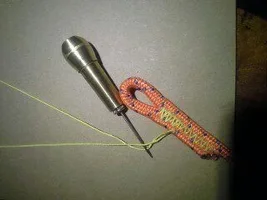
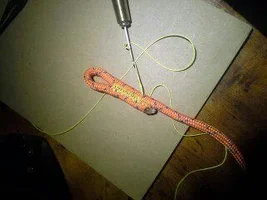
Documenting my hand-sewn eye process

Oops, I'm using the small one! I took the stitches out on the longer one. There were 77 stitches in two passes. The inner pass was33 and the outer 44. All of the stitches were very tight, though.

I'm not sure if maybe it was done this way on purpose so a small eye could be formed in the loop. They might have slightly heated the stitches and pressed the cord on top to hold it until the shrink tube was put on.
 
I just rather splice my own ropes and call it good. I've called some dealers and they only test life support splices to the 5,400 standard, and not the breaking straight of the rope. This info came out when researching the kernmaster splices.

Can you give me more info on the kernmaster splices? I have stitched one and spliced many. I much prefer the spliced kernmaster.
 
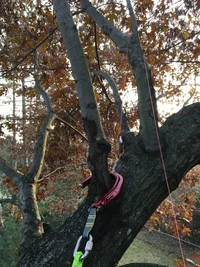
Captains Hook is easily retrieveable with your throw line. It can also be set in the tree using a throw line.
IMG_1467.webp
This way the hook can be gently lowered. If you're in the tree and the hook won't hit the ground, the line can go straight to the hook.
 
Captains Hook is easily retrieveable with your throw line. It can also be set in the tree using a throw line.
View attachment 48273
This way the hook can be gently lowered. If you're in the tree and the hook won't hit the ground, the line can go straight to the hook.

Setting it with a throw line I don't understand. Isn't the main point of the captain that you don't have to mess with throw lines, and that you can twist the hook remotely with your rope? Or maybe I am not picturing setting it the same way you are.

Also, it looks like you still have a strap attached.
 
The throw bag is tossed to a branch near your target branch, or if lucky over it. If on another branch, attach the hook and pull up. Swing the rope and release throw line to get the Hook hooked.
For in the tree retrieval, it is easier than having to get the Hook to drop behind the branch and then twisting the rope to position it for yanking.

Yes, that's a quickdraw dogbone on the Hook.
 
OK I think I am following, so this would be for advancing in a generally upward direction if you need to toss the bag and then attach the hook to it. I was picturing more for traverses where you can't easily get the bag back.
 
You're right, the picture shows a ground set up, or how to rig it in the tree for easy retrieval from the ground.
I've only used it for retrieval while traversing, it possibly could be used for advancing with maybe two throw bags to help drag it over the branch.
 
Hi Bob, I also got an added motivation from the same naysayer, especially when he was behind the locking, then disappearance of a thread I tried to start on this subject over on The House. I initially followed Moss's procedures but later made some adjustments. Like using constrictor knots instead of the c clamps and tape. I also tension the cord or rope while sewing. Good luck, please post the results if you decide to join the "few"!
 
There is a similar discussion happening on a Facebook page right now because someone posted that basal anchors can be dangerous, so therefor they should never be used. My response is - tree climbing is dangerous, so therefore it should never be done.

Once we get past the absolutism of always and never, we can have the real discussion of, when is it a good idea to climb a tree, or sew an eye, and what can be done to bring the known risks down to a reasonable level.

Break testing, documenting technique, and public discussion is the only way that's going to happen for a home solution. And maybe at the end we each say, you know what, this is way to dangerous for me because of this problem we haven't solved. Great, then someone else next year can try again with newer ropes or stitching techniques, or whatever, but don't squash the process, let it flow.
 
...tree climbing is dangerous, so therefore it should never be done...

He does, indeed, make a good point... what I like to think of as the Bobbitt/Crafts argument. If we assigned government regulatory agencies to the task of determining whether marriage was a good idea...

OSHA would determine that wives would be required to wear steel mesh gloves and use special safety utility knives before slicing their husband's dick off while he was sleeping. They would have to use special, approved bio-disposal bags and drop the dick off at designated pecker disposal sites.

OSHA would also determine that husbands would be required to wear certain PPE when operating rented wood chippers for disposing of excess/defective wives. This would include safety helmets, chaps, and night vision equipment when operating the equipment from a bridge in the wee hours of the night. Fresh water lakes and rivers would be off limits, and only designated sewage canals and rainwater runoff ditches would be approved dump/chipping sites.

DHS would determine that marriage is too dangerous for untrained amateurs, and would require certification courses in housekeeping chores, utility knife handling and proper usage, wood chipper operation, and basic GPS and satellite map courses for proper navigation to approved disposal sites. This would be in addition to various drug, disease and DNA testing as well as a six week stint in approved loony bins for the purpose of phsychiatric evaluation.

IRS would determine that a complicated tax form is necessary to handle exemptions and write-offs for equipment rental, disposal fees, etc.

I realize, of course, that goverment regulation is necessary because we're in the middle of a plague of STUPID... but really, sometimes it's better to just let people take a chance with risky, dangerous activities like trying to make a living or getting married.
 
For whatever it might be worth, I have been sewing some tight eyes, and I have a slightly different, but perhaps complementary, approach...
-- I use about a 6 times the rope diameter sew length. (It is a diminishing function, and the "official" number is five times....)
-- I make an eye that is just big enough for another tight eye of the same rope to pass through it.
-- Begin by using a zig zag (sailmaking) sewing machine (very handy for lots of stuff -- adding to your harness, making sewn slings... they're around for pretty cheap if you don't need room under the arm) and sew the meeting between the two parts at about 30 plus stitches per inch -- is like a "bar tack" only narrow, about 3/8" wide (first layer) but grabs both sides and holds everything.
-- Then use 300 lb Dyneema (Braided Fishing Line) Pink or Bright Yellow (so that you can later see an issue if you cut at the eye and don't know it) and begin in the standing side at the outer end, pass the "thread" through, and do a zig zag lock stitch with a frequency of about 5 mm (kinda 6 stitches per inch). You need a piece about 7 to 8 feet long.
- Sew to the middle of the rope. Use needle nose pliers to tighten stitches. (Bury the stitch lock in the middle of the rope, or as close to the middle as you can get it -- no locks anywhere you can see them) up to the throat of the eye.
-- Then sew back, zig zag on top of your first set of stitches, running the needle through slightly outside (slightly toward the outer edge of the rope on each side) and halfway between each stitch of the first set. The stitching will thus "fill in", be continuous (although zig) but not be too "rounded up".
-- When you get back to the outer end of the paired rope, tie a double surgeon's knot in the last little bit of cleft between the two ropes. Then take a "Weller" soldering iron / melter and melt the two ends of the thread knot into the melted end of the rope that is there. The knots stay "inside" between the ropes.
-- I am now wrapping these in Scotch 35 green electrical tape. But of course you can use shrink warp or shrink wrap with glue inside if you want. The only advantage w/ electrical tape is that if you run the splice over something sharp by accident, you can peel the tape to see whether you cut anything you didn't want to.
-- I believe tight is good, but that there is such a thing as too tight in the stitching. In the end, these are stiff, but they are not completely unbendable. As observed elsewhere here, slight irregularity in the sewing I believe is good.
-- I think of this as "lashing" as much as sewing. But I don't go to the outside of the rope (too easy to injure the thread out there) and I end up with something "flat" across the two rope parts. I believe that the locked stitches zigging on top of each other would survive a pretty nasty cut, but I would never hook up a rope to use with even one loose thread.
-- Foolish though I may be, I have confidence that these eyes are strong enough for what I use them for. I worry about everything, but I don't worry about these very much.

 
For whatever it might be worth, I have been sewing some tight eyes, and I have a slightly different, but perhaps complementary, approach...
-- I use about a 6 times the rope diameter sew length. (It is a diminishing function, and the "official" number is five times....)
-- I make an eye that is just big enough for another tight eye of the same rope to pass through it.
-- Begin by using a zig zag (sailmaking) sewing machine (very handy for lots of stuff -- adding to your harness, making sewn slings... they're around for pretty cheap if you don't need room under the arm) and sew the meeting between the two parts at about 30 plus stitches per inch -- is like a "bar tack" only narrow, about 3/8" wide (first layer) but grabs both sides and holds everything.
-- Then use 300 lb Dyneema (Braided Fishing Line) Pink or Bright Yellow (so that you can later see an issue if you cut at the eye and don't know it) and begin in the standing side at the outer end, pass the "thread" through, and do a zig zag lock stitch with a frequency of about 5 mm (kinda 6 stitches per inch). You need a piece about 7 to 8 feet long.
- Sew to the middle of the rope. Use needle nose pliers to tighten stitches. (Bury the stitch lock in the middle of the rope, or as close to the middle as you can get it -- no locks anywhere you can see them) up to the throat of the eye.
-- Then sew back, zig zag on top of your first set of stitches, running the needle through slightly outside (slightly toward the outer edge of the rope on each side) and halfway between each stitch of the first set. The stitching will thus "fill in", be continuous (although zig) but not be too "rounded up".
-- When you get back to the outer end of the paired rope, tie a double surgeon's knot in the last little bit of cleft between the two ropes. Then take a "Weller" soldering iron / melter and melt the two ends of the thread knot into the melted end of the rope that is there. The knots stay "inside" between the ropes.
-- I am now wrapping these in Scotch 35 green electrical tape. But of course you can use shrink warp or shrink wrap with glue inside if you want. The only advantage w/ electrical tape is that if you run the splice over something sharp by accident, you can peel the tape to see whether you cut anything you didn't want to.
-- I believe tight is good, but that there is such a thing as too tight in the stitching. In the end, these are stiff, but they are not completely unbendable. As observed elsewhere here, slight irregularity in the sewing I believe is good.
-- I think of this as "lashing" as much as sewing. But I don't go to the outside of the rope (too easy to injure the thread out there) and I end up with something "flat" across the two rope parts. I believe that the locked stitches zigging on top of each other would survive a pretty nasty cut, but I would never hook up a rope to use with even one loose thread.
-- Foolish though I may be, I have confidence that these eyes are strong enough for what I use them for. I worry about everything, but I don't worry about these very much.


Pictures and videos, please!
 
For whatever it might be worth, I have been sewing some tight eyes, and I have a slightly different, but perhaps complementary, approach...
-- I use about a 6 times the rope diameter sew length. (It is a diminishing function, and the "official" number is five times....)
-- I make an eye that is just big enough for another tight eye of the same rope to pass through it.
-- Begin by using a zig zag (sailmaking) sewing machine (very handy for lots of stuff -- adding to your harness, making sewn slings... they're around for pretty cheap if you don't need room under the arm) and sew the meeting between the two parts at about 30 plus stitches per inch -- is like a "bar tack" only narrow, about 3/8" wide (first layer) but grabs both sides and holds everything.
-- Then use 300 lb Dyneema (Braided Fishing Line) Pink or Bright Yellow (so that you can later see an issue if you cut at the eye and don't know it) and begin in the standing side at the outer end, pass the "thread" through, and do a zig zag lock stitch with a frequency of about 5 mm (kinda 6 stitches per inch). You need a piece about 7 to 8 feet long.
- Sew to the middle of the rope. Use needle nose pliers to tighten stitches. (Bury the stitch lock in the middle of the rope, or as close to the middle as you can get it -- no locks anywhere you can see them) up to the throat of the eye.
-- Then sew back, zig zag on top of your first set of stitches, running the needle through slightly outside (slightly toward the outer edge of the rope on each side) and halfway between each stitch of the first set. The stitching will thus "fill in", be continuous (although zig) but not be too "rounded up".
-- When you get back to the outer end of the paired rope, tie a double surgeon's knot in the last little bit of cleft between the two ropes. Then take a "Weller" soldering iron / melter and melt the two ends of the thread knot into the melted end of the rope that is there. The knots stay "inside" between the ropes.
-- I am now wrapping these in Scotch 35 green electrical tape. But of course you can use shrink warp or shrink wrap with glue inside if you want. The only advantage w/ electrical tape is that if you run the splice over something sharp by accident, you can peel the tape to see whether you cut anything you didn't want to.
-- I believe tight is good, but that there is such a thing as too tight in the stitching. In the end, these are stiff, but they are not completely unbendable. As observed elsewhere here, slight irregularity in the sewing I believe is good.
-- I think of this as "lashing" as much as sewing. But I don't go to the outside of the rope (too easy to injure the thread out there) and I end up with something "flat" across the two rope parts. I believe that the locked stitches zigging on top of each other would survive a pretty nasty cut, but I would never hook up a rope to use with even one loose thread.
-- Foolish though I may be, I have confidence that these eyes are strong enough for what I use them for. I worry about everything, but I don't worry about these very much.

Wow, for a first post, that was a doozy, welcome to the forum leaf!

And x2 on the pictures and videos when you can, I followed about half of that but it sounds solid.
 
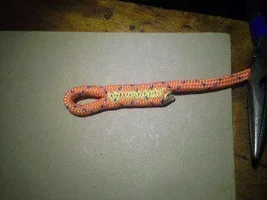
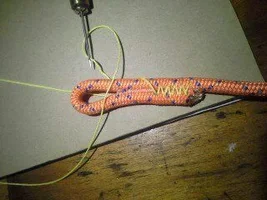
These may or may not help, but they show a (not especially tight) tight eye in a piece of (not very high quality) 8mm. In the first the basic result (before covering). Then, next pic, the initial "basting zig" is white and may be hard to see, and the 300 lb dyneema is begun. (Stitching is slightly wider than for larger sizes. If you count the number of ties and multiply by 300.... ) Then sewn up to the throat and turning back. The finishing knots are between the two pieces of rope to the right. (You can see the yellow end from the outer knot melted into the end of the rope.) Most of the ideas involved have to do with making something that doesn't want to get hurt or come apart. The stitching isn't perfectly even -- it is not as pretty as if it were, but I think you get a slightly better connection to the core of the rope because that way the fibers are held / go one side and another of the sewing.
As noted, I load these -- but not egregiously. (I have a bit of a theory about reasonably safe use of stuff we make and work with -- that applies to welding (I've done a little welding), applies to ... a lot of stuff.
I'm very open to any criticism of any kind of the design, technique, methods, choices, etc. It is more than likely that there are people on this board who know how to do the same thing, only do it better. I'm a little less interested in the "you should have sent this to a professional for lab testing before you used it" argument (not that I don't think lab testing is GREAT!!!), but as a practical matter, we can't send every tree limb we put a rope around into a professional for lab testing, and so there is a place in many of the things we do in life for developing practical experience as to what can be reasonably well done and safely used.


1515731214867.webp 1515729737065.webp 1515730527308.webp 1515731043793.webp
 
Nice work, leaf! Your stitching looks very good, like you said not machine perfect, but I agree, due to the pliable nature of cords and rope, it doesn't have to be perfect.

What brand of fishing line did you use? I thought that the dyneema line would have a bigger diameter. I use 80# Pline brand line that has a teflon coating, which makes it stiff, easier to use with less tangles and threading the needle is easier.

A pull test would give you assurance that your materials and theories are compatible. Too solid or too long of a connection might prevent the cord from stretching, causing it to break at a lower force.

It might have been covered earlier in this thread that the theory is that only half of the zig zag stitches take the load. The ones angled from the short part down towards the eye aren't tensioned when the eye is loaded.
It's possible with your method, and a z pattern stitch to reduce the number of stitches and the length of the connection, maybe making a stronger union.
 
Nice work, leaf! Your stitching looks very good, like you said not machine perfect, but I agree, due to the pliable nature of cords and rope, it doesn't have to be perfect.

What brand of fishing line did you use? I thought that the dyneema line would have a bigger diameter. I use 80# Pline brand line that has a teflon coating, which makes it stiff, easier to use with less tangles and threading the needle is easier.

A pull test would give you assurance that your materials and theories are compatible. Too solid or too long of a connection might prevent the cord from stretching, causing it to break at a lower force.

It might have been covered earlier in this thread that the theory is that only half of the zig zag stitches take the load. The ones angled from the short part down towards the eye aren't tensioned when the eye is loaded.
It's possible with your method, and a z pattern stitch to reduce the number of stitches and the length of the connection, maybe making a stronger union.

Great stuff. Just to mention... in my technique the wide zig-zag stitch first pass is simply a "basting" stitch to capture the compression I created with my narrow vinyl tape wraps. While it contributes some small percentage of strength in the final eye, it is the following two passes that create the greatest thread strength and lock down the important compression force in the join. So while the second and third passes are technically described as zig-zag stitches, the angles are so tight, I believe strength/load variables of one angle stitch vs. another are negligible to non-existent as far as the strength of the overall join is concerned.
-AJ
 
A note on the size of the eye... My goal for eye size is that it be snug but not too snug on a carabiner. In my first sewn eyes I made one too tight, at the point of most bend on the outside of the eye it was clear that I exceeded the max bend radius of the cordage (10mm Ocean Polyester) with a carabiner pushed into the eye. The cover weave was separating and the core was visible. So currently I wrap the cordage on a carabiner to the size and tension I want, tape the throat of the eye, take the carabiner out, tape the eye "flat" to capture the eye size, take the throat tape off and the move on to the pre stitching compression process.
-AJ
 

New threads New posts

Kask Stihl NORTHEASTERN Arborists Wesspur TreeStuff.com Teufelberger Westminster X-Rigging Teufelberger
Back
Top Bottom