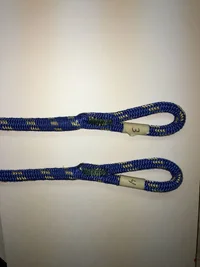
Documenting my hand-sewn eye process

View attachment 38811 View attachment 38812 Your wish is my command!

The top two broke at 3530
The next two at 3400
The third pair at 4570
The last two at 4540
The combo broke at 6530

The rope broke on all of them at where the stitching started. Number 9 broke inside the stitching at the eye end and ripped them as it pulled out.

Thanks for the results. I expect all to break where the stitching started. So number 9 is special. Do you or anybody else have an idea on what shall be done to prevent this kind of failure?

I should like to know the expected breaking strength of the rope involved.
 
Yale rates the 5/16 Beeline at 8000#. Since it is core dependent that might be the breaking strength of just the core. New England Rope has vectran without a cover,which I'm using now as I ran out of Beeline, the 6mm size is rated at 8000# and is about the same size as the Beeline core. They are braided differently so I'm not sure.

As for the breaking at the stitching I'm trying to combine a bury with the typical side sewing, and possibly staggering the passes of the sewing so the load doesn't meet up with a wall of stitches all at once.
 
Yale rates the 5/16 Beeline at 8000#. Since it is core dependent that might be the breaking strength of just the core. New England Rope has vectran without a cover,which I'm using now as I ran out of Beeline, the 6mm size is rated at 8000# and is about the same size as the Beeline core. They are braided differently so I'm not sure.

As for the breaking at the stitching I'm trying to combine a bury with the typical side sewing, and possibly staggering the passes of the sewing so the load doesn't meet up with a wall of stitches all at once.
Beeline is only core dependent when splicing. It is certainly cover and core dependent when used for it intended purpose, heat resistant prussik cord. It is much stronger stitched than when naked eye spliced in a straight pull eye to eye.

Reed Wortley
CTSP #01739
ISA CA #SO-6953A
 
Thanks Reed, is it from personal experience or is there some testing that was done to show that the stitched was stronger than the naked eye splice?
 
Thanks Reed, is it from personal experience or is there some testing that was done to show that the stitched was stronger than the naked eye splice?
It just makes sense that is you incorporate cover and core together with a strong stitch it is strong than the core alone.

Reed Wortley
CTSP #01739
ISA CA #SO-6953A
 
Yale rates the 5/16 Beeline at 8000#. Since it is core dependent that might be the breaking strength of just the core. New England Rope has vectran without a cover,which I'm using now as I ran out of Beeline, the 6mm size is rated at 8000# and is about the same size as the Beeline core. They are braided differently so I'm not sure.

As for the breaking at the stitching I'm trying to combine a bury with the typical side sewing, and possibly staggering the passes of the sewing so the load doesn't meet up with a wall of stitches all at once.

I just want to be sure, that you know that Vectran are susceptible to UV-light.

I think we normally seen results of break tests on sewn eyes in polyester or nylon ropes. These materials have much more elongation than Vectran and Dyneema. With elongation and a straight sewn seam, the forces will concentrate in the rope end of the seam. So it will be normal to see the break here. With Vectra and Dyneema, I suspect that a longer part of the seam carry the load and other ways of breaking appear. Anyway I think this way the breaking occurred at no. 9 is somewhat suspicious. Perhaps there is some difficulty in getting the core engaged with the sewing thread.
 
Thanks Gymnast, it always has a cover, being used as a friction hitch cord.

The 1-2 cord,the 3-4 cord, and the 9-10 cord are basically the same type of stitch pattern. However, the 9-10 cord,as well as the 7-8 one were tensioned while being sewn. Maybe this increased the breaking strength?

I'm scratching my head too why no. 9 broke at the eye side and on the short piece of cord not the long.
 
@FreeFallin, no I haven't had it tested yet. I have two more variations to sew. The ones I had tested all broke at the start of the stitching. With the bury I'm hoping both the top and bottom sewn sections share the load more. I also now stagger the passes to slightly avoid the load hitting all three passes at once. A couple other changes from the first set is I'm using less stitches, 60 instead of 88 on the cord I showed in the other thread, to 45 on the next two to be made. My previous eyes have had four passes with the first going through the top and bottom to create a lot of compression, but that made it very difficult to sew the other three side passes. Now I use a series of double constrictor knots to provide the compression and just do side stitches, so much easier.
This is the cord to be tested, the other was the prototype I made to be sure I could do the bury and sewing
IMG_1152.webp
 
Those really do look good. One thought on the physics of what is happenning - I have found that the load is born as much by the friction that the thread creates between the two ropes, as it is by the thread itself. In other words as the eye comes under load, the rope elongates a tiny bit, slips a little, and the stitches swing the two sides together more tightly. This could create two negative effects of the join taking the load with more of a jerk, and also the fibers all around the join having to slide into loaded position every time. It stands to reason then, that the connection will be stronger and last longer if you can "pre-load" the fibers.

If you are with me so far, I would suggest an old technique of pre-tentioning the join before you stitch so it is always in a "loaded" position. This can be done by pulling, even a little on the ropes to line the fibers up, and then wrapping some thread tightly around the whole length of the join like a basting stitch to hold everything in place, this can be snipped off or left on after sewing. It can be pretty sparse like 3mm apart per wrap it does not need the density of a whipped end.

This is just a thought.
 
This is similar by the way to what Moss was doing at the beginning of this thread with the clamps and tape, but I do think wrapping with a slight pull will keep tension on the line throughout the sewing process better than the tape.
 
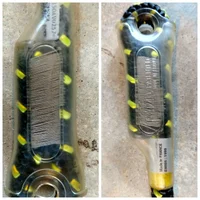
Some may find this interesting. There was a technical notice, can't find it right now warning about bad sewn eyes. They talked about the stitching being at an angle and that was an indication the eye was starting to fail. It was a blog or something on sewn eyes.
Anyway, this is the eye that comes on a Petzl Zillion, note the angle of the stitching. A machine can be set to sew the stitch at this angle in an effort to prevent any slippage in the first place. Side note: Notice that "patented" is labeled on the lanyard. They have patented the lanyard?, sewn eyes? I'm not going to look it up, just find it interesting as I've been forced to deal with patent issues of late. Maybe the plastic cover over the sewn eye is patented. SewnEye.webp
 
The slanted stitches are interesting, seems like that would introduce the kind of slop that a failing eye would have unless there is another set of stitches slanted the opposite way underneath those to tension against eachother, but that seems like a fix for a bad idea to begin with. Not to lecture Petzl, I'm sure they have good reason.

As for the patent, maybe it is for the idea of "rope"?
 
The stitching on the left looks like the pattern for a stopper end that is on a Connect Adjust that I took apart. Doesn't look like any variation in length of the stitches that is visible on the load bearing eye.

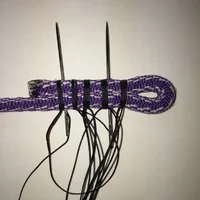
Compression and pattern and strength of the thread work together to hold them together. I use about 80# of tension while sewing. Before the first pass the short and long parts are pulled independently and then together for the next two passes. Below shows how I am now keeping compression during all three passes
image.webp
 
This is similar by the way to what Moss was doing at the beginning of this thread with the clamps and tape, but I do think wrapping with a slight pull will keep tension on the line throughout the sewing process better than the tape.

The tape is used to hold compression one tape wrap width at a time as the basting stitch is applied, when the basting stitch (first pass) is completed it is holding the tension. As the second and then third pass are completed the compression is increased as more thread "volume" is introduced into the cordage. End result is an extremely tight join, I don't believe it's possible to make it any more compressed, you would have to force the needle through with significant force on the last pass and will break needles.
-AJ
 
@moss looking at your process and the way @Brock is tying his I have to agree, I don't think it can get much tighter.

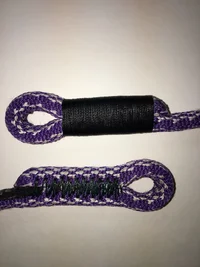
Thinking outside the norms a little, it seems like the earlier tests were failing because the sewing process itself, even with the ball tip needles, compromises the integrity of the core. Has anyone tried doing either stitches really wide so they are only through the outer sleeve, or even scarier - just whip it really tight and shrink wrap it? This is scary because it would be more difficult to spot approaching failures, but I wonder if it would solve the rope snapping where the stitches start.
 
Interesting ideas on the single wide stitching and the seizing to eliminate the threads in the center. I think if the seizing started to give, you probably would be able to see the threads starting to slant as it shifted. Coincidentally that is how I like to finish my sewn eyes
IMG_1144.webp
 

New threads New posts

Kask Stihl NORTHEASTERN Arborists Wesspur TreeStuff.com Teufelberger Westminster X-Rigging Teufelberger
Back
Top Bottom