Documenting my hand-sewn eye process

Adding one to the list here.. Teufelberger Multisling...

Still using C-Lon Tex 400.. hand waxed. (Note- beeswax doesn't stick all that well to it, Id like to find a colored thread like the SS thread that's real tacky & stronger)


6bfc7dec2f4983820130a7a491bf0c67.jpg
f930aee44a9c62f1d0fce7e69d987473.jpg


So.. umm yeah.. this is probably the third go around with this little project.. Hand spliced it once.. Got sewing paraphernalia & decided to redo.. Noticed how long my passes were & decided to redo...

Then i got greedy during the very last step before heat shrinking & tried cutting the tail more... .. Yup.. deff melted two strands like an idiot.... Soooooo... starting over again..... Smh! Just like high school algebra... 4th times a charm!

4e28c87dfec7e454ad046954137791bc.jpg
30390112431a6b6c522cbfd73379312e.jpg
 
Adding one to the list here.. Teufelberger Multisling...

Still using C-Lon Tex 400.. hand waxed. (Note- beeswax doesn't stick all that well to it, Id like to find a colored thread like the SS thread that's real tacky & stronger)


6bfc7dec2f4983820130a7a491bf0c67.jpg
f930aee44a9c62f1d0fce7e69d987473.jpg


So.. umm yeah.. this is probably the third go around with this little project.. Hand spliced it once.. Got sewing paraphernalia & decided to redo.. Noticed how long my passes were & decided to redo...

Then i got greedy during the very last step before heat shrinking & tried cutting the tail more... .. Yup.. deff melted two strands like an idiot.... Soooooo... starting over again..... Smh! Just like high school algebra... 4th times a charm!

4e28c87dfec7e454ad046954137791bc.jpg
30390112431a6b6c522cbfd73379312e.jpg

Ahhh, bummer on melting strands! Yeah I bend the throat as far back as it will go when I do the hot cut. That's one of those moments when you need to clear the mind and focus when you push the hot knife through. If it will show up on th ecordage, I used to make a mark with a Sharpie to guide my cut. Nowadays I can do it without the mark. I've melted some strands, once you do it, not likely to happen again, pain is a great teacher ;-) I've done some cold with a sharp blade, you have to sew the tape in though when you do that. Your stitching looks superb!

When I wax the C-Lon thread I run sections back and forth to heat things up, I get decent penetration of wax, surface wax is skimmed off when you run the thread through the needle eye but enough remains to make a difference. For me the difference is in thread handling during sewing, much better after it's waxed.
-AJ
 
Two reasons why a more "tapered" angle cut is good after the stitching is done, less to hang up when you're pulling the lanyard back through a tight spot and it's easier cut the end and not contact the "throat" when you're wielding the hot knife. Here's recent stuff, showing both sides, you won't see any lock stitches on the surface, each stitch is tensioned then the lock is buried. I think the second photo is the top side, stitching is a little more orderly. I can see I got some fine sawdust or something under the shrink tubing. I use a double layer of shrink tubing of the non-adhesive type, makes it easier to inspect the stitching over time.

45673108155_75641039a1_c.jpg


31646423757_6c8f216c39_c.jpg
 
Very nice workmanlike finish on these Moss - one thing I really like is that your stitching starts back from the cut end a bit more than some of the other pic's in this thread. I think this is probably important is it, in an area of stress on the sewing which seems to be a recurring theme in some of the notes above in this thread. Also do you normally do two layers of shrink on each splice. I've just been doing one. Nice work man!
(Where do you get "CLon thread" from and what size please?)

Addenda: For what it may be worth, when I have troubles with pushing a needle thru tight splices, I use a ball peen hammer (just for the weight) and gently tap the needle thru the rope I'm splicing. Seems to work fine and often allows for straighter needle placement even than hand sewing. Once it pokes thru I just pull with pliers the rest of the way. Watch your thread so you don't pinch it.
 
Ahhh, bummer on melting strands! Yeah I bend the throat as far back as it will go when I do the hot cut. That's one of those moments when you need to clear the mind and focus when you push the hot knife through. If it will show up on th ecordage, I used to make a mark with a Sharpie to guide my cut. Nowadays I can do it without the mark. I've melted some strands, once you do it, not likely to happen again, pain is a great teacher ;-) I've done some cold with a sharp blade, you have to sew the tape in though when you do that. Your stitching looks superb!

When I wax the C-Lon thread I run sections back and forth to heat things up, I get decent penetration of wax, surface wax is skimmed off when you run the thread through the needle eye but enough remains to make a difference. For me the difference is in thread handling during sewing, much better after it's waxed.
-AJ
Thanks for the kind words..

Yes.. i do it the same but as you said my mind was not clear.. i was hanging out my sliding glass door at night with map torch in one hand & razor knife in other.. if i run the map torch inside it sets off my smoke/monoxide alarms.. even with no visible smoke.. But yeah.. i wasn't paying enough attention & didn't have good lighting. The thin razor always cools off before I'm through cutting, so i probably rushed to.

As far as the wax goes.. idk.. again i do it the same as you running it over the thread fast & hot... i guess i just like it super waxy as must just flakes off.. I've been trying to figure out how they make the speedy stitcher thread so tacky.. it has to be a different wax or something.. i like it tacky so it doesn't untwist & fray as easy.. this C-lon I've been using has been starting to split & fray like an abraided thread would after the wax wears off mid project..

Two reasons why a more "tapered" angle cut is good after the stitching is done, less to hang up when you're pulling the lanyard back through a tight spot and it's easier cut the end and not contact the "throat" when you're wielding the hot knife. Here's recent stuff, showing both sides, you won't see any lock stitches on the surface, each stitch is tensioned then the lock is buried. I think the second photo is the top side, stitching is a little more orderly. I can see I got some fine sawdust or something under the shrink tubing. I use a double layer of shrink tubing of the non-adhesive type, makes it easier to inspect the stitching over time.

45673108155_75641039a1_c.jpg


31646423757_6c8f216c39_c.jpg

I agree about the tapered cut & the purpose behind it. I was just trying to get it anotomically identical to the Teufelberger one.. but i got too greedy, went too short.. & obviously too deep!

What do you mean when you say, "you won't see any of the lock stitches on the surface of the backside".. im not following.. i didn't think you were supposed to.. Or are you saying you can see mine in the surface?


Very nice workmanlike finish on these Moss - one thing I really like is that your stitching starts back from the cut end a bit more than some of the other pic's in this thread. I think this is probably important is it, in an area of stress on the sewing which seems to be a recurring theme in some of the notes above in this thread. Also do you normally do two layers of shrink on each splice. I've just been doing one. Nice work man!
(Where do you get "CLon thread" from and what size please?)

Addenda: For what it may be worth, when I have troubles with pushing a needle thru tight splices, I use a ball peen hammer (just for the weight) and gently tap the needle thru the rope I'm splicing. Seems to work fine and often allows for straighter needle placement even than hand sewing. Once it pokes thru I just pull with pliers the rest of the way. Watch your thread so you don't pinch it.

I'm not sure if that aspect is all that important.. if you look here, you'll see how close all of these are cut from the factory.. i thought the same thing before i started looking at the factory ones i have sitting around.

2a313b589d3b816cd92c8cf68bf74748.jpg


A ball peen hammer aye? Are we still using the speedy stitcher in this scenario? I really don't see how there could be any control using that method as far as lining your stitches up on the other side.. i think it would be a luck if the draw type of deal.. I've also not encountered any situation where i would need that much force to pass the needle.. Whipping a rock hard splice... yes.. I've needed these things.. but stitching had been a completely different experience. Maybe if someone is using a bare needle this would be needed.. but i don't think any of us would recommend trying it without the SS, I can see that being pretty painful..

The C-lon Tex 400? Anywhere.. Google it & you'll find a thousand results. Tex 400 is the size. The "Thread Exchange" has helpful info on all this stuff. Terminologies, thread sizes, needle sizes, etc. Thread & Sewing is one of those deals where alot of companys have a different measurement standard they go by.
 
I'm not sure if that aspect is all that important.. if you look here, you'll see how close all of these are cut from the factory.. i thought the same thing before i started looking at the factory ones i have sitting around. I also have some sewn eyes where the stitching is really quite short looking as mentioned above somewhere, and some Teufelberger stuff that is cut off straight and some at an angle so unsure if mfgrs are all that consistent too. Just wondering given the comments above on pulls/ tears near this location of the stitching.

A ball peen hammer aye? Are we still using the speedy stitcher in this scenario? Nope no stitcher anymore, just bare needle most times . . . . some of these eyes have been really really tight on last pass.

The C-lon Tex 400? Anywhere.. Google it & you'll find a thousand results. Tex 400 is the size. The "Thread Exchange" has helpful info on all this stuff. Terminologies, thread sizes, needle sizes, etc. Thread & Sewing is one of those deals where alot of companys have a different measurement standard they go by. Ditto on all the different terminologies for sure - thanks much
 
Thanks for the kind words..
A ball peen hammer aye? Are we still using the speedy stitcher in this scenario? I really don't see how there could be any control using that method as far as lining your stitches up on the other side.. i think it would be a luck if the draw type of deal.. I've also not encountered any situation where i would need that much force to pass the needle.. Whipping a rock hard splice... yes.. I've needed these things.. but stitching had been a completely different experience. Maybe if someone is using a bare needle this would be needed.. but i don't think any of us would recommend trying it without the SS, I can see that being pretty painful..
I just whipped mine up using this needle from treestuff and it wasn't really a struggle. I've done lock stitching on hand spliced eyes that was more difficult. Granted I only did 2 passes and not 3, but it was relatively easy and I could see a 3rd pass if spaced accordingly being doable without a speedy stitcher.

Anyways onto my test results.
First the uncut video of the test. I tried using my go-pro to record it at 90 frames per second, but even slowed down (see the end of the video) you still can't see much.

I succeeded in breaking the webbing sling before the stitching failed, which according to the tag should have been 6500 lbs ABS. Was it new? no; but it was still in good enough condition to not have a concern about needing to retire it and was still in regular the regular use rotation. A second attempt to break the stitching resulted in nothing. I wasn't able to break it; pulling against a 30000 lb truck with a front end loader, the brakes on the truck were slipping and rather than damage the bosses equipment, we called the test.

So now onto the diagnostics.
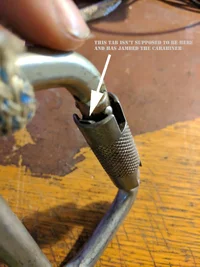
1 carabiner was broken during the test. The carabiner itself is still intact, however the gate had the spring? that actuates the gate jamb and prevents the barrel from rotating and opening.
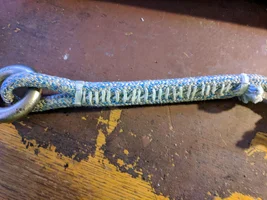
The end to end overlapping hand stitched splice shows very little signs of being loaded. It stretched enough that some of the whipping slipped and the ends of the cord frayed a little bit (this could most likely have been prevented with better whipping, or using a hot knife to melt the cut ends. The stitching shows no signs of wear or slippage and the splice itself still feels firmly joined.
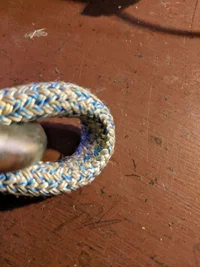
The hand stitched eye shows some slight discoloration and and wear on the cover fibers where the ISC ring sat. But to be honest, I've gotten worse signs on wear first climb on a new lanyard on a rough barked tree. The stitching shows no signs of wear or slippage and the splice itself still feels firmly joined.
The hand spliced eye is the only one showing any signs of damage with a few broken cover strands in the cover, and besides knowing what it's been through, would be enough for pause during a gear inspection, but would probably get a pass and continue to be climbed on.

All in all what I would consider a very successful test on what was for me an untried technique. I feel comfortable enough with the results that I would be comfortable climbing and rigging on something similar for my own use. That being said some additional tests would be nice for my own curiosity, and to see if it's possible to shorten up the length of the splice and retain strength (either through closer stitching, or doing 3 passes).

Lastly a bit of my own musing. I was interested in this more from a curiosity standpoint rather than any actual desire to save money, or vs my own hand spliced eyes. As I've watched this thread there seems to have been a leaning towards replicating what machines are capable of doing, both with attempts to replicate the stitch patterns and density as well as with the style of stitches. Not to say that any of that is wrong, and I don't disagree with that line of thinking; I just figured there might be an easier to reproduce way of getting to the same end result. With the earlier pages of the thread delving into the overall splice strength vs number of stitches vs strength of thread; I assumed that the strength could be retained with a longer length splice with easier to do stitch passes (no 3rd pass which sounded like where most of the difficulty arose)

I feel like I've written a small easy

 

Attachments

  • edited_IMG_20190103_165852.webp
    edited_IMG_20190103_165852.webp
    255.1 KB · Views: 32
  • IMG_20190103_165843.webp
    IMG_20190103_165843.webp
    336.9 KB · Views: 30
  • IMG_20190103_165919.webp
    IMG_20190103_165919.webp
    329.3 KB · Views: 33
  • IMG_20190103_165947.webp
    IMG_20190103_165947.webp
    467.6 KB · Views: 33
  • IMG_20190103_165952.webp
    IMG_20190103_165952.webp
    369 KB · Views: 34
I just whipped mine up using this needle from treestuff and it wasn't really a struggle. I've done lock stitching on hand spliced eyes that was more difficult. Granted I only did 2 passes and not 3, but it was relatively easy and I could see a 3rd pass if spaced accordingly being doable without a speedy stitcher.

Anyways onto my test results.
First the uncut video of the test. I tried using my go-pro to record it at 90 frames per second, but even slowed down (see the end of the video) you still can't see much.

I succeeded in breaking the webbing sling before the stitching failed, which according to the tag should have been 6500 lbs ABS. Was it new? no; but it was still in good enough condition to not have a concern about needing to retire it and was still in regular the regular use rotation. A second attempt to break the stitching resulted in nothing. I wasn't able to break it; pulling against a 30000 lb truck with a front end loader, the brakes on the truck were slipping and rather than damage the bosses equipment, we called the test.

So now onto the diagnostics.
1 carabiner was broken during the test. The carabiner itself is still intact, however the gate had the spring? that actuates the gate jamb and prevents the barrel from rotating and opening.
The end to end overlapping hand stitched splice shows very little signs of being loaded. It stretched enough that some of the whipping slipped and the ends of the cord frayed a little bit (this could most likely have been prevented with better whipping, or using a hot knife to melt the cut ends. The stitching shows no signs of wear or slippage and the splice itself still feels firmly joined.
The hand stitched eye shows some slight discoloration and and wear on the cover fibers where the ISC ring sat. But to be honest, I've gotten worse signs on wear first climb on a new lanyard on a rough barked tree. The stitching shows no signs of wear or slippage and the splice itself still feels firmly joined.
The hand spliced eye is the only one showing any signs of damage with a few broken cover strands in the cover, and besides knowing what it's been through, would be enough for pause during a gear inspection, but would probably get a pass and continue to be climbed on.

All in all what I would consider a very successful test on what was for me an untried technique. I feel comfortable enough with the results that I would be comfortable climbing and rigging on something similar for my own use. That being said some additional tests would be nice for my own curiosity, and to see if it's possible to shorten up the length of the splice and retain strength (either through closer stitching, or doing 3 passes).

Lastly a bit of my own musing. I was interested in this more from a curiosity standpoint rather than any actual desire to save money, or vs my own hand spliced eyes. As I've watched this thread there seems to have been a leaning towards replicating what machines are capable of doing, both with attempts to replicate the stitch patterns and density as well as with the style of stitches. Not to say that any of that is wrong, and I don't disagree with that line of thinking; I just figured there might be an easier to reproduce way of getting to the same end result. With the earlier pages of the thread delving into the overall splice strength vs number of stitches vs strength of thread; I assumed that the strength could be retained with a longer length splice with easier to do stitch passes (no 3rd pass which sounded like where most of the difficulty arose)

I feel like I've written a small easy

Cool stuff! Yeah that's the kicker, if you want a short as possible length of stitching (I do for my eyes) with optimal strength I think you need to do three passes.
-AJ
 
Very nice workmanlike finish on these Moss - one thing I really like is that your stitching starts back from the cut end a bit more than some of the other pic's in this thread. I think this is probably important is it, in an area of stress on the sewing which seems to be a recurring theme in some of the notes above in this thread. Also do you normally do two layers of shrink on each splice. I've just been doing one. Nice work man!
(Where do you get "CLon thread" from and what size please?)

Addenda: For what it may be worth, when I have troubles with pushing a needle thru tight splices, I use a ball peen hammer (just for the weight) and gently tap the needle thru the rope I'm splicing. Seems to work fine and often allows for straighter needle placement even than hand sewing. Once it pokes thru I just pull with pliers the rest of the way. Watch your thread so you don't pinch it.

When I'm sewing the eye I'll have a few inches of cordage that will be cut off when the stitching is done, I don't want any variation in the cordage weave tension or position that might happen if I cut it short before I sew. This is all intuitive but it tests well ;-)

If I'm using adhesive lined shrink tubing one layer, the non-adhesive stuff seems thinner, I've had one layer eventually abrade through so I use two.

If I need a ball peen to tap a needle though I'm doing something wrong. This is all so vague and unquantifiable but if I have the pre-compression on the join just right and the tension on the thread just right, kind of like Goldilocks and the Three Bears, not too tight not too loose, the first two passes push through nice with the sewing awl. the last pass is a little tough to push through but not a problem at all. If I'm fraying or breaking thread on the last pass I've been tensioning the stitches too hard on the first two passes.

Also... about burying the lockstitch which otherwise can remain on the surface on the backside of the stitched cordage. On my first generation stitched eyes I didn't think of it as a problem. Then somewhere in this thread someone mentioned that a machine balances the stitching perfectly and buries the lock evenly inside the cordage. So I had to make that so with the handstitching ;-) That's how I do my stitching now and they test quite a bit stronger than the first generation technique. Don't know if burying the lock makes the difference, probably a combination of all the details of stitching an eye.
-AJ
 
Last edited:
All of the above is why not many people do this, takes a certain kind of mind, I have no idea why the hell my mind is the way it is. Probably the result of some kind of childhood deprivation, me and my brothers and sisters used to invent/make a lot of stuff that we otherwise wouldn't have. I'm sure many of you the same.
-AJ
 
Thanks for the kind words..

Yes.. i do it the same but as you said my mind was not clear.. i was hanging out my sliding glass door at night with map torch in one hand & razor knife in other.. if i run the map torch inside it sets off my smoke/monoxide alarms.. even with no visible smoke.. But yeah.. i wasn't paying enough attention & didn't have good lighting. The thin razor always cools off before I'm through cutting, so i probably rushed to.

Believe me my mind is in and out clear/not clear ;-) Yeah I try to cut outside, thicker knife is good for sure to keep the heat. I have an old filleting knife that I sacrificed for cutting cordage. Nowadays I don't melt cordage for most cuts, just wrap well with vinyl tape and cut with a sharp knife that has a little heft. For the sewn eyes I still melt, if the cordage is all polyester.
-AJ
 
Believe me my mind is in and out clear/not clear ;-) Yeah I try to cut outside, thicker knife is good for sure to keep the heat. I have an old filleting knife that I sacrificed for cutting cordage. Nowadays I don't melt cordage for most cuts, just wrap well with vinyl tape and cut with a sharp knife that has a little heft. For the sewn eyes I still melt, if the cordage is all polyester.
-AJ
You know.. that's how I've been doing it for a while, just in general.. tight wrap, sharp scissors & done with it.. But.. when doing these sewn eyes I've noticed how the core likes to suck back into the cover, leaving one more thing i need to plan ahead for or estimate.. So if it's possible, i melt.. & that seems to have helped with the problem.

Also Aj.. i know you mentioned you use the same needle for everything, but I've been wondering if a smaller needle for this smaller cordage would be helpful... You know for when your working that last pass & you really want to keep the stitches tight to each other. I think a smaller needle & thread would allow that to happen with less struggle.. I will say though, i haven't really tried anything smaller than this Tex 400, so maybe that alone would allow tighter groupings on the last pass.. idk.. hard to explain.. still feel a smaller needle would be helpful.. problem is, is knowing how small you can go without being too brittle.

Lastly, i think I'm going to take apart this Grizzly Splice & see what it's all about.. I haven't heard anyone else comment on it so i guess I'll take one for the team.. From the outside, it just looks so easily repeatable by hand as well as far fewer stitches.. & if it is something that can be easily replicated, then we could take it to the bank that we don't need to have our patterns as tightly grouped either. I mean.. a machine isn't counting picks or choosing where it's going to pass the needle through like we do. It's just a precise pre programmed pattern that runs through the Cordage & from what I've seen the Cordage isn't all that tight.. at least not in the Grizzly/Rope Logic stitching.. Bottom line is, i think it can be replicated with ease.
 
When I'm sewing the eye I'll have a few inches of cordage that will be cut off when the stitching is done, I don't want any variation in the cordage weave tension or position that might happen if I cut it short before I sew. This is all intuitive but it tests well ;-)

If I'm using adhesive lined shrink tubing one layer, the non-adhesive stuff seems thinner, I've had one layer eventually abrade through so I use two.

If I need a ball peen to tap a needle though I'm doing something wrong. This is all so vague and unquantifiable but if I have the pre-compression on the join just right and the tension on the thread just right, kind of like Goldilocks and the Three Bears, not too tight not too loose, the first two passes push through nice with the sewing awl. the last pass is a little tough to push through but not a problem at all. If I'm fraying or breaking thread on the last pass I've been tensioning the stitches too hard on the first two passes.

Also... about burying the lockstitch which otherwise can remain on the surface on the backside of the stitched cordage. On my first generation stitched eyes I didn't think of it as a problem. Then somewhere in this thread someone mentioned that a machine balances the stitching perfectly and buries the lock evenly inside the cordage. So I had to make that so with the handstitching ;-) That's how I do my stitching now and they test quite a bit stronger than the first generation technique. Don't know if burying the lock makes the difference, probably a combination of all the details of stitching an eye.
-AJ

Thanks guys for the comments.
The hammer isn't used to strike, just to push a bit more (straight) than I can seem to do with the sailors palm - maybe more like with the stitcher. Great info about maybe too tight. Back to the lab bench for me . . . this thread is very cool. Cheers
 
IC.. So your not using a speedy stitcher then, right? Your talking about a Sail Palm so you must be just using a bare needle.. Correct? I give ya credit trying to sew eyes without a SS.. that must be hard work.. I'm not even sure how I'd go about it with the needle hole being on the other end.. you must have to pass it through, flip it & passed it back though the same hole, then create your lock.. right?

Or are you doing parameter stitching on yours?
 
Went away from the stitcher and find I've done better with needle and a sail palm first two passes anyway. Stitching is running stitch in a zig zag pattern - as you describe. Last couple were using doubled thread. I've also fooled around with doing only two rows of stitching zig zag and a row of stitching at 90 degrees done with speedy stitcher and lock stitch. These were really strong too - used for bracing busted trees for 6-8 month periods patching up storm damage (sometimes using old dynamic climbing lines - really whatever I had lying around). Still only used class 1 splices on climbing line that is life support though. Am really intrigued by the whole thing.
Not sure what parameter stitching is?
https: //www.tandfonline.com/doi/abs/10.1080/00405000.2017.1312677?src=recsys&journalCode=tjti20
https: //www.research.manchester.ac.uk/portal/files/54512390/FULL_TEXT.PDF

Wife's question - is rope splicing really the guy version of knitting then? Dunno. Have enjoyed the journey so far.
 

New threads New posts

Kask Stihl NORTHEASTERN Arborists Wesspur TreeStuff.com Teufelberger Westminster X-Rigging Teufelberger
Back
Top Bottom