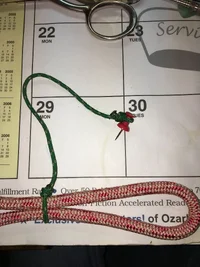
Documenting my hand-sewn eye process

@Jimmycrackcorn - You need to take a trip to a Joanne Fabrics, Or Michaels, or any other sewing shop. If you are anywhere near a WestMarine, you can go in and get the proper whipping twine and you can sew eyes with it etc.

#4 needle is the other "official" one for the sewing awl.
Micheal's had jack shit.. held off on buying via internet because i figured I'd be golden there, but all i could find was tiny #69 thread & tiny machine needles. It was all yarn/crochet BS & about a two foot section of sewing related stuff.. same stuff i saw at Walmart.

Yes I'm aware of that SS #4, but it's a diamond tip, is it not? I'm trying to avoid all that tip grinding nonsense & just get the correct tools for the job.

There's an industrial sewing parts house in my city, they advertise like they "cover it all", so I'm hoping i can see exactly what it is I'm buying if i walk in & explain. Otherwise i have those needles i ordered last night.
Manly men, seamstress style.
"Seamstress"..lol.. i mentioned that word to someone last night & got looked at with concern..

You the manliest though Mr. "SeamstRich".. Hes the fastest needle in the West!!
 
The first number is the hole size, I’m guessing the second is the needle diameter. Joanne’s only has the short machine needles, with 120 hole size being their largest.
 
There is a little hole in the wall sewing supply store in our town. The folks at Tandy leather turned me on to them. Apparently they are the supplier for all of the commercial sewing stuff around here. No lines, super helpful people, they let me try needles in my stitcher until one fit just right and sold me a bigol spool of heavy nylon thread.

I'll have to look them up. I bought a $30 spool of pink thread and 10 ball point needles over a year ago and probably won't have to go back for years.

It was Rushin upholstery supply.
https://www.rushinupholsterysupply.com
I'll pay attention when I come across my needles next (they are in one of a few places) and see if it says what size they are. The online needle options look slimmer than I remember.

@SomethingWitty; Sorry to be a nag, but did you ever manage to stumble across your supply of needles that were perfectly sized for the Speedy Stitcher? It would save a bunch of folks a lot of heart burn if you could come up with the size of those needles. Thanks in advance.

No problem if you have not, I know life can get very busy, especially at this time of year. Happy Holidays to you and yours this season.

Tim
 
I have not yet.
I think they may be in a rope bag with pockets that I used to splice out of but needed an additional bag one day. So they're in the work truck, probably.
My crafting comes in spurts. I think sewing a short rope wrench tether is on the agenda for just as soon as I get burnt out on this forging nonsense.
 
Well.. Jimmy-cracked-corn last night & came up with this..

It's definitely something that will take more than a few tries to get right.. that & the correct tools will probably help..
f728543e2b4e97ef744870b4e414512a.jpg
6d119239e9be6f5faa48d66ff88f8a84.jpg


I did this with a hack job of a needle.. I ground down the SS needle a little too fast & really blunted it.. I'm sure the fact that this 8mm Epicord cover has absolute no stretch didn't make it any easier..

As far as needle sizes go, that is one confusing racket.. I spent about three hours last night trying to find a better/slimmer ball point solution (yes, thanks, I've seen the posted links in this thread). When i look at needle/thread charts, the sizes make sense, but when i go searching for them, the sizes don't correlate.. especially if your looking on Amazon. It's almost as if every company has chosen a different standard or part number system to go by. That & after all that time, i still don't know what each number represents. What i really want to be able to differentiate is, the hole size & how stiff the needle is going to be.. I just ended up buying something off Amazon hoping I'd be able to get it this weekend.. i believe it was s 180/24 135x17... whatever that's supposed to mean..lol. It seemed close to a few other ones that were posted. No clue how big the hole will be & hoping it will fit the c-lon tex 400 i bought.

Yeah, hand-sewing eyes is tough work. PM me your address and I'll send you a ball-tipped needle with the shaft modified to fit your sewing awl.

I need to make a video but never get around to it. A couple of things, after you complete a lock stitch, you want to do two things, load up both legs of the stitch (I either wrap vinyl tape around my pulling fingers to protect them or snip the ends off Atlas grippy gloves). After you evenly tighten both legs of the stitch, carefully pull the "top" leg back a millimeter or two to bury the lock on the bottom side back into the core, if that makes sense. If you pull it too far (pops out through the top) no worries, pull it back through down, retighten and bury it again.

The other thing is the way I finish the ends of the stitching, push the top leg through, get it off the needle, now you have two ends of thread hanging from the bottom of the joined cordage, tie them together tightly in a square knot, put each one back on the needle and push each one back through (be strategic about where you exit the needle on the top), snip the threads leaving approx. 3 mm, melt with a lighter or mini-torch and smash it down with a well calloused finger ;-) Very technical, right? The mushroomed/flattened ends hold tough and prevent the square knot from loosening over the working life of the cordage.

Note about wearing grippy gloves with the fingertips cut off to sew cordage (mentioned recently in this thread): it's possible to overtighten so that the cordage becomes rock hard well before you're done sewing, you end up breaking/bending needles and thread. For the first two passes you shouldn't be fighting too hard to get the needle through, on the last pass things firm up as they should towards the finish. And yeah, waiting for the "rock hard" jokes, this is all manly sewing.
-AJ
 
Last edited:
Ahhhh.. ok.. good tips..! & yes, i followed what you were trying to explain.
But yes, I did notice that right out of the gate.. tightening too much made it harder to pass needle through.

So, as far numerical steps go, you mentioned tightening the lock before bury. What if you center bury in core & then tighten? I just figured as long as its snug & i can't see it popping out, it was ok. Or is it advised to be in the order you suggested for reasons i haven't noticed yet?

I did send you that PM you requested.. there's a simple question in it.. you can respond here or there.. whatever's easier.

I will mention one thing though.. & I'm not sure if it's the same on other cordage's, but, with the size of the SS needle, the tight cover & Dyneema core of this Epi, i noticed the hole didn't want to close up after removing needle. It was like hogged out & very easy to have the thread move in & out of that hole while manipulating the next stitch. Kinda like the Hotdog down the hallway scenario..lol.. I was constantly pulling on the next backside loop to get it taught again.. This may or may not be normal, i wouldn't know..
 
I have not yet.
I think they may be in a rope bag with pockets that I used to splice out of but needed an additional bag one day. So they're in the work truck, probably.
My crafting comes in spurts. I think sewing a short rope wrench tether is on the agenda for just as soon as I get burnt out on this forging nonsense.

Thanks a lot for the quick response. No worries. I think I managed to miss what it is you are doing with the "forging nonsense". It sounds really cool. I hope it turns out well for you, whatever it is.

Thanks again for your time, and have a happy and safe holiday.

Tim
 
Ahhhh.. ok.. good tips..! & yes, i followed what you were trying to explain.
But yes, I did notice that right out of the gate.. tightening too much made it harder to pass needle through.

So, as far numerical steps go, you mentioned tightening the lock before bury. What if you center bury in core & then tighten? I just figured as long as its snug & i can't see it popping out, it was ok. Or is it advised to be in the order you suggested for reasons i haven't noticed yet?

I did send you that PM you requested.. there's a simple question in it.. you can respond here or there.. whatever's easier.

I will mention one thing though.. & I'm not sure if it's the same on other cordage's, but, with the size of the SS needle, the tight cover & Dyneema core of this Epi, i noticed the hole didn't want to close up after removing needle. It was like hogged out & very easy to have the thread move in & out of that hole while manipulating the next stitch. Kinda like the Hotdog down the hallway scenario..lol.. I was constantly pulling on the next backside loop to get it taught again.. This may or may not be normal, i wouldn't know..

As mentioned in the PM I haven't fiddled with Epi. I like to tighten before burying the bottom lockstitch, just seems to work well that way. Looking forward to seeing what Epicord is like to sew.
-AJ
 
So...
Here's goes..
8mm Epicord end to end.. as mentioned before, one tough son of a bitch! Caught the needle threw the tip of my thumbnail trying to force it through on one of the passes.. man that would have sucked had it been any closer!

I will say, i completely underestimated how difficult & how much attention to detail it takes to keep your stitching lines straight.. I thought it would be tit as long as i hit the same pattern of chevrons every pass..

2502fd4786f4b241b669d9e06aa79517.jpg
055ec945506655d9bfa204d6d5cd6ff5.jpg
3e877bc397e69d6ceebc4ce43eba16ea.jpg
e36f8d5d55968e7de81e5e4faf037440.jpg
8a4c815107adf97bbdec3f117517fdf2.jpg


As you can see in this last pic, i completely estimated incorrectly on how much thread i needed. That was definatley hard to recover from & continue on with a even pattern.. idk why... It just was..

Ironically enough, the side i spent less time lining up came out the straightest..

& Then of course i stitched way longer than i planned to & went further than the shrink i had placed on prior..

I was looking at an 8mm ocean poly example before i started & it looks like they are stitching 10-12 picks.. I probably went twice that as I'm not a machine making compact rows.
 
That looks good Jimmy! 4 passes could be a brutal endeavor ;-) I'm wondering if the first and second passes could be a more open zig zag and the the third the only one with the side-by side stitches.
 
I've mentioned this before but worth going over again...

When I place the needle tip for the first zig-zag pass I go in at half the width of the cordage. You'll notice after the first pass that the sitch locations will roll in a little off center from the thread tension. On the second pass I'm essentially placing the stitch locations in between the first pass of zig-zags, but still on center the width of the cordage, which because of the "roll-in" is slightly outside the location of the first pass stitches. On the final pass the same thing happens so even though the cordage is getting harder to go through I'm still going outside the second pass a little which helps. If the first and second pass are over tensioned the cordage is too hard to get though on the third pass then you might break needles or thread. If the second pass doesn't roll in at all (we're talking 1-2 mm off center) then I go outside the center line for the third pass.

Just to add to the the fun, it takes practice to get the needle though straight so it comes out midline on the backside. A lot of my stitching focus is on correcting the next stitch location because the previous one went a bit too far off where I want it on the back side. If it's way far off I back out the stitch and try again. It will never be perfect being hand-made but as Richard Mumford has pointed out, these imperfections in stitch location may actually increase the strength of the overall join.

Also... anyone doing this well is incredibly patient. This is like growing vegetables by moonlight ;-)
-AJ
 
Last edited:
A thumb tack on the backside helps to guide the needle where you want it to exit. Push only hard enough for it to stay in place, the needle will push out the thumb tack if you hit your mark.
538DF5AD-9AC9-48C6-954A-410B65D8BCC4.webp
I try to get the backside to look as good as the front.
 
A thumb tack on the backside helps to guide the needle where you want it to exit. Push only hard enough for it to stay in place, the needle will push out the thumb tack if you hit your mark.
View attachment 56347
I try to get the backside to look as good as the front.

That's cool! I probably would not add that step, it's already going too slow ;-) But I will try it. Judge not until you test. Thx Brocky.
-AJ
 
I've mentioned this before but worth going over again...

When I place the needle tip for the first zig-zag pass I go in at half the width of the cordage. You'll notice after the first pass that the sitch locations will roll in a little off center from the thread tension. On the second pass I'm essentially placing the stitch locations in between the first pass of zig-zags, but still on center the width of the cordage, which because of the "roll-in" is slightly outside the location of the first pass stitches. On the final pass the same thing happens so even though the cordage is getting harder to go through I'm still going outside the second pass a little which helps. If the first and second pass are over tensioned the cordage is too hard to get though on the third pass then you might break needles or thread. If the second pass doesn't roll in at all (we're talking 1-2 mm off center) then I go outside the center line for the third pass.

Just to add to the the fun, it takes practice to get the needle though straight so it comes out midline on the backside. A lot of my stitching focus is on correcting the next stitch location because the previous one went a bit too far off where I want it on the back side. If it's way far off I back out the stitch and try again. It will never be perfect being hand-made but as Richard Mumford has pointed out, these imperfections in stitch location may actually increase the strength of the overall join.

Also... anyone doing this well is incredibly patient. This is like growing vegetables by moonlight ;-)
-AJ

Right right.. the half way point.. I'm sure you do as well, but I'm assuming you start with the picks all lined up & the point of the chevrons all rolled to what would be top dead center..

So seeing as you said your starting in the middle with the first pass & on the second you go inbetween, but outside the original point, yet it still tracks on center because if the rolling affect.. I'm going to assume that on the first pass you are going in the very middle of the Chevron, where there thread will have a chance to walk away from the center a bit. As opposed to hooking around the center of the chevrons "V" where the thread would not have a chance to walk towards the inside... You catch what I'm saying?

I believe i correctly understand what your suggesting. I can't recall what i did on this last one, i think i started my first pass to the inside of the chevron hoping to leave enough room for the second & third to go no further outward than the centerline.. I think i need to try the method your proposing.

Here's a pic of the current one I'm working on.. the first pass you can't really see but the second pass (whether right or wrong idk) came out exactly how i wanted it to in terms of pattern/placement.. However, this third pass is fucking it all up now. Because i started to split carrier stands.. this is why i was wondering about 4 passes.. I was thinking if you did all three without splitting strands, you could just walk outside that center Chevron & continue to have it stay tidy with minimal effort.. To be honest, the way I've been going about it on these last passed feels as if I'm asking the Cordage to receive was to much material within it.. BUT.... If i space the last pass a little further apart, it doesn't end up looking like everything else I've seen u guys doing.. hence the idea to do 4.

Hope you can follow all that.


d35cf6704334b73cb04ab67079b33075.jpg
f45959cb7e3810daed965419f43fccc6.jpg


A thumb tack on the backside helps to guide the needle where you want it to exit. Push only hard enough for it to stay in place, the needle will push out the thumb tack if you hit your mark.
View attachment 56347
I try to get the backside to look as good as the front.

Ahhh.. that's an interesting approach Brock.. so what does it actually do? Does it help hollow the pathway out so that the stitching needle finds its way to it's desired location?
 
It can be used to open a path for the needle, but I use it more to help line up the needle to exit where I want it to on the back side.
 
I don't pay any attention to splitting carrier strands or not, I do make sure that the cordage is straight and not twisted from one side, through the eye/bight and back to what will be the short leg. In the pull tests on my eyes there was no weakness, ie: they test very well so that ignoring whether I'm going through carrier strands or not doesn't seem to effect strength. On the other hand your thread looks thicker than mine, with that thread diameter I can see why you're concerned about disturbing the cordage weave. Don't know if it's a valid concern.

Ocean Polyester easier to work than the 8mm Epicord?
-AJ
 
It can be used to open a path for the needle, but I use it more to help line up the needle to exit where I want it to on the back side.

Right on.. i follow.. you always got a trick up your sleeve for whatever the scenario..[emoji108]

I don't pay any attention to splitting carrier strands or not, I do make sure that the cordage is straight and not twisted from one side, through the eye/bight and back to what will be the short leg. In the pull tests on my eyes there was no weakness, ie: they test very well so that ignoring whether I'm going through carrier strands or not doesn't seem to effect strength. On the other hand your thread looks thicker than mine, with that thread diameter I can see why you're concerned about disturbing the cordage weave. Don't know if it's a valid concern.

Ocean Polyester easier to work than the 8mm Epicord?
-AJ

Hmm interesting.. i believe what i was using there was smaller than that C-lon Tex 400.. Actually wait.. it may be C-Lon Tex400.. i can't remember.. I bought some generic labeled stuff as well as C-lon 400tex & i can't remember what i pulled from last night.. I was busy trying to wax the thread before i started..(which proved to be a disasterous mess, pointless & wouldn't stay on thread)..

Anyhow.. avoiding splitting strands for me is the easiest way to keep the passes aligned & straight. I think this is why my 3rd pass always looks so random, cuz i have no other choice but to go through the actual strands. So some will be through & other won't be & certain stitches end up elsewhere while others remain where they started.

Yeeeeeees... So far, the ocean poly is way easier.
 
Here is the latest Ocean job.. just one eye so far.. on this one I'm trying to take advantage of sewn over Spliced & trying to see how short i can make the e2e.. i think i measured 24 or 26..

So, again.. i haven't quite mastered the art of splitting the strands & keeping things aligned.. i have no clue how the top got that much skinnier than the bottom.. after seeing it i even removed about 5 & restitched them.. and even then it still came out skinnier... hmm... odd.. In typical jimmy fashion, I probably paid close attention for the first two then forgot the purpose behind what i was doing..lol.

Also.. embarrassed to say.. I ran out of thread AGAIN!! I honestly have no clue how that happened as i used a good 7ft of thread & ran out on the SpeedyStitcher side with about a foot left on the lock side.. but i was able to recover alot cleaner this time..

One last note.. with this Ocean i must leave a bit more tail to account for the core sucking in.. as you can see, i have very little core tail inside the cover there..
32858633fdd32f57b541988a9b675130.jpg
38367811d840900f2e0ca1db4e037bdb.jpg
f13b4f1cf319b570423d6cec313f8af5.jpg
4b087445feb10ed6efbab70ebb045684.jpg
 

New threads New posts

Kask Stihl NORTHEASTERN Arborists Wesspur TreeStuff.com Teufelberger Westminster X-Rigging Teufelberger
Back
Top Bottom