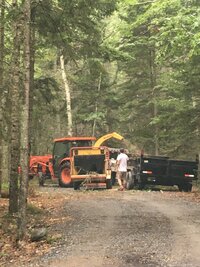
Do you always wear your helmet?

If this question ever comes up in an ISA Certification test the correct answer to:

When do you wear head protection/helmet?

is

When you get out of the vehicle
Yep. Same with eye protection. I remember being a little surprised that it is required eye protection "when engaged in arboricultural operations" (3.3.6)...so basically when you get out of the truck. Reference for others: helmets are 3.3.4 in the ANSI Z133, 2017. "Workers engaged in arboricultural operations shall wear head protection (helmet) that conforms to ANSI Z89.1".
 
@Tom Dunlap (or anybody else), do you know how they define "arboricultural operations"? Estimating? Diagnostic visit? Sales calls? Tree appraisal? (even if all of the trees were removed?) Tree planting? Spraying? Trunk injections? (I wear eye protection when spraying and usually injecting...but not head protection). Is writing a report in the office an "arboricultural operation"?

I don't see that term specifically defined...but arboriculture is defined in Annex A under definitions as: "The art, science, technology, and business of utility, commercial,and municipal tree care." Kinda sounds like using technology (a computer) to conduct business (happens in an office) is an arboricultural operation. I know...that is being obtuse. But where is the line? Maybe that will be clarified in the next edition. I hadn't thought too much about that before now in the context of when is a helmet actually 'required'.
 
@Tom Dunlap (or anybody else), do you know how they define "arboricultural operations"? Estimating? Diagnostic visit? Sales calls? Tree appraisal? (even if all of the trees were removed?) Tree planting? Spraying? Trunk injections? (I wear eye protection when spraying and usually injecting...but not head protection). Is writing a report in the office an "arboricultural operation"?

I hadn't thought too much about that before now in the context of when is a helmet actually 'required'.
Most jurisdictions on this side of the pond have federal and state/ provincial Occupational H&S regulations which specify when HH is required somewhere. I can also think of municipal and contractural specifications as well. ANSI Z is certainly another layer but it is these regulatory bodies that are "the law". Enforcement is another matter entirely though (except maybe in the UK by the HSE Inspectorate there).
 
  • Like
Reactions: ATH
Most jurisdictions on this side of the pond have federal and state/ provincial Occupational H&S regulations which specify when HH is required somewhere. I can also think of municipal and contractural specifications as well. ANSI Z is certainly another layer but it is these regulatory bodies that are "the law". Enforcement is another matter entirely though (except maybe in the UK by the HSE Inspectorate there).
In the US, OSHA enforces safety laws...they are "the law". (maybe you already know this...)

ANSI is an independent organization that holds standards developed by those in the industries, not laws forced upon the industry by the government. ANSI covers a very wide array of industries and it is not just safety. In our industry, for example, the ANSI A300 define standard tree care practices (including pruning, cabling/bracing, lightning protection, fertilization, risk assessment, etc, etc...).

For most fields/professions/industries, OSHA has their own set of defined standards that must be followed. The do NOT have a standard for the tree care industry (an industry with one of the highest injury rates). In absence of their own, OSHA is supposed to rely on "industry standard practices". That's vague, and can probably be defined however the inspector chooses to define it (which may or may not hold up in court if it goes there). However, there is a pretty good argument for the ANSI Z133 to be that standard that they use. It is understood that if an employer were following the Z133 to a letter, they'd have a pretty good defense against claims they are non-compliant...but that isn't spelled out explicitly anywhere in law.

(***As I understand it...subject to correction by somebody who knows more than me!!!***)

 
In the US, OSHA enforces safety laws...they are "the law". (maybe you already know this...)

ANSI is an independent organization that holds standards developed by those in the industries, not laws forced upon the industry by the government. ANSI covers a very wide array of industries and it is not just safety. In our industry, for example, the ANSI A300 define standard tree care practices (including pruning, cabling/bracing, lightning protection, fertilization, risk assessment, etc, etc...).

For most fields/professions/industries, OSHA has their own set of defined standards that must be followed. The do NOT have a standard for the tree care industry (an industry with one of the highest injury rates). In absence of their own, OSHA is supposed to rely on "industry standard practices". That's vague, and can probably be defined however the inspector chooses to define it (which may or may not hold up in court if it goes there). However, there is a pretty good argument for the ANSI Z133 to be that standard that they use. It is understood that if an employer were following the Z133 to a letter, they'd have a pretty good defense against claims they are non-compliant...but that isn't spelled out explicitly anywhere in law.

(***As I understand it...subject to correction by somebody who knows more than me!!!***)
I sat on the OSHA small business panel. This discussion didn't even surface. It was more broad as in so far as PPE and very specific on other items. I'm guessing this was all hammered out about 3 years ago and still no standard. I don't recall seeing this changed with the new Z. I think the boiler plate statement remains.
 
I always say that you don't wear a helmet for the hazards that you know about or see coming. If I see a branch flying towards my head, I don't just stand there and take the blow because I'm wearing a helmet. No, I move out of the way. I have the exact same response to something that I see coming at me whether I'm wearing a helmet or not: I move so I don't get hit, when possible. The reason to wear a helmet is to protect yourself from the stuff that you don't see coming, the stuff that catches you off guard. Absolutely nobody wants to get hit in the head with anything, helmet or no helmet. But when something comes at your head unawares, you'll be wishing the helmet was on there.
 
Last edited:
How about wear a helmet when over head hazards exist or when feet leave the ground.
I like that...I might add (or clarify) when overhead work is being done. That probably comes back to the OP ... Overhead work being done, but possibly not hazards (were they large enough to cause injury???).
 
I always say that you don't wear a helmet for the hazards that you know about or see coming. If I see a branch flying towards my head, I don't just stand there and take the blow because I'm wearing a helmet. No, I move out of the way. I have the exact same response to something that I see coming at me whether I'm wearing a helmet or not: I move so I don't get hit, when possible. The reason to wear a helmet is to protect yourself from the stuff that you don't see coming, the stuff that catches you off guard. Absolutely nobody wants to get hit in the head with anything, helmet or no helmet. But when something comes at your head unawares, you'll be wishing the helmet was on there.
Totally, but conversely if I’m pruning 4-6” caliper fruit trees I see no need to wear a hat.
 
Afaik the helmet I wear is only meant/rated to protect from stuff falling on my head from above.
Yet it shall have a chinstrap otherwise it’s just a hard hat..
sure most helmets don’t have a side impact rating.
Honest question…. Would you rather have a hard hat on with chin strap during a fall or none? There is a balance and we can all be required to wear a Protos or be forced to wear a side impact rated helmet pruning weeping Japanese maples.
I’m seriously not being a smart ass. In Washington I can’t prune a tree and charge workman’s comp a landscaper rate, yet a landscaper can prune the same tree as a landscaper. Difference is $3 bucks per worker hour. Yet I can prune top a hedge row of trees call it a hedge and save that $3 an hour.

Conversely, I can’t fell a tree. Not even a 6” 15’ tree unless I call it logging and pay $17 an hour vs $5. Yet I can be a temp agency that subs out for ‘pre commercial thinning’ apply per contract, and fell non merchantable timber for $2.50 an hour.

We can do much better with allowed situational awareness vs blanket enforced rules.
 
Looked at a new affluent property this week for a design/build firm that wants us on retainer etc. as the owner/crew who contracted for the lot clearing/cleaning was flaky. Three employees showed up as I was there and started in felling and chipping. No hardhats, chaps, eye pro, gloves, and two of them in shorts.

For an single owner operator, do whatever as far as ppe because they are in charge and no OSHA etc. An owner taking a job for a big lucrative project and sending employees over without ppe to drag and chip eye-magnet spruce? Yeah that’s fucking lame on many levels.391BA7A4-3EF9-48EC-AB94-6BDE9600A933.jpeg
 
Agreed. Blanket rules are for children. And imbeciles.
On the other hand, two days ago, at the end of the day, I was cleaning up around the driveway with a blower, till day 2 of a poplar extermination session, brain bucket now off, and looked up and saw a small left over hanger which I proceeded to knock down with a silky pole saw with scabbard on (kids likely to be around later). No problem right? What I didn't count on, or see, was a dried poplar twig/ branch bit that also came down and whacked me on my now bare noggin (it was about +30 C out and I had sought relief from the Pfanner furnace I had worn religiously all day). Hurt like H but thankfully no red juice flowed.
About rules - with a one man show, are you going to see an accident that day - maybe not. What about over ten years of days, maybe. What about over multiple companies in the same WCB rate group over years - definately. (The old astonomers' adage - given enough time the impossible becomes possible, the possible becomes probable and the probable becomes definate). If it can happen, it will we used to say. Same with big companies who statistically see way way more bad stuff than a lone ranger/ contractor out there bashin' wood. So they default to rules, and they ain't no dumb bunnies but do it for a reason - so everybody goes home at the end of the day (and statistically you are safer at work in a big multinational oil and gas company than just about any job you may do - cuz of these rules).
Anyway, so guess this donkey shoulda kept the brain bucket on till I was back in the truck or way out by the garage. That was this week's re-learning experience anyway . . . . Every day somethin' new . . . . kick, kick, kick . . . . . Cheers all.
 

New threads New posts

Kask Stihl NORTHEASTERN Arborists Wesspur TreeStuff.com Teufelberger Westminster X-Rigging Teufelberger
Back
Top Bottom