do we need an eye-splices???

[ QUOTE ]
A splice has very little to do with weakening the system

[/ QUOTE ]

I don't agree with the way this sounds Nick. If you consider the rope and all gear attaching it to the tree "the system", then it would. If you tie the block to the sling with a bowline, it would be a weaker part in the system than a splice would. Right?
 
Yes, but now you're confusing me. You seem to be using supporting information to argue with me, Mark. Damnit, Chokey!

Yes, clearly...tie a sling on with a bowline and you're weaking the system a lot more than if you splice it. This is what I meant when I said that the splice has little to do with weakening the system.

A frictionless hitch??? What's that?

love
nick
 
[ QUOTE ]
A frictionless hitch??? What's that?


[/ QUOTE ]

Just wraps with an anchor at the end. Gradual bending wraps will use more of the rope fiber and apply small amounts of friction throughout the anchor point. Not great for all apps, but my rescue team buds love the idea.
 
Mr Marcin,
Its not about knots,hitches,splices its about the bend and tensile strength find the tightest bend that takes the most direct dynamic load and has the least tensile strength and you have the weakest link.In the scenario you speak of it should be the lowering rope,Right on the 90 degree bend of the half hitch before the timber hitch on the timber your rigging off.That should be the point of greatest bend,least strength,and most direct dynamic load excluding the tree and "providing your using best practice and using "SWL",10-1 on your rope and 5-1 on your hardware.At the end of the day the strength of your lowering rope configuration should be less than half the strength of your block and topping strop configuration with bowline or splice makes no difference.
What i'm trying to say is the original question should never really be an issue.If you use a granny knot to tie on the block and it fails at this point while rigging you have F##ked up you numbers.coz you should be using washing line as a lowering line.......Ho Ho Ho

Sorry i'm ranting on but then it is 1 in the morning and the christmas "sprits" are already out..

Merry Christmas to All

Didj /forum/images/graemlins/santa.gif
 
When using a bowline as eye for a cow; i make bowline a long one, and bury the weakness of the knot behind the crossing bight of the cow. Similar to the Sherrill long splice strategy, of the load then not pulling on the joint of the splice/knot, just the doubled lines. i'd think that the cow hitch's strength would depend on the diameter of it's mount and the tightness of the bight choking around the eye (forcing such and such an angle opf leveraging). This bend on the doubled lines rather than the single line behind a bowline as better.

Splices are strong, and a convenience. They are also fixed length,a nd wear constantly on the same point of the eye.

i too think that it is in the bend of the line that torques the force through the line, rather than feeding straight down it's straight long axis (as in other things), that weakens a line. The more the change (arc) from carrying loadforce along the length/long axis of the rope device; the more the line is weakened. Breaking right before the primary loaded 'deformation'/arc of the line; like the fibers are so delicate under such high loads, they sense the back pressure from the arc before them and snap before entering it (as i have visualized it).

i've always too imagined it as Tom says, leading marls and half hitches forming chokes that reduce the force along the line, till not needing much more than a thumb tack on the end of the line to secure on a load! i think taking a roound turn on the load before running bowline reduces the equal and opposite reactions in the line, but; in connecting with running bowline the strain is back on the bowline, as the full equal and opposite reaction to hold the load. So there is more load on the eye in just taking a round turn then connecting back, than as series of preceding marls/half hitches. So, if 'cheating and using a carabiner/snap as a reusable running / quick bowline connection; risking the stiffness of the metal to be in leveraged position around the round log; it is much better if line doens't just take a choke around the spar, or even a round turn; much more less force on terminations after half hitches and marls.

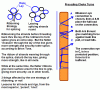
i've been trying to find a source on the net to quote on my site { MyTreeLessons.Com } that teaches the lessons of 3 strand eyesplice like Brion Toss. He shows not to keep the strands you thread back through the line round, but rather to 'ribbon' them flat. This does 2 things in this 1 move, that show mechanics that carry on throught knotting and splicing. The ribboned strands lay flatter, so disturb the line shape, deforming it less; making the splice stronger. The flat ribbons also have more surface griping area as they weave through the braid of the line; this gives more grip/security. In a spice as the strongest of knots, he gives how to preserve strength and security in any line lacing.

Tenex is very strong for it's size; it is hollow and doesn't have friction working at the line from the fibers inside scrubbing against the whole line. i think it flattens out on arcing around a mount, preseving more strength; by being leveraged less, by having less dimension on the arc. Roundness is good for traveling around something, predictable leveraging at every angle, for it has the same leveraged distance, being round.

 

Attachments

  • 17066-Ribboning 3 Strand + preceding turns.GIF
    17066-Ribboning 3 Strand + preceding turns.GIF
    36.8 KB · Views: 54
[ QUOTE ]
find the tightest bend that takes the most direct dynamic load and has the least tensile strength and you have the weakest link.

[/ QUOTE ]
That's what I am looking for !! Mr Didjohn! and I belive it is the bend in cow hitch, I belive it's weeker then bends in bowline!!
And I am looking somebady who'd say loud:

there are many sytuations when it doesn make any difference (I am only talkin about attaching a block to the tree) if you use a splice or a bowline.

Look at this:
"i'd think that the cow hitch's strength would depend on the diameter of it's mount and the tightness of the bight choking around the eye" TheTreeSpyder

or this:

"Splices (...)are also fixed length,a nd wear constantly on the same point of the eye. " TheTreeSpyder

I agree with TheTreeSpyder!

Why everybody is so shure that useing a splice make "block to eye to cow hitch to the tree" system stronger ?? Why??
Becouse for me it's no so clear. But you know me Didjohn:) - f#?%&ing polish man always asking and asking questions:)
Even here somebody already told me:
"Just use a splice and don't worry about it.":)

Can you prove that "block to splice to cow hitch" system is stronger than "block to bowline to cow hitch" in every scenario?? Can you?? Give me your souces, I gave you mine. "NAA rigging for removals workbook"

more and more angry Marcin
 
If we were all sitting in the Tree Buzz Cafe for an evening of Cornhole and Ax Throwing we could have this worked out quite easily. We'd have the T1 line cooking and the WiFi system humming so we could all find our references. Since we're scattered around the globe, it's going to take a little more time to get our language worked out.

Pete Donzelli shared a concept that I like when talking about rigging. He spoke of effeciency instead of strength loss when accounting for bend ratios, splices and knots. Unless we damage the rope, the rope stays just as strong no matter what we use for connecting the pieces. Are we looking for a percentage effeciency loss or the actual load loss because of the efficiency loss? On one extreme, rigging with shoelaces and the other with high density fibers and ropes that are large diameter. The efficiencies of the systems would stay relatively similar [I think] but the raw numbers would change. This variable was already talked about in designing the systems. Weakest link desing factors.

I've got a number of loop slings that are made from pieces of retired climbing ropes. The rope sections are in great shape and I tie double fisherman's hitches. When I decided to use these I sat down and ran the numbers of the strength of the loops. I'm satisfied that using these bits of rope in certain situations is just fine. The problem is that they are so bulky to use. When I want to economize on bulk or component weight I use sewn or splices slings. Another place that I use these slings is in rough and tumble rigging where I count the rope loops as disposable. Say in ground dragging. If the rope sling gets trashed, it gets tossed. I've gotten the oink out of the pig. I save my more expensive slings for other times. My measure of efficiency here is cost not performance. The freebies cost nothing but work just as well as the purchased gear.

This same idea follows for designing a rigging system. Natural crotch rigging and butt hitching chunks onto the lowering lines are both free. But they are really low efficiency systems. When I use a natural crotch it will only be for very light loads. Generally, pieces that I could lift and chuck by hand. The rope is used for a controlled lower. Once the loads are larger than I can control the rigging tools come out.

Knots are no more than inefficient and reusable splices. My lowering lines have an eye on one end only. There are times when I use either end on successive lowers. I follow the thought pattern that I first learned from Don Blair. If the breaking strength of my system is close to the load I'm applying and it causes me to wonder, I take smaller pieces or bigger gear. If I choose to use a bowline, I'm confident that the bowline isn't the weak link by a long shot. the weak link would be somewhere further up the rigging chain.
 
Marcin- it's simple math. I will say it clearly. The splice or bowline are links in the system. The splice is stronger than the bowline. A good splice is a lot stronger than any bowline. Why would you opt for a weaker link?

When you compare the cow hitch and the Bowline, the cow hitch is stronger and has less of a bend in it at the point where most of the load is held.

Treespyder- your idea of using a really long eye on the bowline would surely aleviate the strength loss quite a bit.

Once when I started working at a new place in Oshkosh, WI they had no dead-eye slings, so I quickly made one by doubling a piece of rope over the block, then tying the cow/stilson hitch with doubled rope. It wasn't pretty but it worked that day. I made a sling when I got home that night so I didn't have to deal with it again!

Marcin- are you actually arguing that a bowline is stronger than a good splice?

love
nick
 
[ QUOTE ]
Marcin- it's simple math. I will say it clearly. The splice or bowline are links in the system. The splice is stronger than the bowline. A good splice is a lot stronger than any bowline. Why would you opt for a weaker link?

[/ QUOTE ]

DIDJON DIDJON DIDJON help me please!! !! explain this guy what I am on about. I am moveing to another coutry tomorow and I am not patient enought :) Go as simply as you can possibly go. Take care
 
Extend to loop slings and adjsuters for hitches

Any alteration in the mechancics or angle of pulls; gives the system a different machine command/force set to function by. Like it's own vocabulary. Every change, changes the total mechanics. Changing from 20' to 5' of inline, unleveraged pull is the grey area; that only changes the possible mechanics; until a leveraged arc avails the length to leveraged, loaded mechancis etc.

A loop sling/round sling will wear different points in day to day loading, for longer life; an eye splice would load the same spot always. In the mechanics of how the loop carries the forces, versus the single line with eye splice; if the joint/knot/splice of the splice were to slip etc.; the other side of the sling would carry the load, at least temporarily, securing the loop/knot.

Such as how a square knot joins the ends of the same line in a loop, and is not for joining 2 seperate lines in series. The pulls are different, so a Square KNOT is tied to itself (loop mechanics duty only), and a very similar (instead of joining bight to bight, joins bight to half hitch) Sheet BEND, bends 2 seperate lines together as one to carry the force linear,not around back to self. As the pulls are different on a SheetBend and a Bowline, as to make their security efficiency quite different, from the same exact lacing; only cut eye of Bowline open, to make SheetBend. A Double Bowline, sneaks higher percentage return on line tensile; by softening the primary arc into the knot device over the 2 turns. A water bowline has the same immediate arc as a regular bowline (clove trap instead of , hitch, round turn etc.) so has same strength as a regular bowline, but more security than a bowline or double bowline.

The same property (legs of loop loading differently to ease load on 'looser' one) conversely slips in the form of an adjustable sling (slips easier), than an eye to eye adjustable. Before the loop offered more security, this is the flip side, as the adjuster is then less loaded and doesn't trap, so loop now is less secure as we add a self loading adjuter splice/hitch. An adjustable sling can carry the load on the solid line and allow the slip adjustment to slide, by not clamping down enough on adjustment joint (DdRT vs. SRT), as the solid line leg holds the load. Loading an adjustable eye to eye by the adjustable eye, wears a different position each time; and enacts the lock of the adjuster by loading it. If the main pull is on the static eye of an eye to eye adjustable; a fixed place is worn on the eye in day to day use; but, there is more pull on the slip through the adjuster, than there is force to load the adjuster.

Or something like that, i think
/forum/images/graemlins/propeller.gif
 
[ QUOTE ]
Marcin- are you actually arguing that a bowline is stronger than a good splice?

[/ QUOTE ]

Nick - No, that's not what I am arguing about! I know splice is stronger! what I am on about is ...I'll give an example(it's from didjon): when you have a 3 meters steel chain which holds 2 tons will this chain be any stronger if you made one link stronger than the others?? No! It'll still hold only 2 tons!
so if we take "block to sling to cow hitch" system as a chain
and the point we attache the block as a link we have to realise that by makeing this point stronger we don't make hole sytsem stronger. becouse we still have the rest of the links as week as they were (cow hitch)

NIck - that's what I was asking about, well arguing ....

Marcin
 
i think that just a running bowline with long eye on a rough textured mount will take reduced loadings of the main line forces as well as the equal and opposite force at the ring to lock the load; off of the 'joint' of the bowline knotting. The more delicate position in about anything is the joint; here we try to buffer both forces of the Equal and Opposite Reactions to the joining point.

Direction is always important to force; for 1 thing without direction, there can be no force. What if the force to the mount hitched by clove, bowline, cow, half hitch, carabiner etc. restriction; is a pull parallel to the mount (like hanging a load very heavy at one end) versus parallel pulls (like hanging a balanced load).

i think pulling parallel to the mount, can pinch the line etc. off in a hitch. It is the same pulling force; but taken at different dirction in consideration to how the mount recieves the direction of the same force. As the hitch sets tightly against itself, it then would supply it's own equal and opposite locking force. The turn around the load would not be on axis with the pulling force, like in a pull perpendicular to the host/mounting spar that securing hitch is taken on.

Taking that to Tom's example of precding hitches/marls to the 'joint'; that buffer the jointing of the lines from both the Equal and Opposite choking forces; things change again. The preceding marls/hitches must bring the line down paralallel to the load, so now as the mount switches from perpendicular to parallell loading, the line to the joint is now on axis with the line pull, opposite of above. But; the line will almost certainly take hitch against itself, to 'pinch' off force; buffering the loading to the jointing of line to itself position, even though it is more on axis, direct in line of force pull. As the line enters that ring to join, the force for sure is parallel to the mount and has a better chance of pinching the force off in a hitch; especially as the devices of the mount and line are less slick, to give more securing pinch agianst each other and selves (agianst self in simple hitches).

We now return you, to (y)our normal programming,
/forum/images/graemlins/propeller.gif
 
[ QUOTE ]
[ QUOTE ]
Marcin- are you actually arguing that a bowline is stronger than a good splice?

[/ QUOTE ]

Nick - No, that's not what I am arguing about! I know splice is stronger! what I am on about is ...I'll give an example(it's from didjon): when you have a 3 meters steel chain which holds 2 tons will this chain be any stronger if you made one link stronger than the others?? No! It'll still hold only 2 tons!
so if we take "block to sling to cow hitch" system as a chain
and the point we attache the block as a link we have to realise that by makeing this point stronger we don't make hole sytsem stronger. becouse we still have the rest of the links as week as they were (cow hitch)

NIck - that's what I was asking about, well arguing ....

Marcin

[/ QUOTE ]

Agreed! /forum/images/graemlins/grin.gif
 
HOLY MOLY!

How about we all agree that Tenex is a reliable eye sling... /forum/images/graemlins/afightee.gif

I tried 20lb TEST fishing line in cow hitch ending with a slip-knot, it just didn't hold /forum/images/graemlins/applaudit.gif
 
If you pull straight out on the cow, it can slip sometimes, especially in slippery monofilament etc. But if you draw it by 1 leg bent backwards so it tightens up, as it pushes the straight bar back, and exposes more of the tail, then generally it holds; when a clove or roundturn would walk.

The cow will push the straight bar away from the free end like this to lock, but same done to clove, pushes the Z/slant bar towrds the free end to unlock. i think also in regular line, as the leg you are pulling is suqished into the other leg/free tail the pulled end 'tracks'into the free end tail pulling it (though not in monofiliment). Making the cow lock even more,as the clove walks even more. For as the cow pushes the straight bar away from sliding off free end, the cow also pulls free end tighter (like square knot), working 2 ways to tighten cow. As the clove leg is pulled, it pushes the Zbar towards slipping off the free tail, and also tries to pull the tail out (like thief knot); clove working 2 ways to walk free.

Or, something like that,
/forum/images/graemlins/propeller.gif
 
I agree, strengthening one link does not make the chain stronger. That's common sense.

....Unless the link that you're strengthening is the weakest link.....

love
nick
 
These things are not singular acts, but orchestrations of relationships. The whole system needs to be understood in such modular, yet entertwined events to be tuned to maximum. A rigger makes series of guesses in chains; hopefully giving system highest SWL if it takes just one more turn, angle, tension etc. in the pattern so easily; jsut by knowing the pathways throught he jungle of numbers, that are so immense around trees. Trees are the heaviest, largest; whose stiffness (also more than any other) allows the heaviest to multiply by the largest factor! Because all that stands rather than lays down on the ground; the whole equation, takes on the force of falling; lending changing speed and changing leveraged angle of pull to the equation. i think knowing all the different assemblies and patterns gives ya a better chance against all those odds!

We would more properly say the weakest link in respect to load carried by that link etc. We could put a weaker link in one leg of a 3/1 pull or lower; but something on the mailnline connection to load(single leg support area of sling connecting system to load etc.) of stronger material might give, but be stronger than weakest link.

/forum/images/graemlins/propeller.gif
 
[ QUOTE ]
I agree, strengthening one link does not make the chain stronger. That's common sense.

....Unless the link that you're strengthening is the weakest link.....

love
nick

[/ QUOTE ]

Nick;

I think the point that he is arguing is that the bend/bight of the cow hitch is the weakest link. He is saying that the bend/bight is weaker than either a splice or a bowline. Since, when the cow hitch is tied, the bowline (and the splice) would be at a spot where the load is shared with another leg of the line, the weak link in the system is the bend/bight of the cow hitch.

Using his reference (Rigging For Removal) an eye splice has a strength loss of 10% and the bowline has a strength loss of 35-40% (p. 11). Now the wording gets convoluted. Both the cow hitch and the girth hitch are shown under 'lashing hitch' (p. 12). But, they are grouped along with other hitches that are shown formed with eye and eye slings--basket hitch, vertical hitch, and choker hitch. The strength of each of these hitches is rated as a "...% of possible strength", whereas the strength of a bowline and a splice was rated as "...% strength loss". A lashing hitch (cow hitch and girth hitch) are shown to have "35% of possible strength" which means that they have a strength loss of 65%. /forum/images/graemlins/crazy.gif

Using this reference, the cow hitch is much weaker than the bowline. Since the bowline shares its load with another leg of the hitch, the bight of the cow hitch itself is the weak link of the system.

I haven't checked this against other sources, but I think (?) that this is what he is asking/arguing.

Mahk
 

New threads New posts

Back
Top Bottom