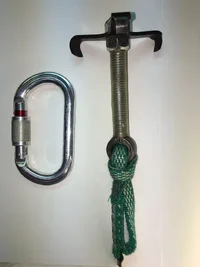
DMM throw hook.

Would the trango cinch work with 7/16th line...like the KM-III?
I am going to get a hook and was thinking of having it on the second side of my lanyard. I have a 25' KM III lanyard with a BOLA on one side and a hitch on the other. I was thinking about using the hook like Moss has demonstrated for fast extra positioning, but also have the capability to hook it out at the end of a limb walk and come back SRT using a trango cinch. I am not familiar with the cinch at all, but could that work for returning from a limb walk. The BOLA does not work SRT. I usually use my tail and create a DdRT system at the tip while out on a limb walk if I want the ease while returning... but I was thinking it would be super fast to use SRT and have it be retrievable. I could use the tail of my line, but as Moss has stated...you don't want to have to tie it on each time you need it. On a long lanyard I could have it installed and ready. Thoughts? And yeah, would the Cinch work on 7/16th?
 
@John_KAYS; I can't comment on the Cinch used for coming back from a limbwalk, as it has been too long since I've tried to use it for climbing, except at the bottom of the tree as an easily used lowering device for emergencies. Other than that my vague recollection is that it's not so good for trying to advance on.

Forgive me if I'm misunderstanding the setup under discussion, but I was wondering why you don't just use your normal SRT device for the limbwalk, and add in at the top either an ascender of some kind with a pulley connected to it, or one of those thimble prussiks, I think they are called, also with a pulley attached to it? Hook your climbing rope through the pulley and keep the down leg with you, clipped through a biner on your side, for a 3 to 1 mechanical advantage system.

I get that you would have to come back up to recover this extra bit of hardware. If lack of retrievability is a deal breaker for you, forget what I said.

Tim
 
@John_KAYS; I can't comment on the Cinch used for coming back from a limbwalk, as it has been too long since I've tried to use it for climbing, except at the bottom of the tree as an easily used lowering device for emergencies. Other than that my vague recollection is that it's not so good for trying to advance on.

Forgive me if I'm misunderstanding the setup under discussion, but I was wondering why you don't just use your normal SRT device for the limbwalk, and add in at the top either an ascender of some kind with a pulley connected to it, or one of those thimble prussiks, I think they are called, also with a pulley attached to it? Hook your climbing rope through the pulley and keep the down leg with you, clipped through a biner on your side, for a 3 to 1 mechanical advantage system.

I get that you would have to come back up to recover this extra bit of hardware. If lack of retrievability is a deal breaker for you, forget what I said.

Tim
That is good too. I often do that for certain circumstances, when the 3:1 haul back is favorable. I was trying to explain a method where you go out the limb on your primary line and when you get there, and want to come back, you install a second climbing system to guide yourself back without the worry of losing your balance and falling/swinging toward the tree. If you have a line at the end holding you toward the tip of the limb, and your primary line is holding you toward the tree, then you can let go with your hands and not fall either way...all you have to do is keep from falling to the left or right, but that's not a problem with the two lines out opposite directions. With the haul back, the pull is toward the tree only, which is fine as long as you are leaning the opposite direction. You can haul yourself back in without having to manage slack and all of that with the 3:1 allowing you to use one hand to stabilize yourself. So yes there are plenty of ways to get back, and there are plenty of different types of limb walks. Arching up, sloping down, straight out... So with all the variety I thought the captain could serve as a retrievable secondary system to glide back in. It wouldn't be a solution for every limb walk.
 
I find that the Hook also works good when you are going out on an ascending branch, the reverse of how you plan to use it. I never thought of using it as you suggest.

When I first got the Hook I put away my homemade grapple, which is a lot smaller. But I recently put it back on as the Hook is some times too big for smaller branches in this situation.

image.webp
 
According to the TreeStuff site ( https://www.treestuff.com/store/catalog.asp?item=1713 ), the Trango Cinch is rated for 9.4 to 11 mm, which puts your KMIII right at the extreme max. I suspect it will work just fine, but I don't know. The rope that comes with the DMM hook kit is 10mm which is right in the middle of the Cinch range. But if I correctly understand what you are asking, as long as most of your weight is not on the hook, then ordinary hitch cord will work just as well for your purpose. It's only when you are trying to descend with all your weight on the hook that the Cinch would be appropriate while the hitch cord would not. I have tried using the Cinch just a few times, and it appears that most people who use it like it, but I have trouble controlling it smoothly. For me, it's always either on or off with no in between. Since I rarely, if ever, try to descend with all my weight on the hook, I just use 8mm black beeline hitch cord. But to answer your question, the Cinch would work just fine in principle for your purposes, but I don't know how well it will work with your rope.
 
I have tried using the Cinch just a few times, and it appears that most people who use it like it, but I have trouble controlling it smoothly. For me, it's always either on or off with no in between. Since I rarely, if ever, try to descend with all my weight on the hook, I just use 8mm black beeline hitch cord. But to answer your question, the Cinch would work just fine in principle for your purposes, but I don't know how well it will work with your rope.

Cinch is not intended to be operated one-handed when you're letting rope through it, one hand on the tail, the other on the lever, it's quite smooth returning back to the center of a tree from an outer position on a limb or for traversing back at a downward angle from one position to another.

I don't use the Hook for for straight up ascent or straight down ascent, at least not often. If I do there's going to be a second anchor in play.
-AJ
 
Super, well I figured I could use the hitch cord for the same purpose, but it sounded like everyone was really digging the Cinch with the Captain. I guess it wouldn't hurt that much to get the kit and then I would have the option of switching the hook over to my lanyard if I find that works for me. As I said, I have never even held the Cinch in my hands, so I don't know what to think or if it is worth getting it also. I definitely think my climbing style would benefit from having the hook in my toolbox. Thanks for the responses.
 
Cinch is not intended to be operated one-handed when you're letting rope through it, ....
-AJ

Good point, moss, and thank you for bringing that up. Yes, I am so totally guilty of wanting to use that Cinch with one hand. That's why I went back to the hitch cord. I can control the hitch much better with one hand and have the other hand free to pull up slack in the other line or hold on to a branch for balance or to scratch my butt or whatever. I'm always needing more hands.
 
That is good too. I often do that for certain circumstances, when the 3:1 haul back is favorable. I was trying to explain a method where you go out the limb on your primary line and when you get there, and want to come back, you install a second climbing system to guide yourself back without the worry of losing your balance and falling/swinging toward the tree. If you have a line at the end holding you toward the tip of the limb, and your primary line is holding you toward the tree, then you can let go with your hands and not fall either way...all you have to do is keep from falling to the left or right, but that's not a problem with the two lines out opposite directions. With the haul back, the pull is toward the tree only, which is fine as long as you are leaning the opposite direction. You can haul yourself back in without having to manage slack and all of that with the 3:1 allowing you to use one hand to stabilize yourself. So yes there are plenty of ways to get back, and there are plenty of different types of limb walks. Arching up, sloping down, straight out... So with all the variety I thought the captain could serve as a retrievable secondary system to glide back in. It wouldn't be a solution for every limb walk.

Thanks for this answer, John; now I understand what you are saying. I was misunderstanding and thought that for some reason you'd be installing the hook near the original primary suspension point. For some slick reason that I was not comprehending. Now I am clear. (Edit: I just figured out where my confusion came from. In this sentence, John says "I usually use my tail and create a DdRT system at the tip while out on a limb walk if I want the ease while returning... but I was thinking it would be super fast to use SRT and have it be retrievable." I was misinterpreting the word "tip" to mean "Tie In Point", which caused me to think that you were referring to the trunk side of the limbwalk. All clear now.)

I'm still a relative newbe, and so I also like to climb with the kind of failsafes that you are talking about, with regard to preventing a large, uncontrolled swing back to the trunk, which might cause serious injury. I don't yet own the Captain hook, so I cannot safely comment on its use in the way that you are considering. @moss seems like one of the most experienced guys on the forum with the hook, and he's so smart that he's always pushing the performance boundries for any gear that he uses, so maybe he would be a good man to comment on this stuff. (Edit: Before I'd even finished writing up this post, moss had already jumped in. Thanks, moss!)

Slightly related, but not helpful to your query, is the fact that I tend to use DSRT to accomplish the control that you are talking about. The problem with it is that it is a lot more trouble to set up than your use of the hook is, and a DSRT setup might be considered to be less flexible. You are looking for a way to go anywhere in the tree at a moments notice, and to still have a safe way to come back in from a limb walk, which the Captain hook might be able to provide.

Thanks for your response to my post. You could also do a forum search to try to find any other posts by moss regarding the use of the Captain, if you haven't already. Good luck, and I'll be interested in following this thread.

Tim

Tim
 
Super, well I figured I could use the hitch cord for the same purpose, but it sounded like everyone was really digging the Cinch with the Captain. I guess it wouldn't hurt that much to get the kit and then I would have the option of switching the hook over to my lanyard if I find that works for me. As I said, I have never even held the Cinch in my hands, so I don't know what to think or if it is worth getting it also. I definitely think my climbing style would benefit from having the hook in my toolbox. Thanks for the responses.

Hey, John. I don't know if what I'm about to say would have any relevance to you with regard to how you might end up using the Trango Cinch, but I'll mention it just in case. When used on a lanyard, where the Cinch just stays on the line all the time, it's a nice, safe bet. The way I was trying to (use) it when I originally bought it though, involved putting it on the rope after I was already up into the top of the canopy, and wanting to come down. Kind of as a backup to my primary system, which would also be releasable when loaded with body weight, unlike my Gibbs style ascender. In this instance, a problem with the Cinch is that I think you have to take it off of your harness in order to install it on the rope. Which means that it can be dropped, if you are not careful. As opposed to something like the Petzl Rig, I think, which I do not own. I think the Rig can be left attached to your harness, and at the same time, be opened up to allow attachment to a rope. More expensive, though, and since I've never owned one, I don't know how good the Rig would be for this purpose.

Mostly I just wanted to let the folks that are considering buying the Trango Cinch know that it is not possible, (I don't think) to leave it attached to a harness, or anything, really, while you are attempting to install it onto a rope. Maybe @moss can correct me if I'm wrong about this aspect of the use of the Cinch. Thanks for listening.

Tim
 
Last edited:
Hey, John. I don't know if what I'm about to say would have any relevance to you with regard to how you might end up using the Trango Cinch, but I'll mention it just in case. When used on a lanyard, where the Cinch just stays on the line all the time, it's a nice, safe bet. The way I was trying to it when I originally bought it though, involved putting it on the rope after I was already up into the top of the canopy, and wanting to come down. Kind of as a backup to my primary system, which would also be releasable when loaded with body weight, unlike my Gibbs style ascender. In this instance, a problem with the Cinch is that I think you have to take it off of your harness in order to install it on the rope. Which means that it can be dropped, if you are not careful. As opposed to something like the Petzl Rig, I think, which I do not own. I think the Rig can be left attached to your harness, and at the same time, be opened up to allow attachment to a rope. More expensive, though, and since I've never owned one, I don't know how good the Rig would be for this purpose.

Mostly I just wanted to let the folks that are considering buying the Trango Cinch know that it is not possible, (I don't think) to leave it attached to a harness, or anything, really, while you are attempting to install it onto a rope. Maybe @moss can correct me if I'm wrong about this aspect of the use of the Cinch. Thanks for listening.

Tim
Thanks Tim, that is good to know. I always like keeping things with me and not gathering them at the base after I drop them. And yeah, sorry about the tip/TIP confusion. I realized that after the fact, so I tried using the term "end" of the limb rather than tip, but I can totally see that causing confusion. It's also hard to describe all of this with a keyboard. I often have to read through my posts multiple times to see if it is too confusing and I still can't get it right. I often have something so clearly in my head and then I try to convey that with text and find out that I can't actually describe it with a post. I should add diagrams and pictures to my post to really show what I'm talking about...It would probably be faster for me to go out and stage a few photos than try to put it in words. ;)
 
@John_KAYS; No worries. It is always very tough to describe in words things or actions that happen in three dimensions. I appreciate you taking the time to clarify things.

I am jealous of the guys who so quickly and easily manage to create and post illustrations or photos of the things they're trying to describe. I think the Microsoft paint program is commonly used for this purpose. I just need to play with it more, myself.

Tim
 
@John_KAYS; No worries. It is always very tough to describe in words things or actions that happen in three dimensions. I appreciate you taking the time to clarify things.

I am jealous of the guys who so quickly and easily manage to create and post illustrations or photos of the things they're trying to describe. I think the Microsoft paint program is commonly used for this purpose. I just need to play with it more, myself.

Tim
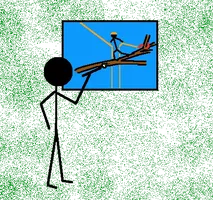
I should have supplied an illustration for my last post that was about supplying illustrations for my posts. So here it is... I should do more illustrations of what I am talking about!
upload_2016-10-22_17-56-58.webp
Image 1: Showing John_KAYS creating illustration of the method he was describing using the Captain for.
 
[snip]
.... with regard to preventing a large, uncontrolled swing back to the trunk, which might cause serious injury. I don't yet own the Captain hook, so I cannot safely comment on its use in the way that you are considering.
... [snip]

Completely agree with you Tim about keeping safe.

As I build my climb skills, I'm doing swings that I would never have earlier contemplated (they still aren't huge). Lots of ways to move about, set redirects and prevent swings without the hook. If anything, if I can set a remote redirect from a nice location where I'm comfortable, or create a quick DdRT on my tail, then I prefer that to using the hook. A hook with its own line usually has to be packed away which takes time.

I'm Captain fan, but today I wish I had had a second water bottle (bring on summer) and left the hook on the ground :)
 
I should have supplied an illustration for my last post that was about supplying illustrations for my posts. So here it is... I should do more illustrations of what I am talking about!
View attachment 40499
Image 1: Showing John_KAYS creating illustration of the method he was describing using the Captain for.

Hey, John! That was a really slick illustration, with lots of subtle detail I would not know how to create. Nice work!

Tim
 
I got the hook today. I tried it out in a tree in the backyard. I think this is going to work really well on the secondary side of my lanyard. My first reaction was that the branch diameter that it is compatible with is smaller than I had been thinking. It still works superbly, but you have that limitation while looking for anchors. I didn't get a Cinch at this point as my primary use for the hook was to be on my lanyard, but I might switch to a smaller diameter lanyard if the hitch doesn't work out in the long run...I definitely noticed the sit back and constant fiddling I had to do with the hitch cord I was using with my KM III 7/16th. We will see how the Captain melds with my climbing, but right off I love the thing.
 

New threads New posts

Kask Stihl NORTHEASTERN Arborists Wesspur TreeStuff.com Teufelberger Westminster X-Rigging Teufelberger
Back
Top Bottom