Detective Dendro, Where are you?

easyphloem

Branched out member
Location
Louisville, KY
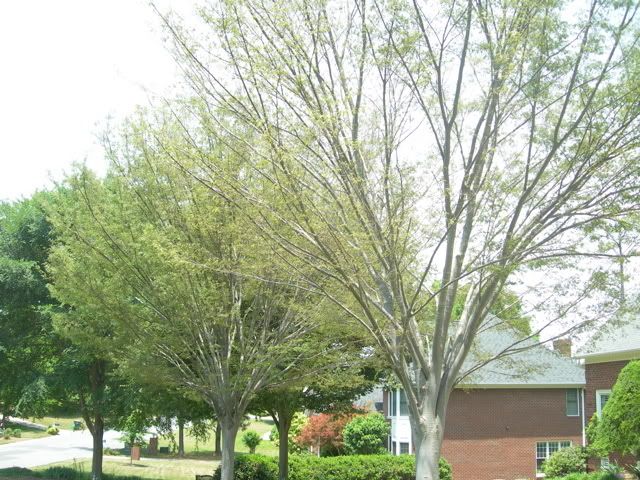
Hi errrrybody. I have a client who is having some trouble with a couple of Zelkovas in his front yard.

I will attach the photos to this post, but here is some background on the trees:

The Zelkovas were planted about 13-15 years ago, and up until last year, have seemed to enjoy where they are growing. I got a call last summer and went out to take a look at the tree on the right side. I saw that the leaves were small, smaller than normal at least, and had the tips of the leaves dying back, but it looked like drought stress, and I recommended watering through the hot season, and we did a soil conditioning treatment (humectants, bio-pack, etc.)

Well, I got a call a few weeks ago, and now the tree to the left of the original problem tree is starting to look the same way. This is one year later, but the symptoms are the same.

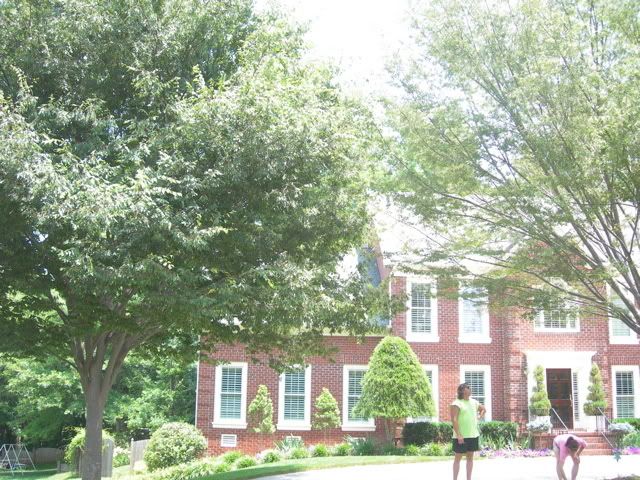
Here are some photos.
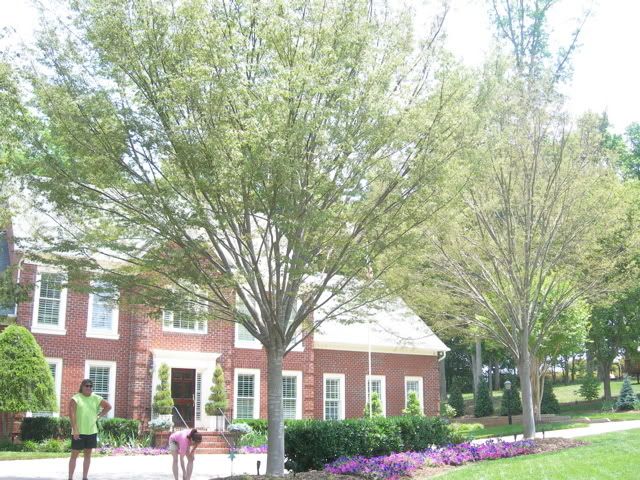
DSCN3108.jpg


DSCN3107.jpg


DSCN3109.jpg

Note the other Zelkova on the far left, it looks great.

I don't see any symptoms of a fungal pathogen, or maybe I am not looking in the right place. I pulled back the soil to see if any fungi might be lurking, but all I found was rich soil with a lot of earthworms. I am taking a soil sample (which I should have done last year probably), and I hope that it might shed some light on the problem.

I wonder if this might simply be the end of these tree's lives, I am not sure how long this species can live.

Any ideas?


Thanks,

SZ
 
Well what do you know, what can you read from the photos; the "disease" is moving from one to the other, two trees are in a flower bed, one is in a lawn, the homeowners want a very manicured look. So has something been added to the bed; salt, ice melter, fuel from a car, sealant on the driveway, herbicides? Has the bed been worked so often that roots are damaged and a pathogen such as Phytophthora entered? What about a vascular wilt or some other blockage?

Why would heat damage one tree, then the next and not a third? WHy would drought affect the one tree last year and now the second this year?
 
Detective Dendro is around but I can't reveal his super secret identity... or I'd have to kill you... and I guess everybody else on the internet.
shocked.gif


He'll probably answer soon if he hasn't already PM'd you.
 
Dendro's regular author, Morus \spillane, is on another assignment. :(
we have a zelkova in raleigh at the ncsu arb that has been dying one branch at a time and no one has been able to diagnose it. Usually the first suspect is girdling roots, but in your case I'm tending with mrtree and looking at pavement/poisoning issues.

let us know how the soil test comes out eh?
 
I definitely will keep everyone in the loop.

I am leaning toward a root problem, and the possible contaminants from the driveway is an interesting theory.

Thanks to you guys for your input!

SZ
 
Weed & Feed error certainly sounds plausible, did they start washing their cars (etc...) there. Maybe powerwashed the driveway with some nasty solvent? was the house re-pointed? Perhaps a new irrigation system was installed or repaired and the roots were damaged?
 
The update that I have so far is that I am having the soil tested by the local extension service, but I might have found the problem.

Last year, when the symptoms first appeared, I recommended watering them, because it was so hot, and the tips of the leaves were burnt looking.
I think my client may have over watered them in the hopes of saving them.


He swears that no cars are washed there, and that the driveway has not been pressure washed as long as he has been there.


But weed and feed........ that is a good idea.


I'll check out that lead, thanks!

SZ
 
Why would you have small leaves because of drought stress? Something was happening before the hot weather hit. Again it appears that the soil and or roots have been damaged.
 
Not to say it's applicable in this case, but one more diagnostic tool to consider in light of recent and dramatic changes to "normal conditions" is to measure spectral changes that indicate diminishing sunlight intensity due to particulate loads in the stratosphere.

"Say what??" is the responses I'm hearing, but we've changed things here on our planet.

Metabolic changes in plant life can be diagnosed by elimination of the obvious - when it becomes fickle, we've tried one deduction after the next and still scratch our heads, open up for looking farther - and sunlight is one important key factor. Sure has become so here in Central Texas.

Just a thought to pass on and another tool to become familiar with.

However, the tarmac and chemical influence of this homestead is what I'd be concentrating on, but overall, expect more of stress-related presentations.
 
Ok is the drive way paved or concrete. I ask this cause if paved using a power washer will push petroleums from the pavement . Just a lil construction alert, I removed a Red maple from a clients house next to his driveway . Every weak end he would wash that driveway. In the soil tests there was a good amount of petroleum products that had been affecting the tree for some time.
 
When I look at these photos I see that the two declining trees are in the middle of the driveway. The trees on the other side are fine as is the hedge that is between the two declining trees. The driveway also slopes from right to left.

Is it possible something washed off the right side of the driveway, was intercepted by the bed edge and redirected toward the grass? This might help to why the trees are dying and not the hedge. BUT if this were the case then why is damage not seen at the grass edge. I would think if oil, gas or antifreeze (etc.) ran into the bed then damage would be seen at the grass edge.

I would be checking the area of the roots/trunk interface for damage. Soil borne disease or mechnical damage seems quite possible. There could even be girdling by string from the original root ball.

Your post raises an interesting question about being paid for consulting and not getting the answer. How much do you charge, does it change if you can't find the answer and what happens if the tree dies?
 
[ QUOTE ]

Your post raises an interesting question about being paid for consulting and not getting the answer. How much do you charge,

[/ QUOTE ]chatting about this on a public forum raises antitrust concerns; not a good idea imo.[ QUOTE ]
does it change if you can't find the answer

[/ QUOTE ]it should not, but...just yesterday i revisited a maple I saw last summer and was stumped by. I told him I would charge when I got the answer. I finally got it, and charged. It's a dumb policy imo your should charge for your time no matter what. guilt or shame should be irrelevant. [ QUOTE ]
and what happens if the tree dies?

[/ QUOTE ]Also irrelevant unless you royally screwed up--then maybe guilt and shame should kick in...
crazy.gif
 
The last paragraph raises some interesting points,

however, in this case, I am dealing with a client who I have been working with for over ten years. I am not charging him at the moment for trying to figure out what the problem might be.


If this was not a regular client of mine, and the new client wants to know what is going on with the tree, I have my basic consultation fee, and if anything extraordinary comes up (re-visits, soil samples, etc.), I would charge accordingly.

I have gotten over the feelings of guilt or shame when a tree I have been working on kicks the bucket....it usually is because of something I don't have any control over.


On the other hand, I am still not making any headway with this puzzle, as I have not been able to devote any real time to figuring it out, what with the constant thunderstorms and wind storms we have been getting here.

Kind of makes me think I should have charged from the beginning to make me feel more obligated to getting to the bottom of the problem.


In the meantime, the Zelkovas look the same, no worse, no better.

SZ
 
Guy my last paragraph is not meant to be split into component pieces and certainly has nothing to do with antitrust.

The question is not specific to Easyphloem's zelkovas it is general. If you charge for a consult and you suggest ways to save a tree, what happens if the tree dies? Have you failed and most importantly can you charge if you do not give an answer? You can charge for your time, but if your time has given no answer is it worth anything? I have found if you charge for time people do not like to pay if the answer is not what they want to hear, the tree is declared toast, or you cannot find an answer.

The best example may be where somebody calls and tells you what they want the answer to be and then won't pay when you suggest it may be something else and you need to investigate the problem. Two days ago I looked at a tree lilac with 5 or 6 broken twigs with dry leaves. The answer was simple, they broke in a wind, the client insisted that a spray was necessary. The client does not want to pay because they did not get the answer they wanted.
 
If I didn't pay for a battalion of differing opinions from oncologists and hematologists, I probably wouldn't have had the cancer they all agreed I had.

In a nutshell, that's what you Lilac client did.

By your post, their problem was one you diagnosed, I'd go ahead and send them a bill - plus a pucker factor 5% addition for them being idiots.
 
oh I have no problem billing, its the customers problem.

As for doctors, we are a bit different in Canada, most of the time we never see a bill, so there goes one major professional who charges for consultation (opinion). This makes it harder for a tree doctor to charge. That combined with the tree service industry is so heavily involved with pruning and removals, makes the consultants role a tough gig in all but the major cities.
 
"Kind of makes me think I should have charged from the beginning to make me feel more obligated to getting to the bottom of the problem."

Stephan, I agree. You should be paid for your time, regular client or not.

[ QUOTE ]
Guy my last paragraph is not meant to be split into component pieces and certainly has nothing to do with antitrust.

[/ QUOTE ]"meant"?? you asked 3 questions in one sentence--how else to answer them coherently? What else do you mean when you ask a question, except to get an answer? If you don't want components split, ask questions separately. Yes discussing rates publicly does have antitrust implications (not that the feds would go after Mark and Tom...
confused.gif
) In any case, that question will properly lead to a MYOB answer.[ QUOTE ]
You can charge for your time, but if your time has given no answer is it worth anything?

[/ QUOTE ]Yes, if you have researched properly and eliminated some possibilities, you have at least focused the search. If there is never an explanation , there is still a service delivered.

If you hire a plumber to find a water leak, and he spends time looking but does not find it, you still owe him for that time.
 

New threads New posts

Back
Top Bottom