Dampner/Snubber

TheTreeSpyder

Branched out member
Location
Florida>>> USA
What is the feasibility of having a heavy duty (rubber?) device like Sherrill sells for dampening TreeSave connected between anchor and friction device (possibly pulley).

Whereby a line strong enoungh to take load is threaded and wrapped around the device several cois then threaded out the other end. In loading conditions, rubber base stretches and squeezes. One with properties of 2" stretch,compression slack @800# could probably take a lot more. This would be for aiding in the absorbing of dynamic shock along with line, or to add that componenet at high loading to a more static line, check loading other ways etc.

In the SRT model w/line tracing to ground/ fig.8 for rescue/ lowering etc. i could see that giving stretch at high loading, yet perhaps not stretch while climbing, especially if support line has friction on it to buffer pull each way.

So something with limited stretch, that would maintain integrity strength of connection, take out shocks over a certain level, yet be stiff at mormal levels (like <.5 " dampening @400# or something) could find some use me thinks.
 
I have a lanyard/sling I used for some work on a ropes course. It is 3/8th polyester hollow/single braid. I stuffed a piece of shock cord/bungee inside. When I clipped one end to me and one end to the tree, then weighted it, you could feel it compress and take a bit of the shock. With a little pulley on one end a big carabiner on the other this thing could be a frictions saver with shocks! I'll have to try that out.

love
nick
 
KC,

You've got my gears moving now, again :)

Would you envision this shock absorber to be mounted below the belay anchor in the SRT setup? Sure is a good idea. Now to figure out how to set the trigger to let it spring at a drop load and not during normal ascent and movement in the tree.

Tom
 
Mark, love the quote....

Tom that would be the idea, that is kinda why i'm here; cuz with the correct properties, there would be stiffness in X range and shock absorbtion at higher levels. And that is where i picture it, between belay/friction device and anchor/tree, integral with the linking of the 2.

Nick, came up with the other form i missed presenting that this could take. The 'stuffed sausage' absorber (was thinking inside Tenex).

But, on the external rubber wrapped device, i was thinking of something the size of a quart of oil (the ole'style cans), so to compress/ stretch that would take some force. With a braided steel cable curled inside for backup (though the tested line that actually hitches would be the strength factor, so cable not necessarily monster) to metal eyes (most wearable part). For this later, i envisioned a solid rubber ball encased in a net of steel cable with eye on each end. The cable net would give uninterupted strength to link too, the ball being the dampner, and obvious clue to which device was larger duty etc.

So for normal body weight i think that properties of negligible slop/ give of ascending, and at a few feet drop worth of impact give 1/2" or something then from there increased absorbing range.

In rigging, if crew was only supposed to have 4-500# per leg of line force/load one of differewnt charachteristics could be made for that range.

So for safety maybe something. In rigging, helping to absorb the greatest most testing forces on the whole system, including support; by taking the the impact resistance out of the formulae. For only the resisted part of the force presented, seems realized in the rig/ bod.

Also this setup, could give low stretch line more flexible utility, by in this setup temporarily lending it dynamic qualities; and perhaps in specific ranges. To the point of, pretightening rig to compress/stretch device to give pull towards support as hinge is cut etc.

Actually, i think there is something floating around out there that will suit the bill, that works better than a tire does....
 
I know that some yacht mooring systems have a snubber built into them...and a 45 ton boat carries a lot of momentum, even moving very slowly, so strength in these snubbers might be sufficient. A Google search may find something you could play with.
 
Are you guys talking about damping the system when rigging or climbing? I couldn't work it out!

If it's rigging, then what happens when the damper/snubber reaches the pulley? Maybe I'm a little comfused.

Nod
 
Sounds like a form of shock arrest but those things are designed to be used once in order to make them function properly.
I'll have to see the pictures.
 
Is there any bounce in the system. If I understand it for personal support it would aid in absorbing shock in a fall. But is there a return stroke or is this intended to be a single use type deal. I worry that the load is at least doubled on the return bounce, can the suspension take the load while bouncing around like that?
 
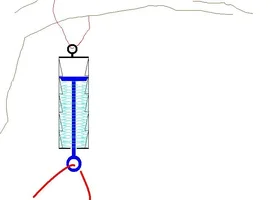
You could rig a spring with a ratchet type setting so that when the spring is weighted, it absorbs the shock, but ratchets prevent recoil. Check the picture and let me know what you think.

love
nick
 

Attachments

  • 6899-nk.springratchet.03.webp
    6899-nk.springratchet.03.webp
    16.8 KB · Views: 62
Tom's idea of an air or hydraulic shock absorber is neat but pretty high tech. On the low end of things. How about a bungee snubber that attached to the climbing line above the anchor(SRT) or above the saddle connector (Ddrt). Let this thing gather a couple of feet of slack in the climbing rope. Since your load rated rope is still what really holds you the only rating the damper needs is for shock absorbtion. It needs to be matched to your bodyweight and expected input forces so that it absorbs shock with out slingshoting you back up too hard. Snub the slack out of the loop with some cord that breaks at about 1.75 body weight (that's a guess and may requie tweaking) that way you can climb without bounce but if you should fall shock absorption should kick in below the injury threshold.
 
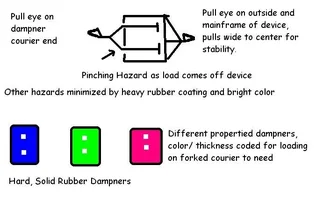
Multi use device, adjustable; human and cargo models. Main idea in climbing was for stiff at climb on SRT, then forgiveness starting at such an overload of unexpected force. Taking harshest shock only off climber of fall incident; still have the lesson learned of falling, just be able to remember it easier and form full syallabications sooner.... In this model/ load setting, seek to be softer than climber, in rigging model less soft as just has to save line, supports hardware etc.; much higher 'setting'.

In rigging, to save equipment, supports with loads at their absoulute peak; clipped out of formulae by device, giving less loading on everything; sometimes saving the day in the short run. Also more cylcles to failure for line etc. in the long run. Especially notable as more dampening given to blocking spar down on itself (pulley under load, climber clinging like tick type position...), in conjuction with/in place of running load, especially when no room to run load.

Too soft would be a problem; unless specifically chosen correctly, favoring stiff, not very compressing rubber, for instantaneously clipping spiking part of force on scientific graph out, without rebound if used in proper range.

Or something like that!

Edit: Perhaps time to give it a K.I.S.S.
Simplify to single hole circular model and incorporate into shaft of Porty, saving space, connections, loose joint in between, easier extensions on vertical line compressions (with 3/1,5/1 jig etc.)to pretighten etc. for rigging model.

Lift/dampning of spring could go to weating in type position on tightened line with pulley bowstringing line perpendicuarily to the axis of the line?
 

Attachments

  • 6912-Adjustable Dampner.webp
    6912-Adjustable Dampner.webp
    29.6 KB · Views: 37
I thought about this possiblity when i first saw the shock absorber in the cobra system. My though was to put one of those rubber dildos(only smaller) in a hollow core rope and incorporate the rope into a pully sling, the sling that holds the brake, or even your cambium saver or fixed end of your climbing line.
It makes sense, with more static lines being used in tree work. The rubber could be hard or soft depending on what load you wanted the rubber to start giving flex.
Adding the shock absorber to your hollow core rope would be as easy as bunching up the rope and sticking a hunk of rubber in.
 
A dampner alone (without being built into Porty), would be able to be put on ground between friction/belay device and it's anchor or between the overhead pulley/redirect and it's support as has been said(or at 3rd point of buffering in this chain of support to load, in between load and line/sling hitching ).

But placing the snubber in the overhead redirect by pulley position, the snubber would take 2xload; it will also give line 2x snubber's own stretching from loading in line slack/load drop. Positined at ground with Porty, the device would take 1xload, and 1x it's own stretching with line slack.

i think that placed at the overhead redirect the snubber would be called on to stretch more by the 2xload on it's point (2 lines of pull on pulley it would attatch too), thus giving more extension of device than at Porty. Then, that stretch gets further doubled by as the device takes the load and stretches it slackens both legs of line at once!

This could give more action/drop than desired, i believe for the same shock buffering gained. i think the same shock buffering would be had at any of the 3 points: at the Porty, overhead redirect, or as a link between the load and the line; choosing either of the end points of line places single leg of pull. i believe such a strategy (snubber at redirect) would have a place, if there was a time when the snubber was too stiff to give buffering in range needed, and double loading at redirect pulley would force buffering of shock needed, from the snubber device overrated for the load; if the resulting extra line slack was ok for the situation.

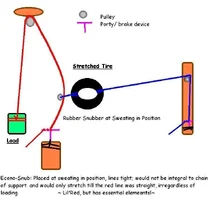
Pre-stretching a snubber, perhaps softer device or spring in a sweating in position (but maintained during loading) of pulling load line sideways like bowstring with loaded line running through pulley to the stretched device could also give buffering. Without extreme distance of this sweat, this would be safest, even if it destroyed snubber from further use; for it would be providing shock releief, have a limited/ predictable stretch point(will just stretch to straight load line run); and not be integral to the support as snubbing at load, redirect or friction device. For, now the load snubber coud break, buffer the load in the snubbing device's own shearing, yet chain of load support, would be unbroken. Guess that means you could use a tire on occasion....to save the day and give more future security to lines, increasing cycles to failure greatly as in attatchmeant.

Orrrrr something like that!
 

Attachments

  • 6919-Farmer Snob.webp
    6919-Farmer Snob.webp
    40.6 KB · Views: 28

New threads New posts

Back
Top Bottom