Cutting through the hinge wood.

Sorry Graeme, but, my e-mail was misinterpreted. I was talking about having "my" post deleted, not yours. Besides, I couldn't have your post deleted if I wanted it deleted. I like reading a smooth flowing thread when a topic of interest is being discussed. I don't like reading a thread which stops with unanswered questions. As far as the didn't think it would happen comment, I just didn't think you'd spend much time writing for the discussion groups. Don't ask why, it's just what I was thinking.

O.K., down to business.

1)You do give the weights of each piece consideration. I'm thinking the weight of each piece should be about the same due to the inertia of each piece. I can see one piece pulling the other over with it and the hinge not breaking.

2) 2 45° undercuts, I don't know the snipe cut.

3) I figured guessing the line length might be the case. The line being slightly off center would make sense. I can see that line easily cutting a person in half, especially with the magnitude of pieces you take.

I can relate to having a good guy on the ground. Experience and cohesion between team members can make a job go real smooth.

Thanks for answering some questions.

Joe
 
Joe,
No problems, flow is good. I am pleased to input to the discussion group when I am home, even though the computer and I do not get along.

1. More important than weight estimations the upper section must be shorter than the lower. Otherwise it will flog you as it passes. On brittle timbers sometimes you need to use a sling joining either side of your pre-cut. This prevents early separation and over rotating of the lower section.
3. Much finer control is gained for the tail line when it is tended through friction on the ground. This allows line to be paid out and held under control during the break.

Regards
Graeme McMahon
 
Graeme,

Can you please discribe the use of the sling in a little more detail. If you have a photo or a drawing that would be even better yet. Thank you.
 
Craig,
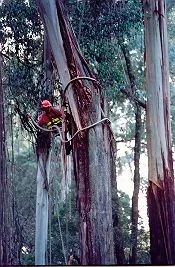
Here's a picture of the sling used on an 85m E. regnans broken off and lodged in a larger tree behind. When pulling the tree over with the previously described technique, the sling prevents seperation at the break and thus the locked head is pulled clear. Break is at about 25m.
Regards
Graeme McMahon
 

Attachments

  • 3431-sling.webp
    3431-sling.webp
    23.2 KB · Views: 119
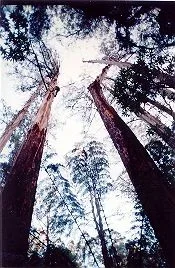
Looking up from the ground, because of 80m dead spars either side, the tree was back released with directional charges.
Graeme
 

Attachments

  • 3433-lookingupsling.webp
    3433-lookingupsling.webp
    22.5 KB · Views: 92
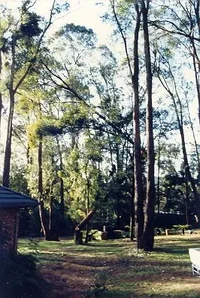
another example of a storm damage job, broken at an ant nest. Tree mid-flight and pulling clear of tree supporting crown. We have installed an mpg of the large ash coming down, only just to big for this forum so its on http://sherbrooketrees.tripod.com/sherbrooketreeservice/
You can see after the break has seperated, the broken ends still travel to the ground together becuase of the sling. Also the supporting tree behind can be seen straightning up as the load is removed.

Regards
Graeme McMahon
 

Attachments

  • 3434-precutexample.webp
    3434-precutexample.webp
    47.8 KB · Views: 92
Graeme,

What are you using for a sling and how is it rigged to the stem? Do you make them yourself out of rope? The technique looks looks to show promise for storm damage situations.
 
Craig

Anything strong enough to do the task, steel or synthetic fibre. Pre-formed eyes with shackles can slide off the upper section unless are well seated, (slack develops as the sections fold up next to each other). I mostly tie off one or both ends, either choked or locked knots.

regards
Graeme
 
I see what you're explaining Graeme. It is similar to a technique I use for getting a stubborn hung up tree down when felling. Sometimes the butt digs in when trying to winch it out with light weight lugall winches. A new face is cut on the underside of the lean at about hip height. The winch cable is attached just below this and tensioned. A back cut is placed leaving a good hinge. The saw operator then leaves the area. The winch then pulls the tree back causing the face to close, lifting the butt up and then hurling it back into space. A good way of freeing a stubborn tip on conifers. Don't try this if hung up in a hardwood crotch! It is very unlikely to pull free, and could break off the stump and hang precariously.
 
I will cut the holding wood in different situations. Last week I removed an entire 80 foot dead pine in a closed canopy by rigging a block on a larger nearby live pine and tieing off the dead pine as high as possible. The pine was then pulled over with the Good Harken device. The ground cut was a spear cut (I call it a slip cut) with a speedy exit when the butt jumped the stump. Part of the top broke broke on impact but that was expected. All were clear in the drop zone. The remaining tree was cut in pieces as tree was lowered down.

There is a real danger of free falling large tops in a closed canopy situation in that the top can get hung, butt end swings towards the tree top where it is hung, and release brings the top back on your head. This happened to me once and gave me a well deserved thrashing for my lesson. It happened during the first year of cutting practice as I experimented with different cuts. A climber was recently killed here in Atlanta with this situation. He felled a 40 foot top into a neighboring pine and the top was slung back at him. The rescue guy said all of the climber's blood had drained from his body by the time he got to him A FEW HOURS LATER.

Another techinique I use often for felling is to cut all holding wood in what I call a "helicopter or holding cut". This cut is for blocking down trees with vertical wood. I use a straight back cut until kerf moves, about 4/5 way through. I then remove saw and cut all holding wood a few inches (bottom cut distance depending on size of wood to be pushed off) below back cut. The pieces I push off are usually 5 feet or less in length.

I use this same cut with a lot of crane work but my second cut is lower down allowing me escape time to drop lower before the crane breaks the section. This cut keeps the butt from swinging around as can often occur using a notch cut.

Of course a straight back cut without the under cut invites a baber chair split that can take your head right off.

Always make sure of the results you will create before making any cuts. Picture in your mind what will happen after your cut. In fact, run that movie in your mind for as many times as needed before cutting so you can get a clear picture of what will happen and where safety resides. Listen to that last minute "little voice" in your head calling you to reconsider before cranking up the saw. You are in the front lines of survival and it doesn't matter if the payroll clock is running because you want that payroll clock to be clicking for you tomorrow.
 
Peter, I`ve never heard a professional use what you refer to as a spear cut when felling a large tree, although I must admit I don`t get out much.
It seems to me it would be dangerous not to have full control of the tree by using a hinge and or a proper face cut.
Maybe you got lucky this time.
 
Kevin;

It's been a few weeks since you posted your question. Hope you don't mind if I respond to your question to Peter I work in the same area as Peter (Atlanta) and thus work on the same types of trees and understand, and use, the techniques he described.

The pines he talks about are loblolly, which typically grow with a tall, clear, slender bole. I worked in Indiana and Pennsylvania for about ten years and lob lollies are very different from the white pines that are common up north.

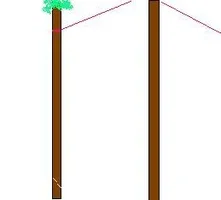
In the first paragraph he is talkng about 'hanging' not simply fellng a tree. A rope is placed high in the removal tree, then the other end is run through a crotch or a block in a second, adjacent tree which serves as a gin pole. The rope is tightened and the removal tree is cut at the base (a friend used to say 'tie it high and cut it low'). The idea is not really to use the gin pole to suspend the removal tree in mid air, but rather to use the gin pole tree to prevent the removal tree from falling over. There are lots more details, but since you asked about the cut, I'll desribe only that. As Peter mentioned, it is really just a spear cut. The 'notch' or 'face cut' is just a kerf cut or sometimes a very narrow face cut. The idea is to have the face cut close and break just as the top of the removal tree lays into the top of the gin pole tree. If the face cut is too wide, then the face won't close, the hinge won't break and the hinge has to be cut with the saw, possibly pinching the bar. The (narrow) face cut is made at a fairly steep angle (45* or more) so that the butt end of the removal tree will slide off the stump. The back cut is made at the same angle as the face cut (45* or more). If the back cut is horizontal then the horizontal cut on the spar will hang up on the stump and prevent the tree from sliding to the ground; it may also pinch the bar. I have also found that it is helpful if the back cut is made at or just above the 'apex' of the face cut. (I say 'apex', although the face cut is just a kerf cut, or a very narrow face cut). If the back cut is made below the apex of the face cut, it wil create a 'step' (called stumpshot in a traditional felling cut) which can also prevent the tree's butt end from falling cleanly to the ground.

In the second paragraph Peter changed topics and started talking about dropping tops.

In the third paragraph he says "felling", but I think he is describing taking out pieces of a spar using a snap cut. This is also a common technique in this area.

Mahk
 
Mahk;
Thanks for the explanation.
I can see where you would have complete control over the tree in this situation.
 

Attachments

  • 3763-kerfcut.webp
    3763-kerfcut.webp
    2 KB · Views: 44

New threads New posts

Back
Top Bottom