Crane failure

Sinko, I noticed the different look at the spot you are referring to. It looked like the angle of the break was different, I thought rust too, but I think it could be the light conditions when the pic was taken.

Tree work is an extra-ordinary job for cranes, once the piece is cut off, there are only 2 options, lift it, or put it down quickly. Weight estimation is a difficult task, and keeping the weight down is very important.

I agree, the possibility of overloaded cranes in the tree business is a VERY distinct possibility. Sad AND dangerous!
 
Then this is a prime example of the put down quickly option you describe. Actually, and I'm only speculating, it looks as though the log on the shed if this is what he was lifting?? appears to only be about @ 45' radius which may have put this truck at the extreme of it's structural chart and since it was picking off the rear may have caused the structural failure as opposed to tipping. Since he was picking the spar or final pick from off the stump it is also possible as some do to take a larger pick and reel it across the ground and back within the chart, pure speculation though. Judging by the amount of debris within the turret this unit was probably not maintained to a very high standard or inspected very often.
 
The tree on the shed wasn't the one being worked on. The failure occurred before the pick. The computer did have the history and showed, at least for this day, that there was no overload.

I agree that the turret shot definitely suggests prior damage or defect.

It may never be known in detail.
 
[ QUOTE ]
Judging by the amount of debris within the turret this unit was probably not maintained to a very high standard or inspected very often.

[/ QUOTE ]

I kind of thought the same thing. Why and how would the turret be so dirty inside? And how difficult would it be to clean it out? Could compressed air simply blow this stuff out?
 
Not sure at all how that much debris could accumulate their or how accessible it is. It is one to include in the daily or weekly routine of maintenance on it.
 
I would venture to say that at some point in its history the crane took picks that were way outside the load chart. I would be curious to know if the crane had one operator through its life or multiple operators and crews. Treework is hard on cranes, especially with inexperienced operators.
 
[ QUOTE ]
[ QUOTE ]
Judging by the amount of debris within the turret this unit was probably not maintained to a very high standard or inspected very often.

[/ QUOTE ]

I kind of thought the same thing. Why and how would the turret be so dirty inside? And how difficult would it be to clean it out? Could compressed air simply blow this stuff out?

[/ QUOTE ]

Many boom trucks have openings which allow debris in. I dont know with respect to this crane but It can be cleaned by hand and air/pressure washing. I doubt the debris itself caused the damage. The part that would attatch and broke is inside the rotational parts and does not itself move.
 
Not having been with the company very long, I believe there may have been one other operator. In the end, the crane manufacturer has assessed it and deemed it to be not due to overload or operator error.

Good news for the boss.
 
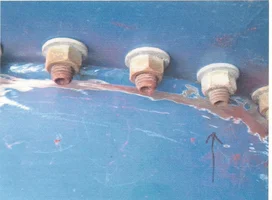
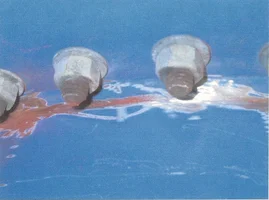
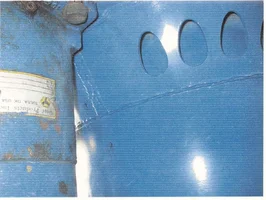
Everything I can see from the pics that is a Manitex 22ton model. Our 22ton had a MAJOR manufactuing flaw at the turret in 2003. We had it inspected and repaired after an operator in Florida told us his had that exact failure in your pictures, when he went for a ride.

Here are some pics of our inspection and repair.
the red dust is magnetic and sticks to anywhere there is a crack or broken weld(ours was cracked 3/4 of the way around the turret).
 

Attachments

  • 169300-scan0002.webp
    169300-scan0002.webp
    341.7 KB · Views: 197
I googled "red magnetic dust" and a bunch of Mars information came up. I wonder where one gets their hands on some of this stuff, and if it's martian in origin.
I sometimes wonder about our Prentice loader turret, we have overloaded that thing more than once. Thinking about it now, I'm not sure we've ever worried about going beyond it's capacity, though I have heard stories about loaders breaking free from their base.
Do you guys with loaders worry about going over the loader's capacity? If we can't pick it up, we cut it up smaller and try again.
 
I would think that overloading would not be as big of a deal as shockloading.

A slow gradual pick that goes to overload would not be a big deal.

a limb or log coming off and bouncing the crane, spiking the capacity into the overload area, would be what would cause damage.

our k-boom computer stores all our info too. well, the overload times and any trouble codes.

There will be hundreds of overloads registered.

If I lift the main cylinder (or even the next knuckle) and come to the end of the cylinder, it will quickly reach overload if i top out the cylinder. I'm talking with no load too. So, an overload will be registered, but there was no actual weight on the boom.

I take it into overload (not actually "overloaded" I guess, it's a warning before the crane is truely overloaded, but it shuts me down and only allow me to boom in or boom up very slowly for a few seconds at a time). But I get into this area all the time when picking butt logs or heavy lifts off the ground because, if it can't do it, the computer won't let me do it. I can use the ground a little to add just a hair of support and allow me to boom in and get us out of the warning area.

A weight PAST an overload warning would have a chance more to tip the crane, vs. crack something off. But this won't happen unless you didn't pay attention that the crane wasn't picking up the weight and opening the kerf as you cut. (or you rigged it wrong and the peice flipped). And an incident of weight past overload from the ground won't happen because the computer won't let you do it. You would need a load to drop off of something to put you past overload.
 
Like our ropes there are cycles to failure with everything. Persistent overloading stresses the structure and will lead to failure in a situation where there is no overload. An analogy of this is an electrical circuit breaker that trips due to an overload. With every O/L the ampacity of the breaker is actually reduced until it is no longer able to carry a load near it's rated maximum.

I understand the O/L warning without load is misleading but it keeps you operating your crane well within the design limitations. Maybe talk to your dealer about why it does that.
 
[ QUOTE ]


I understand the O/L warning without load is misleading but it keeps you operating your crane well within the design limitations. Maybe talk to your dealer about why it does that.

[/ QUOTE ]

Why would i talk to my dealer about why it does that? I know why it does that, it's common sense. WTF?
 

New threads New posts

Back
Top Bottom