Conterra Scarab use for rigging

Phil

Carpal tunnel level member
Location
Oak Lawn, IL
2022-10-15_10h38_24.pngI came across this device in a treebay post about a morgan block. https://www.treebuzz.com/forum/threads/wtb-morgan-block.47365/post-722022

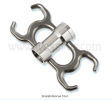
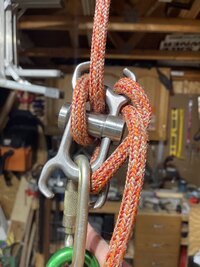
@evo mentioned the scarab as an alternative and then a couple folks piped up with how useful it is. I hadn't heard of it before so looked it up, watched some videos and started thinking about how I would use it. I did a search on here to see if a thread already existed in regards to how folks utilize the scarab device. I didn't find one so I want to start one. I have the device sitting in my shopping cart over at Wesspur. Just need to be convinced to pull the trigger on it.

My immediate thought on why I should add it to my kit is self rigging operations and its flat/small profile. Its something I can keep on my harness that's not heavy or bulky. Its mid line attachable and has variable friction options and the ability to lock off, just like a mini porty.

I have a tree to remove soon at my dads place and I will be double whip tackle lifting lots of stuff from over a fence. I think I can do all this as a solo operation from in the tree. Set the rigging blocks and install the scarab near my cut area. pretension the line and lock it off. Make my cuts, release the lock and friction from the ears and pull the limb up. Either relock to make the final removal cut if needed or just lower the piece to the ground for my dad to grab and walk out into the yard. It makes sense in my head but without having one to try in the scenario or a mock up, can anyone say with confidence this would work smoothly? @evo mentioned the DWT use so hoping you'll reply here with any insights. you also mentioned using a loopie with a screw link. What size link did you use? Largest wesspur sells is 3/8. I would imagine a loop runner girth hitched directly to the scarab would also work? Probably would be best to use a link though to avoid textile on textile rubbing with the lower line is feeding through the device though.

Use with a 3/8 line is mentioned but I have 1/2" 3 strand for my rigging. Any idea how that would run? I could get my hands on some velocity for a thinner, smoother running line if I have to though.

I can visualize using it a speedline tensioner as well. Can kinda visualize using it for negative rigging but would like to see it in action or in a still photo all setup. I'm not really understanding the use as a balancer as was mentioned.

Outside of my specific example, I'm looking for a breakdown of other ways folks have used the device. Pictures always help as I am a visual learner. I'm not really looking for use in rescue or belay operations but purely as a rigging tool.
 
@Phil I’ll send you my phone number just had hand surgery so typing isn’t my thing at the moment.
You are on the right track. Wouldn’t recommend a textile connection for the reason you stated. Also nice to have the tail tail captured.
Negative rigging has some risk with slack introduced. I’ve done it but not to be trusted in critical situations, where I might be in auto mode.
1/2” three strand wouldn’t run well, more so in a double whip
Should be available this afternoon or tomorrow
 
Last edited:
10mm stable braid is rated at 5k, is fairly cheap, and durable if not natural crotched. Haven't used the scarab but I bet it would play nice
 
i havent used the scarab but the situation you described with your dads tree, sounds like the rigging wrench might work well (lifting trough a friction device is ussualy not much fun)
 
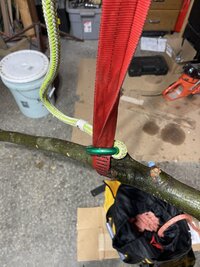
I’ve got a rainy cold shop day here so I thought I’d show how I personally use the scarab. My system is sort of a riff on the very good solo rigging system that I believe @Jehinten came up with. I’ve used the scarab as aerial friction in a fixed rigging point, but using it this way allows me to add or subtract friction easily without needing to climb back up to the device if it isn’t close at hand. It also allows for easy return of the “working end” no matter where it might end up after the branch is removed.

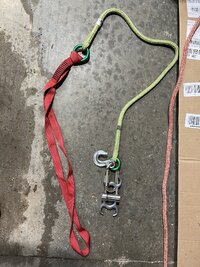
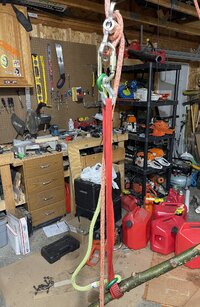
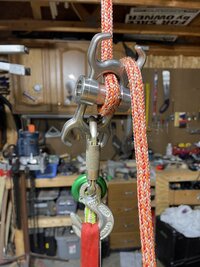
It goes without saying that I use this for light solo rigging. I pick a good rigging point above and usually install a friction saver of some sort as I am most often pruning. The non work leg gets tied off to the tree. You place a bight of rope into the scarab per the device instructions to start and attach the loop around the branch to be removed and in into the hook as pictured. The rope can be easily locked off so the branch can be cut and allowed to settle safely while keeping the system taut. Remove the half hitch lock and allow the branch to fall to the ground in a smooth controlled manner. Give the rope a few jiggles and it all comes loose to easily be pulled back to you.

346A4AF9-CEE7-4A6E-9233-E35CB46A7859.jpeg

E2A382B2-38B4-4BCB-9CCC-D5A1025CCA1E.jpeg
0ABDF834-33B9-48CE-92F2-ECFEE25732F8.jpeg

08969775-15BA-4A9E-98DF-0304F18A04EE.jpeg

B4769841-7111-46EE-B325-EBEC4F762647.jpeg

A note for those squeamish about the hook and loop: as long as everything is kept taut you should not have an issue with the loop coming off the hook. I’ve never had a problem with it. When I first saw the system I played with it in situations where complete failure wouldn’t result in any damage until I was completely comfortable with how it would perform. I encourage you to do the same should you put any of this into practice. Ymmv and use at your own risk. And now back to my much needed shop cleaning.
 
I’ve got a rainy cold shop day here so I thought I’d show how I personally use the scarab. My system is sort of a riff on the very good solo rigging system that I believe @Jehinten came up with. I’ve used the scarab as aerial friction in a fixed rigging point, but using it this way allows me to add or subtract friction easily without needing to climb back up to the device if it isn’t close at hand. It also allows for easy return of the “working end” no matter where it might end up after the branch is removed.

It goes without saying that I use this for light solo rigging. I pick a good rigging point above and usually install a friction saver of some sort as I am most often pruning. The non work leg gets tied off to the tree. You place a bight of rope into the scarab per the device instructions to start and attach the loop around the branch to be removed and in into the hook as pictured. The rope can be easily locked off so the branch can be cut and allowed to settle safely while keeping the system taut. Remove the half hitch lock and allow the branch to fall to the ground in a smooth controlled manner. Give the rope a few jiggles and it all comes loose to easily be pulled back to you.

View attachment 84192

View attachment 84188
View attachment 84191

View attachment 84189

View attachment 84190

A note for those squeamish about the hook and loop: as long as everything is kept taut you should not have an issue with the loop coming off the hook. I’ve never had a problem with it. When I first saw the system I played with it in situations where complete failure wouldn’t result in any damage until I was completely comfortable with how it would perform. I encourage you to do the same should you put any of this into practice. Ymmv and use at your own risk. And now back to my much needed shop cleaning.
So your using this as a connection point for a DWT, is that correct? I like it, and as you mentioned, it makes getting the rope back easy if it's swinging away from you after the cut.


A note for those squeamish about the hook and loop: as long as everything is kept taut you should not have an issue with the loop coming off the hook. I’ve never had a problem with it. When I first saw the system I played with it in situations where complete failure wouldn’t result in any damage until I was completely comfortable with how it would perform. I encourage you to do the same should you put any of this into practice. Ymmv and use at your own risk
100% agree. Low and slow isn't just for trying out new climbing techniques. I'm glad to hear that system is working for you.
 
Agh. This is making my brain hurt. Video!! Too much voodoo going on in those pics.
This may help with the sling portion of his configuration. This is the system that I developed. The bungee in the video is pretty new (still experimental) to see if it'd aid in getting the hook to release when it needs to. The rest of the system has been shown in solo rigging threads on here, but never a decent video to show it working. I can look for a link if needed for that thread.

Still not sure it's a decent video, but it is a video. :LOL:
 
This may help with the sling portion of his configuration. This is the system that I developed. The bungee in the video is pretty new (still experimental) to see if it'd aid in getting the hook to release when it needs to. The rest of the system has been shown in solo rigging threads on here, but never a decent video to show it working. I can look for a link if needed for that thread.

Still not sure it's a decent video, but it is a video. :LOL:
Thanks! That was the part I couldn’t figure out. Still a lot of voodoo tree magic
 
Agh. This is making my brain hurt. Video!! Too much voodoo going on in those pics.
Sorry man I can’t video this stuff very well with a phone and keep both hands free to set stuff up. I can’t see spending the dough on a GoPro either. Hopefully the video above helped enough to get you there.

So your using this as a connection point for a DWT, is that correct?
Yep pretty much a whip with a twist.
 
it looks like its critical to keep the yellow rope with the two rings longer than the red loop runner? is the little ring on the yellow rope necessary or could you just put the eye on the carabiner?
It’s just a friction saver I had laying around. It’s really overkill as it’s main function is to pull the whole thing back. Some day I’ll get around to splicing something purpose made for the task. It should be a little longer than the sling but the sling can start quite a bit longer since a lot of the sling gets used around the limb. If you use it the way I am with the scarab you could just put the eye on the carabiner. In Justin’s system a ring there works better.
 
Back
Top Bottom