[ QUOTE ]
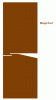
Ahh, but if you are have a lateral limb, and want to cut short pieces (say max 4 feet),then break it free, and drop it, just make your mismatch cuts vertically. Works like a charm.
[/ QUOTE ]
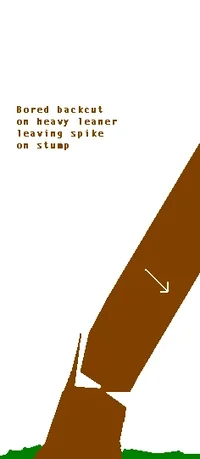
Great trick Rog. i think this works in several stages. i think ya kerf under the horizontal limb, then come down from above. The initial failure/fold is the same strength as any other kind of face etc.; because the load pulling on it is the same. The kerf shows early close strategy.
This close gives a push up/out on the branch; as the still connected tissue/'hinge' is now tensioned. This can hold sometimes until seperation, then let go like it was suddenly dropped; not kicking back towards tree, or perhaps sometimes not kicking back as hard is enough.
Mostly this early close doesn't let the Center of Gravity of the limb rotate too far below the close of the kerf at close/ release i think. If the CG does come too far below the pivot/ close of kerf; then the limb is more likely to 'kick'/swing back towards the tree. If a limb is too long for this, i think it is becasue the CG can settle too low in the few degrees of movement the limb makes to clsoe the kerf; can make it kick back towards the tree at close. Then this responding push by the close, and the CG as ForcePoints have an angled branch between them so are more likely to 'spin'/tourque branch back towards tree; especially if the angled force down the limb can also flex it back to move CG even more unfavorabley lower than clsoed kerf before release. They are working in opposite directions and not inline anymore, so there is rotation. But if the CG is higher(like in an upswept but horizontally attatched limb), i can usually drop a longer length for the CG won't settle below the limb when the kerf closes; because it starts higher/ more likely to get a 'snap' at release.
i think a deeper kerf gives an earlier close; to let the limb's CG settle downwards less, for more straight drop release. But also, this gives the support at kerf close/prep for re-lease more leverage. Now the distance from the closed kerf to the kerf's 'hinge' is a longer distance for higher multiplier. i think this gives less fibers to cut, for a more instantaneous release. Quick, sudden release being another factor of a straight drop. i also think this is more friendly to the tree, in that the fibers aren't pulled as tight, so the stretched fibers don't go back that far beyond the cut.
Many times, i can work this slow, purposefully close the kerf then detatch. If set right, and you know CG won't come below limb, can go faster and slam it close to get a 'pop' out/off. But if CG can come below branch back towards tree at close, the speed only accentuates that bad positioning of CG to pivot at hold, right before release; throwing back harder(which is sometimes useful).
Lots of times if there is a heavy side, i'll undercut/kerf that side deeper, and purposefully close it early, for more pushup support on that side. The harder the lean/CG pulls to the side, the better that works.
In larger stuff, i might close the heavy side early with a close for this push effect, with the opposite side of the face still open/pulling at the same time. This gives both the push and pull working to center at once. Also, the pushes and pulls work in opposite dirctions for more of a tourqued, than linear pattern of force (stronger force like opposing out of line forces whne CG drops below kerf close before tearoff/release) i think.
Or something like that...
/forum/images/graemlins/propeller.gif