Large photo
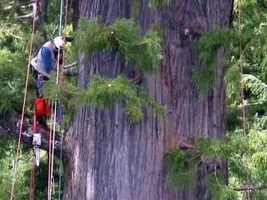
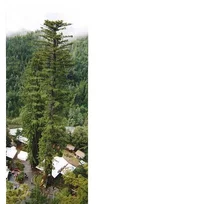
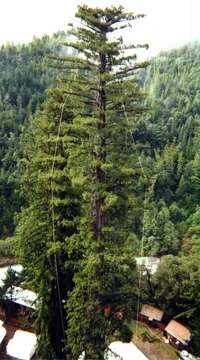
Here's a larger size (96k) attachment, without the base added. No retouching. Scott is in the very top, John is on the right, near the top.
The two ropes seen running full height are speedlines that were stowed for the night. When in operation, they had been stretched and anchored out on the sides.
A third speedline runs from the top of the tree out to the rear, out of view behind the trunk in this view. Because of housedrop powerlines, it was tensioned by it's groundcrew while standing on top of a semitruck storage container in the back yard.
The speedline on the left, for example, was hooked to a GRCS (Good Rigging Control System) winch mounted to John Sanborn's trailer hitch on his pickup truck (which he drove from Wisconsin to California, specifically for this project). Tensioning was a piece of cake with this setup, and the rig was slacked off with each cut, allowing us to lay these 25' long pieces of deadwood right where we needed them, alongside Highway 101.
The 3 individual speedlines were operated by 3 crews, all on different radio channels. Each of these 3 crews were composed of 2 climbers and 2-4 ground folks.
The 3 sets of climbers could have been on different planets from each other, the tree was so massive that the trunk blocked the view like a sailboat behind a battleship. The heighth differentiation put us in remote vertical strata; the foliage was so dense, that when we went out on a limb, we vanished from sight of the others; Our puny voices slipped off into the mist, with no reflective surfaces. The canopy spread was probably 50'-75' wide.
On the climbing team, one guy would tie off the limb with a separate control line & cut the limb while the other would take a wrap on a friction device and lower it to the ground, all while operating the radio. Balancer slings were used to maintain the horizontal orientation of the limb--we didn't want it to swing, for a crumbling limb would shower buildings & people with unannounced debris. Luckily, that didn't happen much. Warnings were given by both voice & radio. Multiple marls were halfhitched to package the rotten limbs. Cleanup stub flushcuts were cut & toss in a rare few instances.
Looking at this tree in the late 1980's, I couldn't fathom how these pieces could have been snaked out through the limb structure without hanging up. The solution was to start at the bottom and work our way up, leaving less material for stuff to hang up on.
Each cut involved redirecting the limb sideways on a downward slant along the speedline, towards the outside of the canopy. Sometimes we had to wait as the limb slowly pivoted around, then it was lowered as the alignment matched up with a gap between lower limbs.
Close communication made this job. As creative rigging options became evident, the crew had to work a little harder to pull them off. For example, rather than working on two limbs side by side, we sometimes had to do one of them, then climb up and do several lowerings above it, returning to the lower area later for the branch on the side. This meant a lot of climbing up & down to reduce "the distinct likelihood of the work hanging up", as Jerry put it his pre-climb instructions to the crew.
When a 200' line has to be pulled up after each lowering operation, great care is taken to make sure that strenuous act is done only when absolutely necessary. The advanced skill level of the crew lessened the repetition, and their flexibility and cross-training in tackling different jobs spread the load out among more folks.