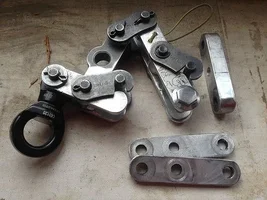
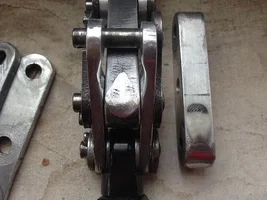
Compact Bulldog Bone

If anyone want to know, the Bone works well with 10,5 mm rope as well. However with a custom made bollard that have a radius cut into it. Aprox 22mm at the smallest outer diameter. I've also noticed that the bone tends much better if I pull it from the top attachment point on the spine. Not the D-ring on the upper arm or the hole on the spine. Barely any friction, but the rope doesn't fall trough by itself. Not sure how to do this in reality. Maybe thats why I've seen someone attach a cord to the hole on the spine and then up trough the gap on the top?
 
....Barely any friction, but the rope doesn't fall trough by itself. Not sure how to do this in reality...

With a tether attached at the D ring location on mine, the rope will fall through with just tail weight at about 10 to 15 feet up if the rope is directly overhead. This is with Vortex.
 
Gordon, is there any ropes that you want/need to test new bones on that you don't have? How long of a piece would you need to perform tests?

I ask because if you need these things, perhaps some of us have some we could send.....if not, then maybe some of us would be willing to chip in a little pocket change to make it happen. There have been posts suggesting we compile a database amongst users to know what will/won't work, but it would be nice to recieve this kind of data from the builder, so that customers and potential customers could make informed decisions.
 
I like the idea of getting data on the ropes that work well.
I do have one comment and I don't want to sound negative and I understand the desire to have this data but....
I like to choose my rope based on the climb I am making, static for tall trees long ascents, fatter more dynamic for smaller trees, lots of laterals, moving around, knotablity, weight..etc. etc.....
I recognize that every device is different and I think it is obvious where I'm going on this. Until I get more personal experience I'm just running my fingers but I wonder with so much being said how much of an issue this is.
 
Barely any friction, but the rope doesn't fall trough by itself. Not sure how to do this in reality.
The length of the tether in relation to the length of the bridge can play a role in this. If the tether attachment pulls up to the point it is tensioning the bridge it applies the lower friction point.
 
...I like to choose my rope based on the climb I am making, static for tall trees long ascents, fatter more dynamic for smaller trees,.......but I wonder with so much being said how much of an issue this is.

A change in rope diameter and/or construction frequently means the upper friction bollard needs to be changed.

Typically a larger diameter rope requires a smaller bollard, however this is not always the case due to rope construction. Construction can effect the bollard size on approximately equal diameter ropes as well. An example would be Tachyon 11.5mm and Yale 11.7's. Tachyon usually does better with the 5/8" bollard while the Yale 11.7.s do better with the 3/4" bollard.

Any recommendations would only be a starting point due to other variables like climber weight and rope condition.
 
The length of the tether in relation to the length of the bridge can play a role in this. If the tether attachment pulls up to the point it is tensioning the bridge it applies the lower friction point.
Yes, agreed. Your bridge needs to be 'just' slack for freedom of ascent.

It also seems that a taught vertical line can be a deterrent unless the Bone is specifically machines with the new groove in the spine. Without the machined groove, a slight lean back during ascent can make it run more free.

I started with some original Bone designs and slowly brought them up to date. Most recently with a couple newer spines. I got them without the grooves, just to see what the difference would be. I found that the groove I created helps mostly on ascent. I machines it bassd on the geometry of the Bone when it's collapsed and the spine is angled back. Once it's engaged for descent, the pinch happens just above the groove. I'm liking this so far.

I've also snubbed out the lower arms on one unit just to see if they were extraneous. Luckily, I still have two extra lower arms hanging around since I actually used them to make the spine of my first Franken-Bone (formerly was a 3 yr. old OAR). My next thought is to thin out the remaining interior of these snubbed lower arms for ultimate rope channel when slack tending in a forward direction.

Here are a couple shots...image.webpimage.webp
 
lookin good dude
Thanks, Mac. As you can see, it's time for new cotter pins. I'm not climbing on this one right now, just experimenting lowish and slowish. Once it seems close to dialed in, I'm putting all new pins in.
 
I did think about making that groove in mine but the problem is also at the top. As you may recall I posted a picture with callipers and the gap between the top bollard and the pin form the chain link. The gap there is narrower than the diameter of the rope and due to that there will always be drag here. I haven't taken the time to machine it further to figure out how small I can make it without falling to the ground.
 

New threads New posts

Back
Top Bottom