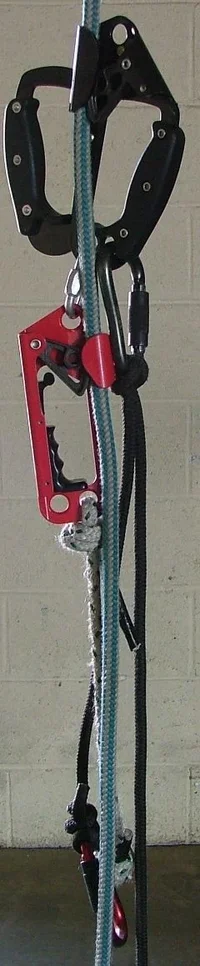
CMI 2 handled ascender

Mahk,I can assume you are going by the ratings on the spec sheet.The ratings on the handled ascenders are 20kn bottom and 18kn top hole,yet these ascenders are allowed at the ITCC.
 
Roachy:

You are correct. I think that this is an issue that really needs to be addressed.

The following is copied from this thread:

http://www.treebuzz.com/forum/showflat.p...=true#Post55278


[ QUOTE ]
In this and other threads people have raised questions about what type of gear is appropriate for ascending in tree care and what holes can be used in certain models of ascenders. This question of gear ratings really needs to be looked at more closely. In the June TCI magazine Daniel Murphy wrote a great article about footlocking which was discussed in this TreeBuzz thread:

http://www.treebuzz.com/forum/showflat.php?Cat=0&Number=50708&an=0&page=3#50708

(the thread also gives a link to an on-line copy of the article).

In the article it is stated:

“All ascenders carabiners, screw links, and shackles must be rated at a minimum of 5,000 pounds and meet other ANSI guidelines.”

Although there were some great points about technique, much of the gear that was shown does not meet the 5,000 pound rating that the author says it must. In Figure 2 the blue ascender on the right is a Petzl Ascension, rated at 18 kN for the top hole, and 20 and 15 kN for the bottom holes. See

http://en.petzl.com/ProduitsServices/B17%20ASCENSION%20B17502-F1.pdf


Below the Ascension is a Croll, which is rated at 12 kN for the bottom hole and 5 kN for the top hole (the top hole is really just a guide for the chest harness):

http://en.petzl.com/ProduitsServices/B16_%20CROLL_%20B16500-03.pdf


To the left of these is a Microcender. I haven’t been able to find a rating for this on the web or in any of the product literature

http://en.petzl.com/ProduitsServices/B54MicrocenderB54500%20040598_1.pdf

so (a couple of years ago) I wrote some emails to various sources and found that the shell of the Microcender is rated at about 3500 pounds.

On the rope with the Microcender is a Kong double handled ascender (called Twin Ascender by Kong). I haven’t been able to find any specs on this ascender in the literature or on the web, but I would guess that it is rated about the same as the ascenders made by the other manufacturers i.e. about 20 kN.

These ascenders are shown throughout the article, but none of them meet the ANSI Z 133.1 criteria for tree climbing (I am not familiar with standards outside of the US, so I don’t know if they are acceptable in other countries or not).

This is not meant to discredit Daniel Murphy, but only to point out how certain pieces of equipment have been quietly accepted into the tree industry without any discussion or research. Other ascenders which are widely used, but are also below the Z133 requirements are the CMI Expedition and the CMI Double-Handled Expedition ascenders, both rated at 4,000 pounds:


http://www.cmi-gear.com/catalog/ascenders/expasc.asp

and the CMI large Ultrascenders, rated at 4,600 pounds:

http://www.cmi-gear.com/catalog/ascenders/large.asp


[/ QUOTE ]


I believe that one reason that these items have been allowed is because there are so few replacements. We routinely DQ carabiners that are rated at 22 kN, knowing that the climber can easily get another carabiner that is rated at 23 kN. But, DQing all of the ascenders, descenders, and fall arrest devices that do not satisfy ANSI would probably mean that most of the ascending and floating false crotch systems would also disappear from US TCC's, and US climbers would not be able to use these at the ITCC.

Addressing this issue is a monumental task and, to date, noone has endeavored to do so. But, I think that the topic has to be looked at or it will be forced upon us by a serious or fatal accident.
 
You have to be careful when you read the spec that the CMI ascenders are rated at 4000 or 4600 pounds. This is for a pull between the top and bottom holes on the ascender body. Since we do not load ascenders in this manner, it is a meaningless spec. The 4000 or 4600 pounds number is NOT the amount of tension that the ascender can put on the rope.

The Lyon report has test data for various ascenders being used on kernmantle ropes. They all cut the sheath in the range of 5 to 6 kilo Newtons in a Fall Factor 1 drop test with a 100 kilogram mass.
 
[ QUOTE ]
You have to be careful when you read the spec that the CMI ascenders are rated at 4000 or 4600 pounds. This is for a pull between the top and bottom holes on the ascender body. ... The 4000 or 4600 pounds number is NOT the amount of tension that the ascender can put on the rope.

The Lyon report has test data for various ascenders being used on kernmantle ropes. They all cut the sheath in the range of 5 to 6 kilo Newtons in a Fall Factor 1 drop test with a 100 kilogram mass.

[/ QUOTE ]

Unfortunately this has been (erroneously) used to justify the use of ascenders in treework. The explanation is: the ascender does not meet the ANSI strength requirement, but this is Ok because the ascender will slip on or damage the rope at a much lower rating.

This has always seemed twisted to me. In essence these people are saying that, yes, the ascender is rated below what is rquired by ANSI, but that is OK because the ascender could cause a system failure at a much lower load.

Can you provide a link to the Lyon report?

Thanks Bob.
 
[ QUOTE ]
This is true Mahk, but it is similar to requiring a split-tail used to tie a taughtline hitch meet 5,400# even though it will slip at less than 1 ton.


[/ QUOTE ]


Similar, but different. Tests that I have seen show that various friction hitches will slip at various loads--there is a wide variety of loads, depending on the hitch and the host rope, but the friction hitches do slip. In some cases they have melted the rope, but I don't know of any friction hitch that has severed the rope.

Ascenders and fall arrest devices have been tested on kern mantle rope. Some of the devices slip, while some have severed the sheath or the entire rope. But I haven't seen any tests that are done with arborists' climbing lines. What happens to them? For some of our ropes the strength is in the cover. If the ascender cuts the cover what will happen?

I'm not saying that we should tank all of the ascenders and fall arrest devices. But, I do think that there needs to be more work done to test the compatibilty of various ropes and devices in the various ways in which we use them.

Lots of work to be done...
 
[ QUOTE ]
A buddy of mine got one so we rigged up a kit for him. On the first hitch up the rope he dropped off and fell. Well, fell isn't really the right word because he was only inches off the ground.

[/ QUOTE ]

I took delivery of a new 2-handled CMI on Fri. I quickly noticed that the main spring did not have enough tension to close the cam with any confidence. (By close I mean fully bottom out in the frame.) The cam would sit partially open, at times resting against the safety trigger. It seems either the spring is not strong enough or there's excess friction in the pivot or I don't understand ascenders. The only way it would fully close is if I let it snap from a full (or nearly so) open position. It seemed even more sluggish when I took it to my relatively cool basement.

Out of curiosity I installed my Fly rope into the ascender and allowed it to close to its natural resting point. (I didn't allow it to snap shut.) When I moved the rope through the ascender it did not force the cam to engage. Perhaps if it were fully loaded a few times it would loosen up. I haven't tried that. I'm opting to replace it.

I returned a CMI Ultrascender for this same thing last year. The replacement worked fine and I could not "trick it" into staying partially open.
 
This is a picture of my revised SRT frog set up. The black line going down to the right goes to a foot loop for the left foot. On the right foot I use a Pantin. The Red carabiner hooks to the saddle. The screw link is rated to 5000 LBS. The white and the black cord hook to same carabiner, but I often separate them on my saddle

I agree with Tom’s take that primary and backup should be separate and independent as possible. However, I also think that the best systems while redundant are also easy to install and use. After all, one of the reasons to use such a system is to save time. The best systems combine redundancy with ease of use without overburdening the climber with complexities. Just my take.

To bring up another related point. If, as in this system, there are two ascenders joined in tandem, designed to be used together, could you not cut the ascender ratings in half and still satisfy ANSI standards? This is the same argument that is used to justify using a split tail cord that is rated less than 5000 lbs in a closed system where two legs of the cord support the weight of the load.

Not saying I condone either practice just wondering.

Tony
 

Attachments

  • 78511-Srtsetup.webp
    78511-Srtsetup.webp
    49.6 KB · Views: 124
ChuckR wrote:


[ QUOTE ]
I took delivery of a new 2-handled CMI on Fri. I quickly noticed that the main spring did not have enough tension to close the cam with any confidence. (By close I mean fully bottom out in the frame.) The cam would sit partially open, at times resting against the safety trigger. It seems either the spring is not strong enough or there's excess friction in the pivot or I don't understand ascenders. The only way it would fully close is if I let it snap from a full (or nearly so) open position. It seemed even more sluggish when I took it to my relatively cool basement.

Out of curiosity I installed my Fly rope into the ascender and allowed it to close to its natural resting point. (I didn't allow it to snap shut.) When I moved the rope through the ascender it did not force the cam to engage. Perhaps if it were fully loaded a few times it would loosen up. I haven't tried that. I'm opting to replace it.

[/ QUOTE ]


This issue was presented to the manufacturer. Kris Kirk responded:

[ QUOTE ]
I am not sure what the exact problem is for the ascender but if I had to
> guess I would say that it is possible that when the rivet was set in the
> ascender, that it may have been pressed too tight which is why he is getting
> the sluggish cam. What I would suggest is that he sends it back to us
> immediately so we can fix it or replace it completely.
> It should be noted that on the expedition ascenders, the cam should not
> bottom out against the body. There should be a slight gap between the cam
> and the body when the cam is fully closed with no rope in it. The
> expedition ascenders were designed this way to prevent the cam from sticking
> on the body when it is fully closed. The cam should rest against the safety
> stop which provides two purposes. It keeps the cam from sticking in the
> body and it also makes the ascender stronger. Please forward this on ...and have him send it back to us so we can replace it. As always,
> we stand behind our gear 100%. Thanks for the email and have a great day!
> Best Regards,
> Kris Kirk
> CMI Corp.

[/ QUOTE ]
 
[ QUOTE ]
To bring up another related point. If, as in this system, there are two ascenders joined in tandem, designed to be used together, could you not cut the ascender ratings in half and still satisfy ANSI standards? This is the same argument that is used to justify using a split tail cord that is rated less than 5000 lbs in a closed system where two legs of the cord support the weight of the load.


[/ QUOTE ]

I think you are conflating two different issues. The use of two ascenders derives from a requirement of the 2007 rules of the ITCC (section 2.2.30). ANSI does not directly address ascenders.

The use of two ascenders is so that one ascender serves as a backup system to the other (2.2.30 also states that a "...pliable Prusik cord that is placed above the ascender..." could serve as a backup). 2.2.30 does not state specifically, but I would interpret it to intend, that both the main and the backup system meet all of the requirements for gear and life-support equipment. Someone else might have a different interpretation.

ANSI Z133.1 2006 section 8.1.9 says "Prusik loops, split-tails, and work-positioning lanyards used in a climbing system shall meet the minimum strength standards for arborist climbing lines."

My understanding:

Strictly speaking, "Prusik loop" means that it is the doubled cord (loop) that is being considered, not just a single length of the cord. Thus a single length of the cord used in a Prusik loop may be only half of the minimum strength standard for climbing lines.

"...split-tails, and work-positioning lanyards..." means a single length of the cord/rope, not a doubled length of the cord/rope. If this were interpreted to mean that the cord for a split tail need be only half the strength that is required for climbing lines, then the same interpretation would have to be given to work-positioning lanyards.


THAT BEING SAID, many people understand the strength requirement for split-tails the way that you described.
 
CLARIFICATION


My posts that talked about gear ratings and the ITCC only reflected my thoughts on the matter. I did not mean to imply that any specific item that had been allowed in the past, would or would not be allowed in the future.

Sorry for any confusion.
 
Mahk,

I only brought up the point becasue, like you, I feel it is an unclear area ripe for misunderstanding/misinterpretation. If infact you had an two ascender system with two seperate lines rated to ANSI standards attached seperately and used exclusively in tandem, then I believe you could use the "Prussic cord" argument you so clearly put forth. (I use the term "argument" philosophically)

Either way, right or wrong, my whole point was to show that , no matter how advanced and/or safe our climbing systems are compared to the past, we still have many issues to iron out.

Thanks for the as always precise input.

Tony
 
[ QUOTE ]
You have to be careful when you read the spec that the CMI ascenders are rated at 4000 or 4600 pounds. This is for a pull between the top and bottom holes on the ascender body. Since we do not load ascenders in this manner, it is a meaningless spec. The 4000 or 4600 pounds number is NOT the amount of tension that the ascender can put on the rope.

The Lyon report has test data for various ascenders being used on kernmantle ropes. They all cut the sheath in the range of 5 to 6 kilo Newtons in a Fall Factor 1 drop test with a 100 kilogram mass.

[/ QUOTE ]

I completely agree. The ascenders are designed to run on kernmantle ropes. The sheath tearing is an in-built safety factor, not a worry. This is why a systems approach must be used with ascenders. Use a true kernmantle EN 1891 Type A rope that is between 10.5mm and 13mm diameter. That isn't a blaze, or any other double braid (I'm not even convinced by the fly) and certainly not a single braid or hollow braid. If in doubt, ask the manufacturer what rope they recommend to run in their device. Definitely don't use a line thinner than 10mm is my advice. This thin rope option is for double line mountaineering technique where the second line is belayed independantly for back up.

This whole debate just highlights how the 'Z' standards cling to an old school approach to safety based on STRENGTH, rather than systems SECURITY. We have similar problems the same in the UK due to ambiguous, mis-guided standard setting (even when the required infromation is freely available).

It just shows how far the industry has to go to realise professionalism at its core.

Did I really read 22kN krabs being DQ'd in preference to 23kN - COME ON!!! With such a massive safety factor there is negligable difference.

Don't let mis-guided Dogma ruin a chance of safe ergonomic techniques. Outlawing the Frog when its actually safer than most single line ascent techniques, and blows footlocking off the scene; thats outrageously anal and narrow minded!

nono.gif
shakinghead.gif


There are other chest ascender like the Croll that may be stronger in the shell (as if it matters).

The fact that the EN1891 Type A line has in built energy absorption, the rope is anchored at the base massively increasing that energy absorption, the top ascender is clipped through the top holes and attached with an energy absorber, makes any issue with a Croll's strength paranoid to say the least. The Frog is the worldwide No.1 Caving and roped access system of choice - Can anyone really believe that because one component isn't to 'Z' strength requirements, its dangerous!? SORT OUT THE Z133 STANDARDS and educate those that sit on the committe why a rigid strength clause is not secure.

With this dogmatic approach, a shelled cam ascender that meets the strength, but cuts the rope rather than slips could be chosen. I shudder to think of such scenarios.
 
[ QUOTE ]
This whole debate just highlights how the 'Z' standards cling to an old school approach to safety based on STRENGTH, rather than systems SECURITY. We have similar problems the same in the UK due to ambiguous, mis-guided standard setting (even when the required infromation is freely available).

It just shows how far the industry has to go to realise professionalism at its core.

[/ QUOTE ]

I agree. There is a lot of work that needs to be done.


[ QUOTE ]
Did I really read 22kN krabs being DQ'd in preference to 23kN...

[/ QUOTE ]


Yes. There is a lot of work that needs to be done.


[ QUOTE ]
Outlawing the Frog... Can anyone really believe that because one component isn't to 'Z' strength requirements, its dangerous!?

[/ QUOTE ]


Outlawing? Dangerous?

I did not mean that I agree with the Z. I was pointing out what the Zsays and was trying to show some of the issues that need to be addressed.


[ QUOTE ]
SORT OUT THE Z133 STANDARDS and educate those that sit on the committe why a rigid strength clause is not secure.

[/ QUOTE ]


I agree. But, there is a lot of work that needs to be done to sort out the Z133 standard.
 
Sorry Mahk. My comments were not aimed squarely at you, or anyone in particular, just the general argument evolving in the thread. Its good to thrash these things out.

We share many of the same concerns, particularly the correct use of rope with ascenders; type and diameter.

Because of the sheath slippage effect of ascenders, this is why I don't have faith in a prusik above; if there is enough force to cause the ascender to cut the sheath, there is enough force to cause the prusik to slip, except it'll slip onto the core exposed by the ascender slippage, and damage it from further slippage, if it grips at all due to the decreased rope diameter.

Also, using the ascender to advance the prusik, then unclipping the cam to enable the prusik to grip without worrying about the cam cutting the sheath, IMHO won't work; any inertia on the line will likely cause the cam to flick on, taking over control. Same issue where used as floating false crotch anchor.

I believe in the Frog type system primarily because of the seperate and distant attachment of ascenders, positioned to afford great bio-mechanical efficiency and safety. I always clip the top holes of the handled ascender, so slippage from a side pull isn't an issue, it retains the rope in the device and pushes twigs away from the cam (although normally my hand shields the top of the cam). This is attached to a spelegyca energy absorbing lanyard to 5kN, that strips to an open full strength sling. With the 11mm kernmantle low stretch (not static) line, and backed up with a Croll that doesn't have slack tending issues. With a ground descent system (and gri-gri on harness in case I need to descend whilst ground man is chatting up the sexy client round the back of the house) my only concerns are what I'm tied into above (like any system).

Hey, I noticed a pink mark on your picture of prusik with cmi 2 handled ascender - was it 'borrowed' from Tom Dunlap? You know how he just loves pink gear...
grin.gif


Bringing the thread back to the start, I think the two handled design that allows clipping the top holes is the way forward. Shame about the easy cam flicking. I prefer two holes at the top. If the Petzl ascension came with a two handled version, that would make the bio-mechanical efficiency of my system about as perfect as practicable.
 

New threads New posts

Back
Top Bottom