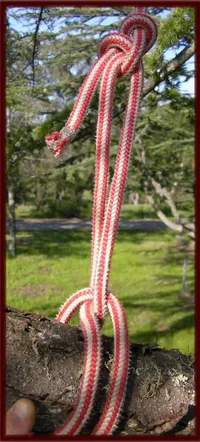
Clove hitch

I think this student miss heard the instructor
I know these instructors and they probably said that it had to be backed up with a half or Marlin
I personally don't use it at all unless I am sending up a pole pruner or water bottle
Running Bowline or a Cow Hitch both backed up with a Marlin are my favs
Rev
 
This shows off my ignorance about common rigging practice... it never occurred to me to tie onto a piece of wood to be cut with a clove hitch... I generally use it as a hardware hitch.... that and for water bottles and pizza boxes.

Big smooth wood gets an RB with one or two marls. I use runners on smaller stuff.
 
I had a clove with two half hitches roll out once on a 14" x 4' log of beech. I may not have had the half-hitches snugged up as well as they could be but since then I haven't used it.

I occasionally use a roundturn running bowling if it's a situation where I feel a running bowline on it's own may move a little.
 
Another place I like a double clove is on skinny branches where it's tough to tie the running bowline small enough. Knotless rigging works best here but I don't always use it.
 
I use the clove, but always backed with a half hitch or two, ALWAYS! Just the way I was taught. Most of the time I use the cow hitch though, again backed up with a half hitch. I find this to untie easier than the clove.
 
I think that as long as you can tie the clove hitch inline, there is no other use for it. A running bowline is much easier to tie, and quicker..As you can imagine I almost never tie the clove hitch, even for an inline polesaw knot i use a cats paw (girth hitch) instead of the clove. AS for Hanging blocks and such, a timber or cow hitch is the way to fly for me.
 
I have one block with a hook on it and the clove works great for attatching it to the tree. The other blocks are more standard and use an eye sling and timber or cow for attaching.

TLHamel, good point, the clove is key for tying to small stuff that a RB might be a little big for.
 
One method for securing a Clove Hitch is to use a Bowline knot as shown in the attachment. In the "Fundementals of General Tree Work" by G.F. Beranek he also states the use of a bowline knot to secure a Clove Hitch. (on page six)

You'll see in the book that the bowline is close to the clove hitch this is preferred.
 

Attachments

  • 117812-BowlinebackupClove.webp
    117812-BowlinebackupClove.webp
    59.9 KB · Views: 126
I use the double clove for spider legs and for smaller diameter limbs that a running bowline won't cinch. If the clove is tied in line with the pull, there is not much strength loss. Don't know the exact figure, but less than a runnin bow.
Have hoisted 5,000 pound picks with the double clove. Tie, dress, set, no problemo. All the tie offs in this vid are double cloves. 5,000 pound pick.

http://video.google.com/videoplay?docid=-6318928115619744914

This 1 has 3 spider legs all tied with double cloves. 2,700 pound pick.
http://www.youtube.com/watch?v=HtH5HOniqoU
 
i all ways place hitches at swells, imperfections etc. or make small humboldt to dawg hitch into.

But furthermore; i think clove, running bowline etc. are best on pulls perpendicular to the host mount/ spar. This then places the Standing Part pull to one side of the spar, and the bight around the opposite side of the spar is then inline with the pull of the Standing Part properly. To do this with a rigged load hanging on a line; the load would then have to be perfectly balanced(horizontal). Taking same lacing strategy to a mount spar that lays inline with the Standing Part(like most hanging loads would do); then places the locking bight on the opposite side of the spar perpendicular/leveaged to the Standing Part's pull improperly. This is why ABoK/knotting bible places pulls inline and perpendicular to spar in 2 separate chapters, back to back.

When coming to an inline pull on a host spar, we should precede the Clove, running bowline etc. with a marl or half hitch. This then becomes the primary hold; but the leg of line coming out of the marl/half hitch (to the clove, running bowline etc.) stands properly inline with the Standing Part's pull; and is therefore not leveraged. Note; if hanging a load in such fashion; both primary and secondary should be before the initiating force of the CG.

Also, this gives 2 grab points on the load.

A clove is an important knot to know; as 'snuggle' and constrictor hitches etc. are formed from it.

 
I guess I'm in the minority. I use the clove all the time and have never had a log roll out. I did strip all the bark of a big gum branch early in the spring once. I suppose the bowline would have done the same.
 
With Blue gum it is better in my opinion to notch the wood. The bark can and does come right off the wood. Doesn't matter the knot or hitch you use it can happen to them all.

If in fact, you have never had a clove hitch fail, you then are very lucky indeed. I remember telling my brother to back up his clove hitch and he told me he never had one come undone untill that next piece rolled out on him and crushed a fence. He now has a different opinion of the use of a clove hitch. Yes it easier to tie and untie and it has it advantages in some situations but it does also have its draw backs.

Use with caution....
 
[ QUOTE ]
"Clove hitch. America's number one hitch for attaching logs to ropes. If you don't use clove hitch, then @#% you"

- Ricky Bobby

[/ QUOTE ]

I can't tie a clove hitch right now... I got a cougar on me!
 

New threads New posts

Back
Top Bottom