Clock hitch

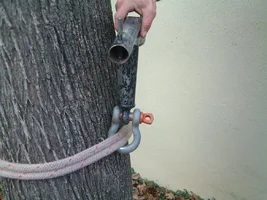
Make sure screw pin is on the flush side and there you go. Also this was shown to me by Riggsy for anchor at base of tree as shown. I can't see how this could be used for block apps. It's also intended to move around the tree to where you need it.
 

Attachments

  • 9391-DSCF0556 (2).webp
    9391-DSCF0556 (2).webp
    105.4 KB · Views: 278
Sawdust,

Thanks a bunch for posting the great pictures. Now there is a record for referal.

I've used the CH at the base of a tree for a redirect anchor. We'll do that when we want to keep the friction device out of the drop zone. Or when we use the ATV to lift limbs. I could see using it as the anchor point for a block especially if it were an overhead false crotch. If it were used on a pole I would want to make sure that it was snugged up nice and tight so that it didn't turn into baggy pants and fall down the butt.
 
Just going over some older posts and was wondering what anybody else thought of the Clock Hitch besides Tom. You guys had all sorts of things to say before about it and you were'nt even tying it right. Now that you see the right way, I have 2 questions, 1,how is "your" clock hitch look now and perform,2, have you tried the correct way and how do you like it now?? I'm not trying to be rude. I just find it weird that so many things were said about a knot without knowing what it was. Now theres no response.
Just wondering....
Later
 
I'm still unimpressed by the Clock Hitch: what's the point?
One could more simply wrap the line around the tree and then thread the end through the eye, which might better equalize the tension on the wraps (though I think tha the eye's part will get the higher tension). So, position eye as for Clock, but then simply make a full round turn and thread, tighten, and tie off.

I concur in others' opinion that running the line through the eye in the opposite way that an eye is intended to be loaded is a bum idea.

One thing to consider is the tension on the two (or more) wraps around the tree: how do different systems develop tension. This can be tricky, depending on the friction of the object. (I've made some binder knots that can give a quite misleading impression of tightening, when in fact they are mostly just shifting rope around.) One way to get some idea of this I guess would be to position some small, compressible objects beneath the wraps at the block-attachment point and then see how the paired wraps tighten--is one getting much tighter than the other?

[RescueMan wrote: ]
> In rescue, an increasingly popular anchor system made with
> 1" tubular webbing (could also be rope) is the Wrap-3-Pull-2.
>
> This takes 4,000 lbs test webbing and creates a 12,000 to 14,000 lbs anchor,

Really? Has this been TESTED? I frankly suspect that the actual strength much lower--approx. 8K?--, as the outer wrapping tape AT THE 'BINER compresses & cuts the inner.

--knudeNoggin

 
i could only see getting those numbers out of 1" slings laced that way 4K x 1.65 = 6600 x basket positioning of 2 legs.

Nice pix on Clock, much more sensible knotting; but i still think that the load would pull perpendicular to the run of the line. i tried to show that i think line is like metal, wood etc. in the Bent Line Thread ; if anything is not loaded only along it's length, it is leveraged; a perpendicular push or pull to the axis of any support (line, bolt, beam etc.) being the worse direction of leveraging. So i don't rest easy with Clock, and the sudden high loads that can be amplified even more, by the leveraging multiplier per angle of bend induced.

i like the ol'Portys; i have an eye bolt i ran down the center of mine, for mounting a compression rig to for pretightening straight into the nose. It is handy and doesn't get in the way; need a long bolt! i gave it, fender washer, 2 nutz and messed up the threads after them.
 
>> getting those numbers out of 1" slings laced that way
>> 4K x 1.65 = 6600 x basket positioning of 2 legs

But my point is that this figuring is *theoretical*,
and ignores the effect of slapping a highly loaded 1" tape
atop the other highly loaded 1" tape at the 'biner--that
amounts to a lot of pressure on the inner tape at the bend!

And consider one of Tom Moyer's results of pull testing, where a 1" tub. sling
joined w/Grapevine failed AT THE PIN. Now, Lyon Equip. opine that such failures
might result from the combination of pressure AND movement of the material,
which results from material feed out of the tightening knot.
In any case, the simple math of 4k x 2 = 8K exagerates reality, there.

Cf. www/xmission.com/~tmoyer/testing --to wit:
----------------------------------------------

11/18 Test #3: Pull a new 1" tubular sewn web sling to failure.
One of our members sewed the sling on his home machine with a random stitching pattern (for testing purposes only!)
.:. Result: Failure of the stitching at 5260 lbs.

11/23 Test #3
Repeat of 11/18 Test #3
.:. Result: Failure of the stitching at 5920 lbs.

11/18 Test #4 Pull a new 1" tubular sewn web sling to failure.
The sling was sewn professionally with 5 bar tacks.
.:. Result: Failure of the stitching at 4720 lbs. [!!!]

11/23 Test #2 Repeat of 11/18 Test #4
.:. Result: Failure of the stitching at 4730 lbs.

11/18 Test #5 Pull a new 1" tubular web sling to failure.
The sling was tied with a water knot(Ring/Overhand Bend).
.:. Result: Material failure in the knot at 4980 lbs.

11/18 Test #6 Pull a new 1" tubular web sling to failure.
The sling was tied with a double fisherman's knot (Grapevine)
.:. Result: Material failure at the bend over the shackle at 6210 lbs.

Discussion: I was surprised that the home sewing job outperformed the professional bar tacking - and that the bar tacked slings were so weak. I have always been told that sewn slings are stronger than tied ones.
[knudeN: FYI, I've been told that in fact bar stitching is about the
WEAKEST form of stitching (for a given quantity of material);
its popularity must result from simplicity. The strongest(?)
form is a *tall*, boxed 'X' type, finely done.]

The sling tied with a water knot failed at 4980 lbs. If the two sides are loaded equally, each side carries 2490 lbs of tension. The CMC Rope Rescue Manual claims a 36% strength reduction for a water knot in webbing. Mountain Search and Rescue Techniques also lists a 36% strength reduction, although in nylon rope. If these are correct, the webbing has a material strength of 3890 lbs - very close to the 4000 lb rating usually assumed for 1" webbing.

The sling tied with a double fisherman's knot was the strongest of all slings. It is notable that the sling did not fail at the knot.
------------------------------

--knudeNoggin
 
Re: W3P2

KnudeNoggin said about W3P2 anchor slings: </font><blockquote><font class="small">In reply to:</font><hr />
Really? Has this been TESTED? I frankly suspect that the actual strength much lower--approx. 8K?--, as the outer wrapping tape AT THE 'BINER compresses &amp; cuts the inner.

[/ QUOTE ]
I haven't been able to locate any hard test data on this, so I've asked both Tom Moyer and SARBC to conduct such tests. But the theory is sound enough that vitually all the recognized authorities on rope rescue recommend this anchor system (CMC and MRA among them).

</font><blockquote><font class="small">In reply to:</font><hr />
my point is that this figuring is *theoretical*, and ignores the effect of slapping a highly loaded 1" tape
atop the other highly loaded 1" tape at the 'biner - that amounts to a lot of pressure on the inner tape at the bend!


[/ QUOTE ]
Pressure, yes, but there is no cutting action involved as per your quote above. What makes tubular webbing ideal for such anchors is that there is very little internal shear around a tight radius as there is with round rope. While friction might be an issue if there is any movement between the two strands, I think there is enough equalizing room in the large-diameter wraps around the anchor to minimize or eliminate relative motion at the 'biner where the friction would actually serve to prevent movement.

</font><blockquote><font class="small">In reply to:</font><hr />
Test #6 Pull a new 1" tubular web sling to failure.
The sling was tied with a double fisherman's knot (Grapevine) Result: Material failure at the bend over the shackle at 6210 lbs.

[/ QUOTE ]
This is consistent with the "theoretical" strength of 12,000 lbs (approx. double the above results) for two strands around the 'biner.

And the upshot of it all is that, even if the 12,000 lb "theoretical" figure is a bit overstated, this anchor more than meets the NFPA requirements for 9,000 lb strength. And this anchor eliminates all the problems of using manufactured D-ring slings: lack of choke on the anchor resulting in vertical slippage, failure to equalize if the load focus shifts, and triple-loading or side-loading the carabiner.

- Robert
 
</font><blockquote><font class="small">In reply to:</font><hr />
I've been told that in fact bar stitching is about the
WEAKEST form of stitching (for a given quantity of material);
its popularity must result from simplicity. The strongest(?)
form is a *tall*, boxed 'X' type, finely done.]


[/ QUOTE ]

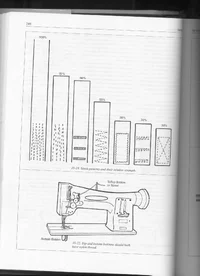
See attached pic - On Rope pg 240

The strongest pattern is the W. The reason bar tacks are used is because a bar tack machine will sew 60 odd stitches in under 2 seconds, A sewn sling with five bar tacks can be completed in under 20 seconds, and it looks neat and tidy.

Dave
 

Attachments

  • 9603-sewing.webp
    9603-sewing.webp
    134.6 KB · Views: 142
Beisdes speed, consistency is another reason that bar tacks are used. The machines for sewing bartacks allow the manufacturer to make splices that can be tested and controlled. I seem to remember something about the length of the overlap being less using bartacks than the same strength for sewn stitch pattern. More stitches can be put in a smaller space.
 
&gt;&gt;&gt; The strongest(?) form is a *tall*, boxed 'X' type, finely done.]

Whoa, there--wrong extreme, egads!
Thanks, yes, the strongest is a 'W'('M'), finely done.

(-;
 
"I'm still unimpressed by the Clock Hitch: what's the point?"
- did you seriously ever max a tree to the point you thought it would break? The ratings on ropes , take them to the extreme limit , without failure. Some people might be suprised by what some things will hold , seen some S*it in my life. The cow hitch under serious load , will stretch out to the point where it looks like it wants to come untied, and the timber hitch , the first wrap presses into the otherside of the rope and strecthes too. Now the Clock hitch is never in need to be re-adjusted. I spliced every rope I ever used and the eye never comes into play , so , stop that silly talk. If you plan on going "No wood on rope" with a clean system , you need an anchor point that can be slid around the tree. Tie it however you want , but this way will never break ,you couldn't break the sling if i paid you too. I don't break slings , but i let em know I'm there. Sometimes you guys think too much, all that math will make you goofy.
 
</font><blockquote><font class="small">In reply to:</font><hr />
The ratings on ropes , take them to the extreme limit

[/ QUOTE ]

I also noticed you talking about stretching out rope. I'm not really interested in the Clock Hitch, but I hope you don't mean to intend that you're putting loads into large ropes that come near their ultimate strength. It's a little like playing with a bomb. The spring energy stored up in such line or what the rope may be attached to could be of deadly proportions and it's not always evident which way it might fire off. The working load limit of your rope keeps you away from the edge of a cliff, so to speak.
 
i've often wondered about the bar tack thing as pictured in "On Rope", seeing as CMI has claimed for years in catalog and on phone, that the bar tacks are stronger than the rest of the sling. You would hope that both experts would agree and that the CMI would know their products, and have tested them enough, accrued comments, research etc. Thanx for the test results, food for more thought etc.
 
How would the clock hitch be setup with the newer style portawraps, any pics? The porty shown in the picture in this thread by sawdust had an attachment point, and then was connected to a shackle.

jp
grin.gif
 

New threads New posts

Back
Top Bottom