i kinda must agree with MM again (darn'it); about Tom; and Rob has been quite an addition here and around, bringing in polished science of the same mechanichs from a different perspective, giving fresh light to many things. Heck, i've even learnded from Mike's posts across some boards and years now.
i think that a clock hitch that is not dogged by deformity on the mount or pulled perpendicular to the mount, has a chance of sliding up or down, so would be tighter set to prevent that, but that makes line load at a leveraged angle. i think that, though a Porty/device grabs both lines only 1 will be tight enough generally to carry most of the load.
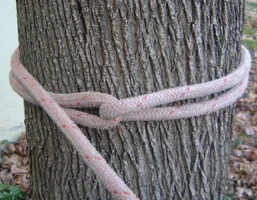
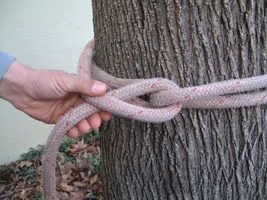
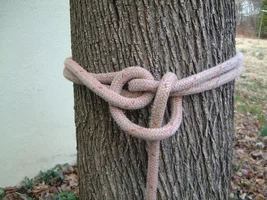
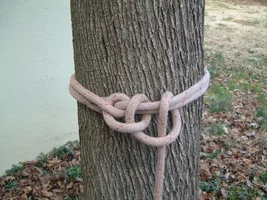
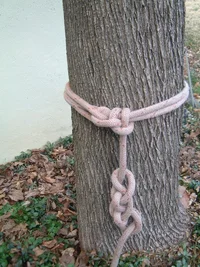
i think RescueRob's pic of the common anchor wrap from his world would be worth exploring as alternative. It only grabs one of the lines, allowing the other to seat to the anchor, giving some choke to prevent sliding up or down; wihtout forcing line to such a leveraged angle. Also, the joint of the knot in the line (or flat rope), in his version is in the most protected point from loading possible in the configuration. Yet, would easily be moved around and relocated even on a limbless run.
i think that anytime something incurs a pull or push, not on it's solid axis, it becomes leveraged; whether flexible line or stiff board or carabiner. Even a carabiner is leveraged if pulled correctly, it is just leveraged on it's short axis and not long one. If both long rails of the carabiner were as one, the device would be stronger IMLHO, for the spread that seperates them is leverageable, so is kept small, but the wider apart the spread is, the more leverageable. Less leverage on the small axis, so is maximum usage point. Just patterns to train eye to look for while scanning a rig i think.
-KC




 Glenn was the first person I met online, then emailed off line, then met in person. I know that I could have connected with a lot worse people