Chunking Down Wood

Location
Seattle
Yesterday we took down a 100' Black Cottonwood. The drop zone was tight enough where all the brush had to be lowered, but the wood dropped next to the base of the tree.

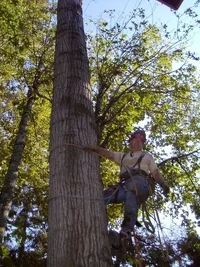
Here's a shot of the tree during lunch. All the brush has been stripped. Only the top needed to be lowered, then the fun begins with the big saw.

There was one interesting piece that hung over the Bigleaf Maples on the left. With a high tie-in for the lowering line, we swung the branch sideways into the clear area over the roof. When it was time to lower it, the ropeman didn't. Well, the hinge finally broke off, and the butt started to chase me around the trunk. Timing is everything. If only the limb had been lowered after it cleared the obstacle below. Made me kinda antsy for the next few cuts.
 

Attachments

  • 12997-Cottonwood6.webp
    12997-Cottonwood6.webp
    95.8 KB · Views: 259
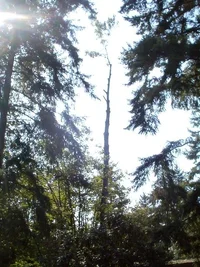
The attachment shows a view of a piece of wood flying off into the brush below. The site is a native woodland hillside in a rural area.

This chunk was cut with the MS200T, and had a slight lean, so it could be pushed by hand. Our parameters for wood size were that nothing exceed 8' in length.
 

Attachments

  • 12998-Cottonwood2.webp
    12998-Cottonwood2.webp
    92.9 KB · Views: 221
Now I've got the Stihl 044, and the chips are flying!

These boomers made the ground shake. There must have been a root from the tree in the drop zone.
 

Attachments

  • 12999-Cottonwood1.webp
    12999-Cottonwood1.webp
    124.5 KB · Views: 218
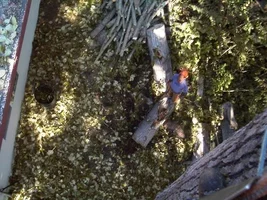
Here's Don, on the ground looking up at the camera. Smile pretty! Sorry I called you John by mistake in the last photo series thread, 'Buttcatch'.

On the left side of the photo in this attachment is the roof of the house, with a trashcan next to it. The tree is about ten feet away from the eaves. The stack of limbwood is on the bank of a steep dropoff. The trunk sections where John is are partway down the hill, but the photo doesn't show it.

Notice (barely in view in the lower right corner) that the saddle is employing two safeties, an orange steel core Hi-Vee line, and the Blue Streak climbing line as a backup. I spose some dinosaurs still only use one flipline.
 

Attachments

  • 13000-Cottonwood3.webp
    13000-Cottonwood3.webp
    94.5 KB · Views: 196
The stick was flopped from here. There was plenty of room, and it didn't roll down hill after it hit the ground. Those upper chunks kept it in place.

This attachment shows the flipline setup a little better. The adjuster is a 3/4" stainless steel Gibbs ascender, with the 1/2" steel core Hi-Vee line running thru it. My hand is covering the nick in the flipline, madfe famous in this photo from my homepage.
web2.jpg
 

Attachments

  • 13001-Cottonwood4.webp
    13001-Cottonwood4.webp
    119.2 KB · Views: 135
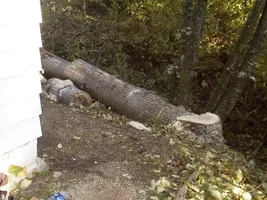
The beached whale. The precious maples that the brush had to clear are right behing the stump.

Another day another dollar. It wouldn't hurt to mention the 60 mph winds we had last Dec. 16, 2003. Nothing like what our Florida friends had to deal with, I'm sure. But, there is a big patch in the roof of this house, where an 8" limb crashed down in the storm. That's the reason these cottonwood are coming down. The backlash of fear.
 

Attachments

  • 13002-Cottonwood7.webp
    13002-Cottonwood7.webp
    89.7 KB · Views: 151
Ox, thanks for the pics. Were you a sub on this job? If so, do they get angry when you pause to take a photo? You should take pictures, it's what you will have in the years to come to remember and share your jobs.
 
All the wood stayed. A separate contractor was hired to haul it. We took extra care to try to keep it close to the access point, as a matter of courtesy.

I was a sub, but I understand the job was bid tight. The tree service owner & his helper were the only ground guys, and they had to hustle.

The 20-25'long limbs were lowered and hung upside down next to the roof. One guy held the rope thru the bollard lowering device, while the other chopped the brush from the limb's stem. Then the stem was lowered the rest of the way, and untied, freeing up the ropeman to haul brush out to the truck.

As a sub, I would have preferred to have a third person to help them on the ground. As it was, there were pauses while they got caught up. This meant I spent more time in the tree. More time standing in the spurs for really no reason, other than to save someone else money. I was not asked how many people were optimum to do the job efficiently. Such is the lot of the lowly arborist.

It would have been great to have a photog document the lowering, but that was not to be. The first pic was at lunch, and really was the first pause in the action. After the top was lowered, the ground crew was completely caught up, to their credit.

The first three 6' logs were leaning, so they could be pushed. All the ground crew had to do after that was pull each log over, untie the tag line & send it back up to me after each cut. The rest of the time they could watch, take photos, rake and dump chips.

As professionals, we pretty much know each other's capabilities. It went very smooth, the maples didn't get busted (neither did the house!), and no one got hurt. The lowering of each piece was done exactly the same way each time. A repetitious job eliminates gambling, and shortcuts can lead to errors. If the method you're using aint broke, why fix it?
 

New threads New posts

Back
Top Bottom