
Chainsaw lanyard: yea or nay?

This is about to be the worst diagram ever so I apologize, but here we go.

Say you have a large limb, or leaning top. Sometimes you just make an under-cut, then a top cut and it pops right off. But if your cuts are mis-matched enough and if it breaks in just the wrong way, a little kerf can go with the falling piece and take your saw with it. That would probably be the most common situation, but it can happen other ways as well.

(edit: rotated the image for clarity)
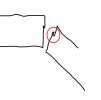
0 Saw Grab.jpg
S
 
Last edited:
Now you've got me considering adding a low strength component. Thanks for sharing the event you witnessed. I do have a question about it, probably because my limited experience isn't giving me the correct picture, so please bear with me. I'm picturing chunking down a spar. As the log falls over, the kerf you're cutting opens up and is no longer a kerf so I'm not picturing how his bar was held in the kerf. Did he have his saw in a cut that was not one of the "felling" cuts? Did the piece fail while cutting the notch? Screwed up snap cut? I'd rather not learn this lesson the hard way.
So he was a poor climber, and had terrible cutting technique. He made his notch, then proceeded to make the back cut BELOW the notch, and cut past his hinge, so when the piece broke off, a portion of kerf remained, more or less as is pictured in @27RMT0N drawing above. It’s not something that should ever happen to a decent cutter, but it did happen to this guy.
 
I'm too lazy to look, but I know there are videos out there of saws getting yanked out of a climber's grip, or the climber getting yanked off his perch when this happens.
 
... He made his notch, then proceeded to make the back cut BELOW the notch,...

Just a clarification on this. When making a bypass cut on a forward weighted limb or stem, you 'do' want to make your back either directly behind or below the kerf in order to reduce the likelihood of saw-snatch.
 
Just a clarification on this. When making a bypass cut on a forward weighted limb or stem, you 'do' want to make your back either directly behind or below the kerf in order to reduce the likelihood of saw-snatch.
Good point. This was not supposed to be a bypass cut, it was supposed to be a felling cut, and should not have had any bypass - if his cuts had lined up or at least not bypasses, there would not have been a saw snatch.
 

New threads New posts

Kask Stihl NORTHEASTERN Arborists Wesspur TreeStuff.com Teufelberger Westminster X-Rigging Teufelberger
Back
Top Bottom