Center Punching Hinge in Tree

TheTreeSpyder

Branched out member
Location
Florida>>> USA
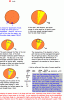
i have played with several ways tweaking and screwing up with hinges; watching each output and examining hinges after the fact etc. Sometimes i would get everything jsut in the right structure within the hinge/face and wanted to maintain the strength of the hinge (not cut more cuz gettin thin); yet the dang thang wasn't moving yet, but i knew i was close.

This is my strategy, and why i think it works. Stumper (whom seems to know a lot about specific properties of wood)always said the neutral fiber must exist; somehow i think we both figured they should have a strategic value. This strategy is kinda like a horizontal center punch to hinge through the face "for hard head leaners"(some might say). Nick (who asked Doc Shigo) said that the reason the technique worked was not because of taking out stiffer center wood as i believe Sorensen indicated in a film for Stihl. i always thought there about had to be a merging truth to all of it, and i think this is it.
 

Attachments

  • 10231-Neutral Fibers.GIF
    10231-Neutral Fibers.GIF
    168.5 KB · Views: 125
Ken, if it isn't moving I would be inclinded to wedge it or pry it over.
But then the the question remains ... why isn't it moving?
Could it be the hinge is too far forward?
 
Though the topic drifted into a parallell examination of center plunging face as a preset to falling; using this as a release i play with in the tree mostly.

Those are times of no wedges, limited diameter etc. of spar. Generally i know i can cut further and still have hinge left, but less by the time it starts to move; when i want it to stay horizontal, so needs more help from hinge. So this is what has worked, and why i think it works; by reducing the hold against path, while maintaining hold agianst downpull; instead of taking fibre from both of their strength positions at once with just an even backcut across.

Or something like that!
 
Maybe the center punch unleashes the potential energy between the compressed and stretched fibers kickstarting the hinge. Kind of like pouring cold water in a hot glass, creating enough of a difference that something has to give.
 
Are you talking about hinging a standing tree that has been limbed already, or a complete tree?

I have seen many people have problems felling trees due to... back cut made to high above the notch, failure to remove all wood up to the hinge (leaving a small amount of uncut holding wood in the back cut area other than the hinge), using seperate cuts to make the back cut that do not join (one cut slightly above or below the other) or making a back cut that is not level to the notch (not level with, the back cut MUST be made 1/20th the DBH higher than bottom of the notch face to cause the tree to split downward rather than upward and potentially injuring/killing the sawyer).

The "heart cut", making a plunge cut into the face of the notch can help reduce the problem of felling a tree where the problems listed above are present, but will not completely eliminate it. Especially if the plunge cut is not made level too, and meeting with, the back cut (before the back cut is made of course).

I also prefer a notch that is only 1/10 the dbh myself. This allows you to have control of when the tree falls in most cases (except for leaners). I like making all my cuts, being able to set the saw down then wedge/pull the tree at my convinience. This smaller notch also creates a more elastic hinge by maximizing the amount of sapwood in the hinge area.

Take care, climb safe.

Jon
 
i speak mostly of climbing cuts, some felling; but look at the mechanichs about the same. It is something that started with felling, and an olde Stihl tape with Mr. Sorenson showing the technique to eliminate the center of the hinge to save the thicke$t end of the log from splintering up center so many feet; also de-scribed a theory that you eliminated the inner/stiffer fibers and now rode on the younger/more flexible! Nick said that Shigo said that the fibers should be the same, sometimes they seem drier to me... Then as necessity wuz being a real Mutha (Don't fergit May9th!) a few years back; somehow it got tried in tree as a partial hinge release to incite folding.

i think that the center punching of the hinge removes leveraged fiber that resists forward (to target)movement (allowing said movement); while maintaining most of the resistance against SideLean (off target pulls). i wish to allow folding to target, and resist against off target pulls. So in the tree i would DutchStep up, hinge pull up, and maintain the leverage of pull up, while reducing the pull across in hinge pattern, and with this.


i think that 1/10th of dbh doesn't give strong leveraged resistance against SideLean, for it reduces the distance of the span across the hinge that leverages against side lean i think, and the pivot placement would not provide as much forward lean/power to steer away from SideLean, as well as providing more leveraged pull agianst target by the SideLean. i would only go nearly so shallow on a hard head leaner (so that the forward leverage was more limited by the pivot of hinge being forward, rather than moving hinge back; where by lean would be increased, worsenning the problem. A forward leaner i think would increase leveraged pull hinge with further back without tree moving, by increasing the angle from hinge to C.o.B. To give more forward pull (possibly to override SidePull force can be a good thing, unless there is already too much i think. Moving hinge back also decreases lean of a back leaner i think, so my only purpose for such shallow hinge would be hard head leaner, no side lean. A BackLean i think would be best with a deeper hinge, to place the pivot of hinge closer to the BackLean, lessening it i think.


i think there must be compressive are to be connected, as lean increases, leveraged fibre pull to the opposite direction keep the tree balanced and compressed unto stump. Each fibre has equal strength, the fibres farthest from the compressed part of stump (or hinge) have more leveraged power, by virtue of this distance. Nature Conserves Energy, takes the path of least resis-stance, so will only work as many leveraged fibres as She needs. So, on the downard pull axis i preserve the compression, and keep the other used part, the leveraged opposite of the pull fibres(up). The mid ones aren't used that much on pulls on this axis (IMLHO). Horizontal pulls (in previous example)
 
You are losing me here...

If you are talking about hinging LIMBS to swing at or away from a target, I wouldn't use a "heart cut" at all, I would want to have as much holding wood as possible within the hinge. I also leave the upward side of the hinge thicker than the lower side to help compensate for the weight of the limbs downward pull. Too thick of a hinge on the upward side frequently results in the limb simply breaking off and falling down with little of your intended swing or will sometimes pinch your bar. Depending on the tree type, characteristics and weight of the limb in question, a tip tie may be required as well to negate these problems.

As to characteristics of heartwood vs sapwood, sapwood is clearly more elastic. This is clearly visable when using the 1/5th notch, ( I mistakenly said 1/10th in my previous reply, sorry!) back cutting cleanly and examining your stump after felling a tree. It's especially obvious on trees like spruces and pines. If you take a look, you will see the grains break longer in the sapwood than the grains of the heartwood. So, using the 1/5 DOES give you more elasticity no matter what the lean of a tree or limb by including more sapwood into the hinge area. To compensate for side lean, the same goes for felling as for working within the tree, leave slightly more hinge width on the side of the tree oposite to gravity/weights strongest pull to compensate.

In the case of an extremly foreward leaning tree, the 1/5th is almost usless. Not to extremely sideways, backwards or foreword leaning trees are ideal for the smaller notch. Of course once you get into extreme leans, you will want to use guide ropes or block the tree below where it could fall into a target to ensure precision anyway.
 
Brutha Jon let's talk........

i do mean in the tree as final release, but am making comparisons to on ground as preset, to distill the common principals from the 2 examinations, as place to look for similar power betweent he 2. It is something that i tripped over stumbling in my own dark; that i use more confidentally, because of my perception of the mechanichs as i have watched.

i think it has made a lot of differance for me in the small scale, but high leverage angles of 'in tree'. i had good luck with it on the ground too, but looked at it not quite so deeply, but tilting the scenario to this angle and leverage gave knew perspective i think.

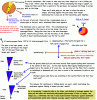
Depth of face to amount of flexible fibre is a good point; but i think that the most leveraged fibers of pull (that would depend on the ability to stretch most?) would very often toch the outside diameter all the way around, so in a face stretched across the full face, the most levereged fibers oopposite a SideLean would be in the younger fibers found there. But, that theory is prolly another go for a hard head leaner w/o appreciable SideLean. i always break the lean up into the 2 directions it faces on the hinge, with the folding axis and agianst (perpendicualr axis). Looking at these things for quite some time, has made me appreciate the 'axis' deal.
 

Attachments

  • 10261-Intersection of Leveraged Fibers for 2 Different Paths.GIF
    10261-Intersection of Leveraged Fibers for 2 Different Paths.GIF
    154.4 KB · Views: 72

New threads New posts

Back
Top Bottom