[ QUOTE ]
What about a clevis shackle?
[/ QUOTE ]
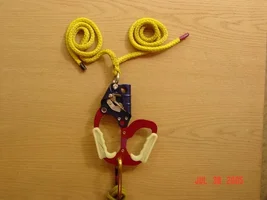
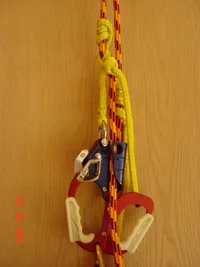
That is what Bruce was using, but the flat part of the pin (what you would hold to un/screw the pin) made the pin a little longer than the recessed pin of the bow shackle and made a 1/2 inch rope a very tight fit.
[ QUOTE ]
Also, whatever shackle you use, couldn't you also use an advanced closed hitch, like knut, VT, XT, etc. and have each end of the hitch line knotted to the top of the shackle just like you would do if it were a carabiner?
[/ QUOTE ]
Bruce used a Valdotain. He had an eye spliced in each end of the hitch line and just slipped the eye over the biner after each hitch was tied.
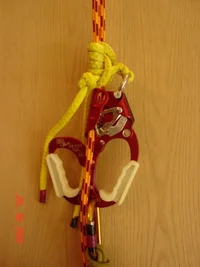
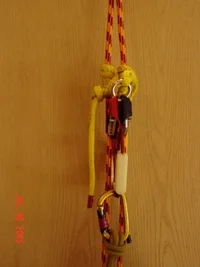
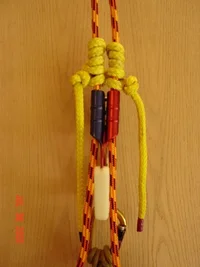
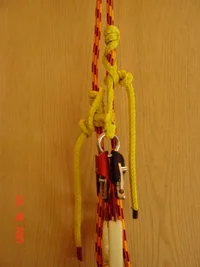
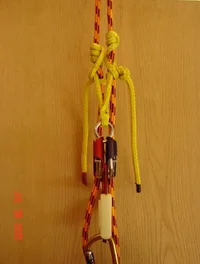
I wanted to eliminate the biner. The pin of the shackle is secured with Lock Tite. If I used a closed hitch I would either have to tie the end to the shackle after tying the climbing hitch; or I would have to use the shackle without Lock Tite. I would tie the hitch, thread the knotted (or spliced) eye on the shackle and then insert the pin. The process would have to be reversed to take the ascenders off. Since this would be done in the tree, there was the possibility of dropping the pin and/or shackle. Without the biner, it seemed easier to use an open knot.
[ QUOTE ]
These hitches would give much less resistance I believe than a Tautline.
[/ QUOTE ]
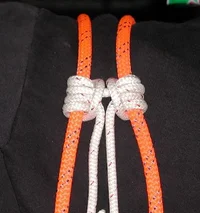
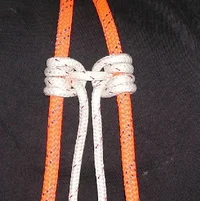
When ascending the tautline does not give much, if any, more resistance than some of the other hitches. It is essentially five wraps around the climbing line, which is the same, or less, than other hitches. The tautline binds when descending, which (right now) is not the intent for this setup.
But, you're right, the hitch is still something that needs a lot of field analysis. Because the two hitches are right next to each other, I have wondered if a hitch that is easy to release could catch on the hitch on the other side of the line and cause a freefall.
I have also thought of putting a Dualcender above the Kongs as a backup, but have only tried it in my garage.