Burls and Badges

I feel descending on a static line with ONLY a friction hitch is

  • relatively safe

    Votes: 0 0.0%
  • not safe at all

    Votes: 0 0.0%
  • I do not know

    Votes: 0 0.0%

  • Total voters
    0

guymayor

Branched out member
Location
East US, Earth
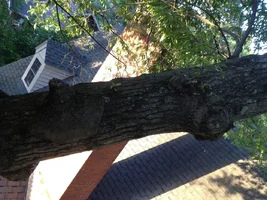
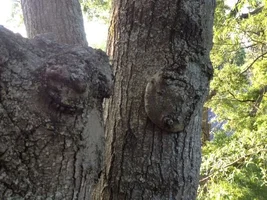
In a willow oak today with the most burls I have seen in that species. Also "badges", one name for those flat plates; "shields" is another. Seldom see decay noted in either--dozens of burls in this tree, but only 3 had rot.

Seen the shields in other species but primarily q phellos. Fairly rare; most often seen in very old (or in this case declining) specimens. Anyone seen these shields before, or have a clue of their origin?
 

Attachments

  • 323573-photo(7).webp
    323573-photo(7).webp
    84.2 KB · Views: 226
I know that galls in oaks are insect related. So I always assumed that burls were too.

Of course there's a distinct possibility I could be wrong on both counts!

Jomoco
 
Calloused over something and kept going, I assumed. Seen them. Oaks and I think hickory and maybe sugar maple.
 
[ QUOTE ]
looks like growth callous from and old wound that left a stob. see those all the time in the woods

[/ QUOTE ]I agree that describes the burl's probable origins. The wound could be a pruning wound or something else.

The badges on the other hand do not seem associated with wounds. Though we can only guess what is under there, the placement is too random to suspect wounds imo, definitely not pruning wounds/branch scars.

I typically see them on older trees, often with some interior decay. It could be called a "veteran characteristic", but that does not tell us much. On this declining willow oak, there are several in or near forks, and others on the stem.
 
I have only seen those badges or shields once before on a willow oak. The trunk from the ground up to about 40' was covered with them. Also the tree was hollow. I assumed that the badges were the tree's last resort at compartmentalizing the internal decay. I didn't know what to call them so I called them pancakes.
 
When I come across odd things like this I cut them to length in the field then rip it down vertically a bit. Using my bandsaw to slice and dice back at the shop gives a 3D dissection. That's how I've figured out a few mysteries. Besides, digi pics are easier to shlep around than chunks of wood!
 
" I assumed that the badges were the tree's last resort at compartmentalizing the internal decay. I didn't know what to call them so I called them pancakes."

Here's another pancake, this time on a branch, and seems to be spreading from a burl. Kinda blows the decay connection, but i still have no definitive explanation. The tree will be pruned soon; I've requested the odd chunks to be set aside for slicing.

Last resort, or first resort? ..., or the first of their return--did Ragnar or Francisco or John G say that?
 

Attachments

  • 324085-badgeandburlsbranch.webp
    324085-badgeandburlsbranch.webp
    184.2 KB · Views: 105
Please take some pictures. I would like to see what they look like from the inside.

Maybe it is related to a poor collar cut? Probably not though since we would see it more often.
thinking.gif
 
Dude, it's exactly what I said! A callous starts, it covers the area but then continues.

can't you guys see that!???
 
So if a burl can be found on a trunk no old cuts/damage beneath them?

Would that allow you to mistaken...or non-perfect in your analysis of cause?

Is it cool to chuckle if you are mistaken?

Dampen the dynamic load so to speak?

Jomoco
 
[ QUOTE ]
that is NOT a burl.

[/ QUOTE ]

Sorry X, didn't quite catch which pics you were referring to.

You're right, those are calloused over branch stubs ah lah naturallll.

Forgive my false assumption you were referring to burls rather than stub callouses.

Jomoco
 
Viral hi-jacked tree tissue. The virus modifies the tissue to suit its needs. Warts.

Not sure, just a guess.

I was in alaska last year and there were tons of pines with burls. Definitely interesting formations.
 
The flushcut theory does not fit all; some pancakes/badges/shields are popping up in forks, which supports The load-damping, adaptive growth theory. In the last pic the shield forms out of the burl and spreads down. Tree was last pruned 14 years ago.

The burls/bumps are mostly at nodes/growth points, not just terminal bud nodes or pruning cuts.

That's right jon; spoken to Hank on the road home from the mills. That was really a "click"ing point in the mystery, esp. from Hank's pov.
 
I read that wasps cause galls by laying larvae that secrete hormones.

Those hormones alter the branch or root growth characteristic without killing it. An oak gall is in effect a benign tumor.

Much the way Royal Jelly(a hormone) alters a bee's growth characteristics.

Virus? Hormones?

Inquiring minds want to know.

Dissect those badges Guy. I'm fairly confident you'll find they're calloused over old stubs of branches long dead.

Jomoco
 

New threads New posts

Back
Top Bottom