Brummel tail bury length

Muggs

Been here much more than a while
Location
Canuckistan
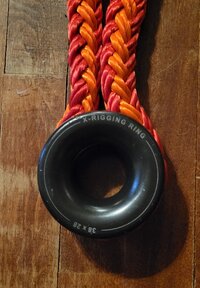
I'm making a dead-eye sling, Beast ring on 7/8" Tenex. I have found many different recommendations for the length of the buried tail after the brummels. Last year I dissected a professionally made sling in 5/8" and I think the buried tail was only about 10 or 12 inches or so, much shorter than I would have expected. My assumption is that when the sling is installed on the tree in a cow or timber hitch, that all the strength is coming from the 2 brummels and very little if any of the strength is based on the tail bury beyond the lock stitching. This might be different if you were just loading the sling straight, end to end. So my question is, does the length of the tail bury after 2 locking brummels actually affect the strength of the sling very much, and if so, what is the proper minimum length bury for a rigging sling like this?
20240128_113718.jpg
 
The bury is mostly just something to do with the tail. I wouldn’t stray from the recommendations but it can even be taped to the working part of the line.
 
Here it is
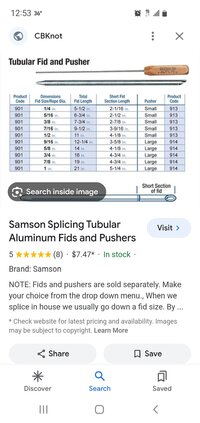
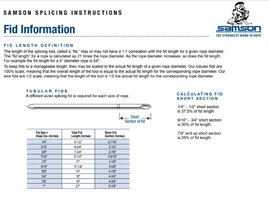
For what it's worth, short, long, full fid are just 7,14,21 times rope diameter, respectfully.

Edit: I did a little more digging and apparently I'm recalling the short fid and long fid lengths incorrectly. I might be going crazy but I could have swore I had documentation that broke it down as a 7, 14,21 measurement.
1000001506.jpg
 
Last edited:
Two fid lengths of bury would be the strongest splice, locked Brummells are only needed if a straight bury isn’t desired, like friction hitch cords. Stitches could replace the locked Brummells with the longer bury and be as secure for the times it’s unloaded.
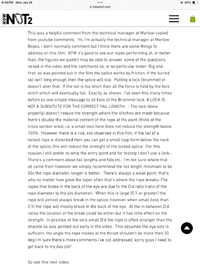
When using locked brummels the length of bury does affect the strength, from testing Class II cord, a locked brummel and a fid and a half bury loses 25% of the cord’s strength. A LB and three fid lengths bury only loses 5%.
 
Two fid lengths of bury would be the strongest splice, locked Brummells are only needed if a straight bury isn’t desired, like friction hitch cords. Stitches could replace the locked Brummells with the longer bury and be as secure for the times it’s unloaded.
When using locked brummels the length of bury does affect the strength, from testing Class II cord, a locked brummel and a fid and a half bury loses 25% of the cord’s strength. A LB and three fid lengths bury only loses 5%.
So that's my real question, when testing them like this, is that comparable to how we are using them? In the field, a locked brummel dead-eye sling is tied on the spar, with lots of bends and crossovers in the cordage, which must have a big impact on how the fibers are loaded. I just can't see how the forces pulling on the hardware can get efficiently transferred through, to behind the brummels, to where they are actually acting on the buried tail. Not sure if my wording makes sense...
 
Three years ago I was playing with an X ring and 2 locked brummels and had some leftover tenex that I tried with 2 different length buries - the first one with about a FID length bury after the brummels did seem to move with the 4Runner yank test in a straight line pull - the second one with about 2 1/2 or a little more bury didn't (tapered back a fid length from the end of the bury). That was kinda my qualitative stab at "more seemed better-er". I settled for about 2 to 2 1/2 on anything I made thereafter - stitched up as well - (at least with rings and tenex) in the Cave of Wonders and they've since stayed put when wound around stems. But I'm not rigging out to the margins of WLL either. I did have some bull rope from Canada somewhere once that had a really slippy waxy kinda coating - when splicing it I went way longer with the cover bury as well - a FID just didn't sit right with it. Splice held well and the 5/8' rope is now long gone.
 
I'm so eager for someone with the means to do the testing in real use case scenarios. I would be willing to chip in some money and splicing time to make it happen, but I would bet it even matters what kind of tree/bark your working with, and as Delaney pointed out, how well tied your rig is. I would bet Patrick is correct, at least to a sufficient degree that the deeper buries past a full fid length in polyester won't matter enough until you start working past advisable WLL.

Actually, I have dozens of gray pines with very rough, deeply furrowed bark that I will be removing, and they're super heavy. I could complete a portion of the testing too, but I would need a few things, and probably a real solid ground person to assist.

I could probably also get some testing done with our smooth eucalyptus, which is also very dense, and easy to get heavy loads.

Now, who wants to throw down to get a couple of Linescales and a spool of Tenex, or similar cordage?
 
Last edited:
I have a Linescale but I don't think it would show what I want to know, without pulling them so hard that they are near the breaking point. I do think a lot of commercial splicing shops are burying short to save on cordage, which is maybe an admission that the bury length doesn't have too much of an effect. Then again maybe not...
 
I have a Linescale but I don't think it would show what I want to know, without pulling them so hard that they are near the breaking point. I do think a lot of commercial splicing shops are burying short to save on cordage, which is maybe an admission that the bury length doesn't have too much of an effect. Then again maybe not...
maybe the recommendation for WLL could be a little higher with a deeper bury, but that also doesn't serve the commercial shops, as it encourages using smaller, less expensive cordage, which has less profit to be made on it.
 
Is this comment regarding dyneema? Slippery stuff... and straight pulls...
Yes, the video was about dyneema, and of course, always straight pulls. I have never seen a sling pulled in a real world scenario like we're discussing here. But, Ryan has a portable setup with a hydraulic, so perhaps he could be convinced to help the arb community... Where to do that safely though...
 
Is this comment regarding dyneema? Slippery stuff... and straight pulls...
Yes, the lengths are for Class II, Class I results are the same for their required bury lengths. I’m not seeing much sharp bending or much interaction with other rope parts except the 90 degree bend around a single diameter of rope when it is used for a dead eye sling. The rest of the bury would be wrapping around the tree, maybe a 180 degree at the end of the bury with a smaller tree.
 

New threads New posts

Kask Stihl NORTHEASTERN Arborists Wesspur TreeStuff.com Teufelberger Westminster X-Rigging Teufelberger
Back
Top Bottom