Breakaway Lanyard

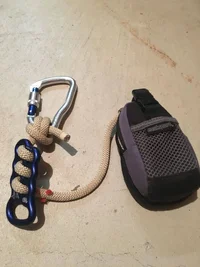
Another device that might work that I thought of after reading evo's and nish's last posts, is the Kong's Kisa, that could work if properly set up. It needs the right size cord for the climber's weight and a tapered tail that would slide out.
IMG_1361.webp
 
I don't know how practical it would be and hope to never find out, but when I'm working a sketchy tree or limb and am tied into something good, I untie the stopper knot in the lanyard and have the plan to let it out all the way should what I'm lanyarded into start give way...
 
That's the way the Kisa would work, but it would be an automatic release, without the climber having to release it. Snagging of the lanyard may be a problem, while the Kisa rope could be real short. The longer the lanyard the more friction and heat, also.
 
The situation is climbing a suspect tree while being tied into another tree. If the suspect tree fails the lanyard would break and the climber would swing back to the other tree. One problem is the lanyard has to be used to keep the climber attached the suspect tree and has to hold his weight in case of an unindented slip, without breaking. It seemed similar to your use and I was wondering how "scientific" you got with your testing.

Brocky, it just hit me that an easy solution to this might be a latch attaching the lanyard, that would be released by tension from the rope from the second tree ( lets call that the secondary line). That way the full strength of the lanyard would be maintained until tension (say 200lbs-300lbs) was imparted from the secondary line. The only reason I would use a high release force (hundreds of pounds) is to decrease the likelihood of accidental release due to any smaller branches dropping on the secondary line and tensioning it as they hit the line. The latch itself would not directly attach the climber to the secondary line. Rather for the tension to release the latch you could use a piece of say 8mm line running from the latch to the secondary line. It would be attached to the secondary line with a prussic so that you could adjust it to release when desired, by making its length to the latch less than the length of the slack in the secondary line to the climber. And by moving the prussic toward the climber (making it longer than the climbing lines attachment to the harness) disengage it from activating the latch.
 
That's a good idea. However, I'm going to use the Kisa, as I already know that it works. For the last 8 years or so I have been using it as a shock absorber on my harness. With the proper cord it holds your weight and only slips if more force is experienced. In a fall factor one drop, it slides about a foot and a half and you come to a gentle stop. I'll have to test to make sure the cord will slip all the way out for this use.
 
I believe that the BOLA is a good option, as it will slip given sufficient load, and in a sketchy situation you could let the lanyard rope run right out the device if the end was left untied as already suggested. Another advantage as I see it, is the you can isolate yourself from the circle of the lanyard, by terminating back to the top teardrop.

wrfybMM.jpg
 
I didn't know that it would slip without the climber pulling the handle. Any idea how much force before it slips? With the Kisa, both ends would also attach to the carabiner at the end of the cord, eliminating the circle, with the added advantage of everything going with the falling tree, and not coming back to hit the climber.
 
I depends largely on the rope used. With a relatively dense 7/16" size rope, I would say anywhere from about 300-600 pounds pressure.
 
That seems like it would be ideal as long as you're not in the circle. The Bola could also use a short cord that exits it,taking the whole lanyard with the falling tree. The short cord would help reduce snagging as it slides through. Plus the Bola isn't relying on the cord or rope size to function properly, like the Kisa.

Edit: two more Bola advantages:
If the climber realizes what's going on he can use the handle to make sure the rope slips through it.
On normal jobs you would have one of the best lanyard adjusters to use.
 
Last edited:
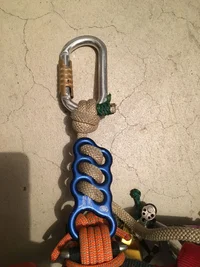
Another device that might work that I thought of after reading evo's and nish's last posts, is the Kong's Kisa, that could work if properly set up. It needs the right size cord for the climber's weight and a tapered tail that would slide out.
View attachment 47109

I think this looks like a great system, thank you for sharing! Many good ideas but this is quite literally a situation where "whatever you're most comfortable with" really counts.

I also like Tom's idea about having both ends break away. I bought some dyneema whipping twine from a boating store that has a 180 lb breaking strength. I might use this on the carabiner/snap side and make a connection with a specific number of separate loops based upon what desires break away point was desired. Most throwline is so strong, I wonder what product you might use for a reasonable break away.

Anyways Brocky, sounds like you're getting into some "fun" how about some pictures when you do the job???
 
To reiterate:

If I was ever in a situation where I am considering a breakaway lanyard I want both ends to release at a very low rating. A hundred pound pull can take a climber off their stance. Not good!
 
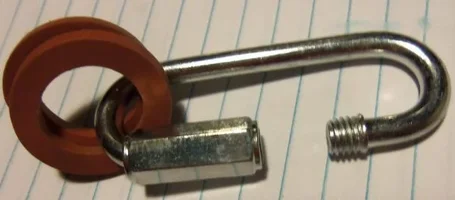
So, if using the breakaways, both ends should go to one set of breaking cord, or rings. Or if both ends are attached to cords, wrapping the lanyard each time would break both at nearly the same time. Another option is to use the lanyard in SRT mode with one set of cords.

This Kisa is attached to my harness with about 6' of cord in a pouch to the right. This set I don't want the cord to run out. I have another set where I'll shorten the cord to about 3' and taper the end to make sure it easily exits the device.
 

Attachments

  • IMG_1364.webp
    IMG_1364.webp
    512.3 KB · Views: 25
I'd say to use fresh zip ties to avoid UV damage. I cut off my old ones. I would break test one, then decide how many to use. If I'm using a break-away, I'm going in Full A-game, or not at all. I'm not worried about slipping and shock loading accidently. 250 pounds should do.
 
I know we are talking about a device that would release at a specific force here. I think this is a tricky thing to figure out, because the threshold of breakaway may be close to loads that are perceivable where fall prevention (I did not say arrest) is needed. There is also a lot of forces where the climber would likely be in serious danger that is still less than our target of 5000 pounds for (most) of our "life support" rated gear. the analogy I can think of is much like trying to use a fuse in a engine starter wire.

One concept that comes to my mind is a cutaway system. I imagine a device where the line/lanyard is threaded through the ring. When activated, the ring triggers a cutting blade and cuts the line. Through design, it could be activated two ways. One could be a pressure system where it would cut if the climber was being crushed. The other could be a double or triple locking system that could be activated manually, much like a locking carabiner.

As far as the zip ties and orings and such, if the real goal is true separation at a specific force, an entire full length system would likely be more reliable. Friction may keep the full force of an event from being applied to the breakaway component during an event. A lanyard made of throwline might work. Of course if would only be applied when it is really only positioning, such as hanging from an artificial crotch, but you need to be positioned on a nearby stem. The real life support and redundant tie off is elsewhere.

 

New threads New posts

Back
Top Bottom